
REVIEW · TOKYO
Tokyo: Imperial Palace with Nostalgic Alley Kagurazaka tour
Tokyo’s past is under your feet. This three-and-a-half-hour walk links Tokyo Station, the Imperial Palace, Edo Castle remains, and the old streets of Kagurazaka in one tidy route. I like the way the tour connects grand political history with ordinary local life, and I especially like the small-group format, limited to eight people, which leaves room for questions and conversation.
The strongest part is the guide’s storytelling. Shuntaro and Hiro have both earned especially warm praise for explaining the sights, answering questions, and offering useful ideas for the rest of your time in Tokyo. The main drawback is simple: this is a long walking tour, and the Imperial Palace’s inner grounds are not open to the public, so you see the historic outer areas rather than the emperor’s private residence.
Key points to know before booking
- A three-part Tokyo story: You move from Tokyo Station to Edo Castle remains, then finish in Kagurazaka’s old restaurant and geisha quarter.
- A small group of eight or fewer: The limited size makes it easier to hear the guide and ask about Shogun-era Japan.
- A local cafe break: Coffee or tea is included during a 25-minute stop at Aomi Coffee Kudanshita.
- Kagurazaka beyond the main sights: Geisya Komichi, Hyogo Yokocho, and Kakurenbo Yokocho offer narrow lanes and traditional buildings away from Tokyo’s biggest crowds.
- A practical walking route: Comfortable shoes and clothes matter, since the tour lasts 210 minutes and includes several outdoor stops.
- Good value at $51: The price covers the English-speaking guide, coffee or tea, a snack, and access to a well-planned route that would be difficult to piece together efficiently.
From Marunouchi to the heart of old Edo
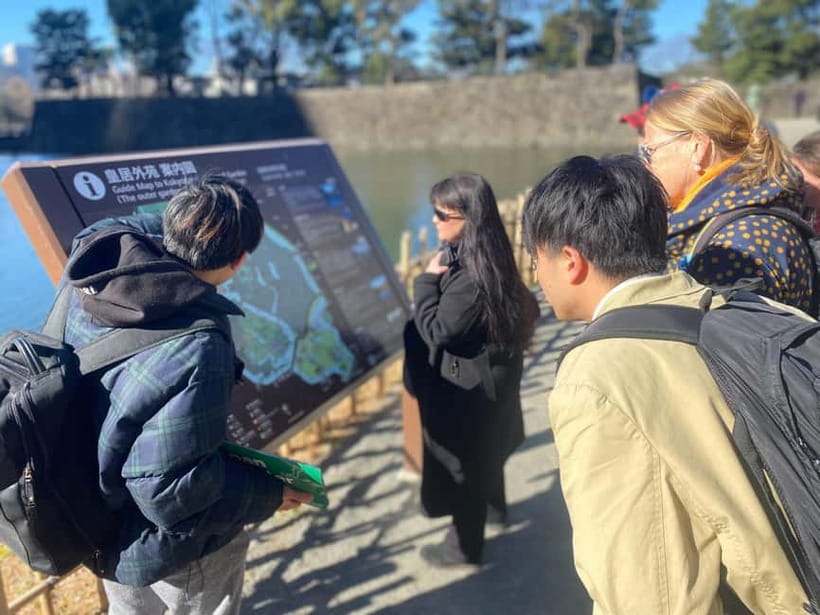
The tour begins outside the Shin-Marunouchi Building, near the cafe called STAND T. Look for the BEAMS sign on the second floor, and use Tokyo Station’s Marunouchi Central Exit. From there, the meeting point is about a two-minute walk.
This is a useful starting place because Tokyo Station gives you an immediate sense of modern Tokyo’s scale. The station area is filled with offices, shops, and handsome buildings, yet the Imperial Palace is close by. In only a short distance, you shift from a major business district to stone walls, gardens, moats, and broad open grounds.
The Tokyo Station stop lasts about 10 minutes. It is mainly a photo and orientation stop, so do not expect a long architectural lecture here. The value is in getting your bearings before the walking begins and understanding how close the station sits to the former seat of political power.
Your guide then leads you toward the Imperial Palace. Along the way, the focus turns to Edo, the old name for Tokyo, and the Tokugawa Shogunate. That background makes the palace grounds easier to read. Instead of seeing a wall as simply an attractive photo backdrop, you begin to understand it as part of a much larger military and administrative center.
More Royal Palace Tours in Japan
- Tokyo: Imperial Palace and Shogun Historical Walking Tour
★ 5.0 · 2,251 reviews - Tokyo: Imperial Palace Japanese History Walking Tour
★ 4.9 · 987 reviews - Tokyo: Imperial Palace and Shogun Walking Tour
★ 4.9 · 935 reviews
Imperial Palace walls and the Ote-Mon Gate
The Imperial Palace portion takes about an hour. The palace is one of Tokyo’s essential stops, but it can feel puzzling if you arrive without context. The public areas are spread out, and the most important buildings are not all visible. A guide helps you understand what you are looking at and why the surviving walls and gardens matter.
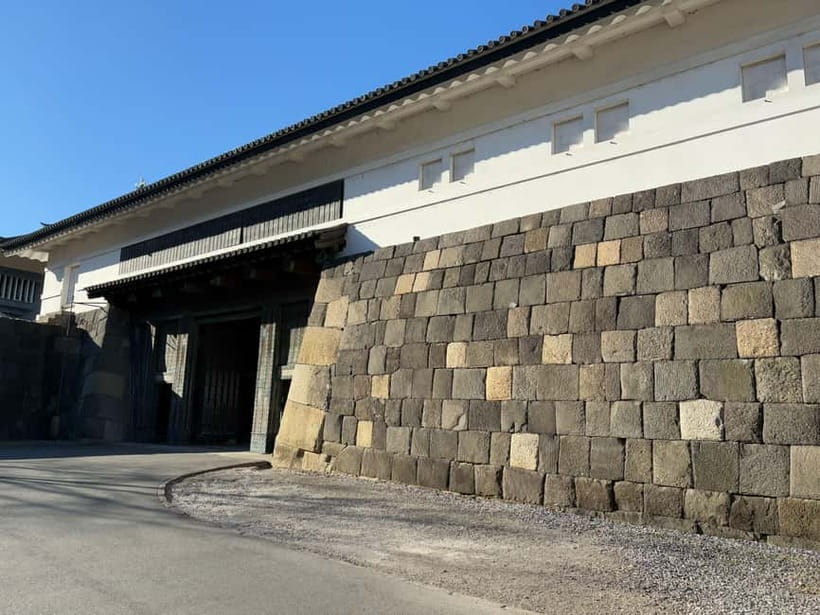
The Ote-Mon Gate is one of the clearest reminders of Edo Castle’s former strength. Its scale and carefully built defenses give you a sense of how seriously the Shogunate protected its central compound. I find this more rewarding than simply taking a picture and moving on, because the guide can connect the gate to the political system that ruled Japan for more than two centuries.
You do not enter the inner palace. That area is not open to the public, and it is important to set expectations before you book. You are visiting the public grounds and historic remains, not touring private imperial rooms.
The Ninomaru Garden offers a change of pace. Here, the hard military character of the gates and walls gives way to a more refined Japanese garden setting. The itinerary allows time for photos and explanation, so you can appreciate the contrast between castle defense and carefully arranged natural beauty.
Edo Castle ruins and the scale of the Shogun’s world
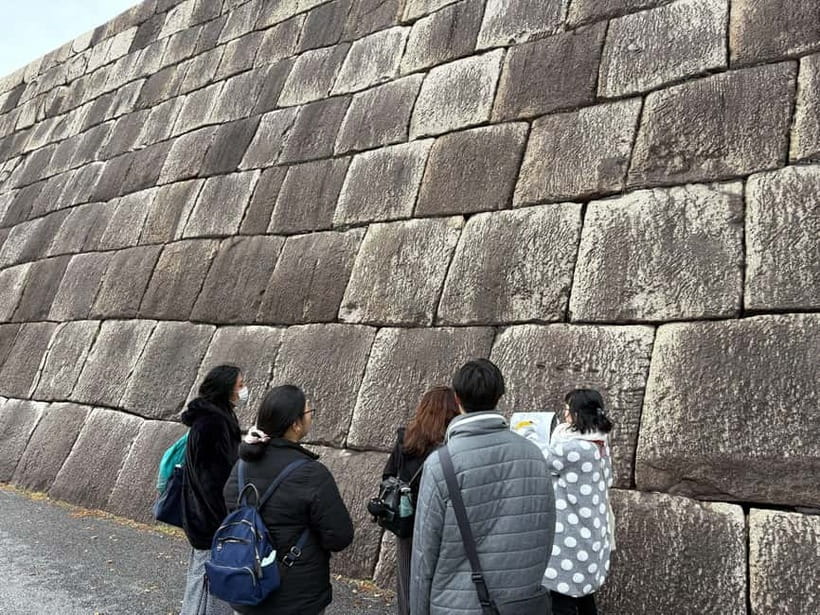
The Edo Castle ruins are one of the tour’s most useful stops. Much of the original castle complex has disappeared, but the remaining stonework and open spaces help show how large the compound once was. Your guide uses the ruins to explain the Tokugawa world and the role Edo Castle played as Japan’s political and cultural center.
This is where the tour’s theme becomes clear. You are not simply collecting famous sights. You are walking through land that once belonged to a vast castle complex, then following its influence into modern Tokyo.
I would pay close attention here if you are interested in Japanese history. The tour is not designed as a long academic lecture, but it gives you a quick, understandable explanation of the Shogun system and the process by which Japan developed as a unified country. If you already have a strong background in the period, you may want more detail. For most first-time visitors, the amount of information should feel manageable.
The route also includes a short stop at Nippon Budokan, with about five minutes for a photo and explanation. The building is connected with Japanese martial arts and major events. It works as a brief link between old warrior culture and modern Japan, though it is not a long visit. Think of it as a quick orientation stop rather than a major attraction.
Aomi Coffee Kudanshita and a welcome pause
After the Imperial Palace area, you stop at Aomi Coffee Kudanshita for about 25 minutes. Coffee or tea is included, giving you a chance to sit down, ask questions, and rest your legs.
This break matters more than it may sound. By this point, you have spent a substantial amount of time walking outdoors, and the pause divides the tour into two natural sections. The first half explains Edo Castle and the Imperial Palace. The second half takes you into local streets, shrines, and old lanes.
The cafe is described as a local, distinctive stop rather than a major sightseeing attraction. I would treat it as a practical break with a bit of neighborhood character. The experience may change if the shop is closed on the scheduled day, since the group can stop somewhere else.
The included drink adds modest but real value to the $51 price. You are not paying only for a guide who walks ahead of you. You also get a planned rest, coffee or tea, and a snack later in the route.
More Royal Palace Tours in Tokyo:
- Imperial Palace East Garden and Edo Castle Walking Tour in Tokyo
★ 5.0 · 510 reviews - Tokyo: Imperial Palace East Gardens Walking Tour
★ 4.8 · 353 reviews - Tokyo: Imperial Palace, Sensō-ji Temple, & Tokyo Tower Tour
★ 4.5 · 339 reviews - Tokyo Castle, Imperial Palace, Shogun & Garden Walking Tour
★ 5.0 · 211 reviews
Tokyo Daijingu and a shrine connected with love
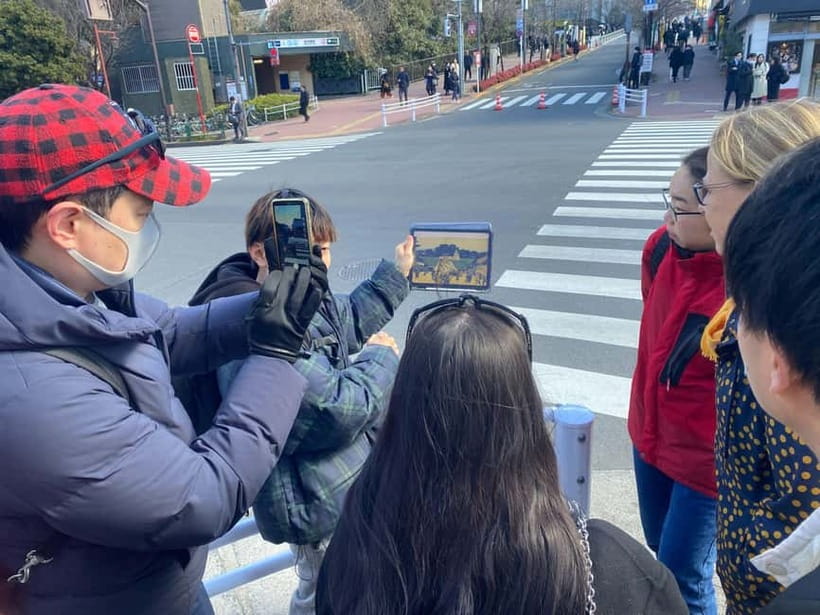
Tokyo Daijingu is the next major stop, with about 20 minutes for the guided visit. This shrine is associated with love and good relationships, giving the tour a different mood from the formal palace grounds.
The contrast is one of the route’s strengths. The Imperial Palace shows state power, military planning, and the authority of the Shogunate. Tokyo Daijingu brings you into a more personal side of Japanese religious life, where people visit with hopes connected to relationships and good fortune.
Your guide can explain the shrine’s role and customs in a way that makes the visit more meaningful than a quick photo stop. You should still expect a short visit rather than an extended religious tour. The attraction here is the setting and the story, not a long ceremony or private access.
From the shrine, the route continues through quieter streets toward the remains of Ushigome Gate. Like the palace walls, these remains are best understood as part of a wider defensive system. They also show how the old castle territory extended beyond the most famous central sights.
Kagurazaka’s old lanes and former geisha quarter
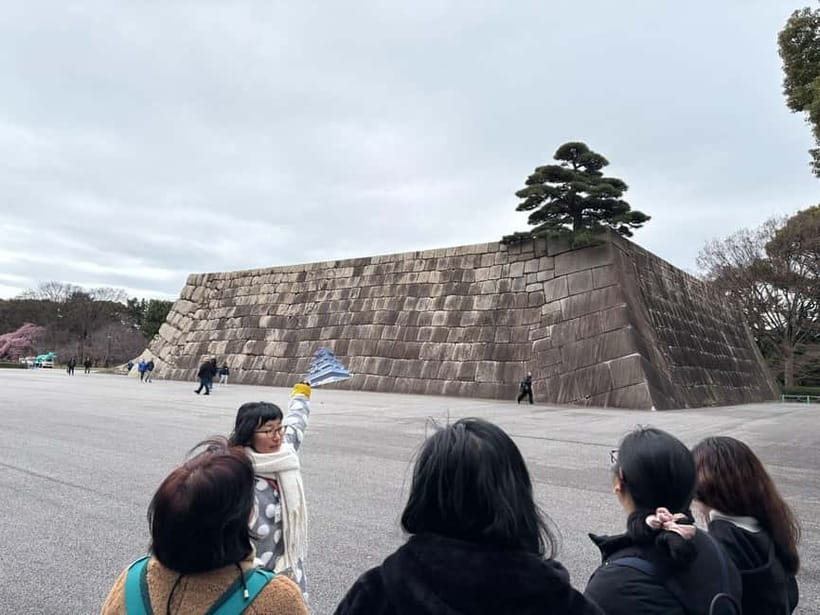
The final section takes you into Kagurazaka, the part of the tour that feels most different from the usual Tokyo checklist. Around 200 years ago, this area was known as a red-light district, with teahouses where maiko and geisha performed. Today, local restaurants, shops, and traditional-style businesses occupy the area.
That past has not vanished completely. The narrow lanes and changing street levels create a more intimate setting than the broad avenues around Tokyo Station or the crowded entertainment districts of Shibuya. You get a sense of how older forms of dining and neighborhood life fit into the modern city.
Geisya Komichi Alley is one of the first lane stops. The name and history point to Kagurazaka’s connection with geisha culture, while the present-day setting offers photo opportunities and a look at local businesses. You should not expect a live geisha performance. The point is to see the streets and hear how the district developed.
Hyogo Yokocho Alley provides another look at Kagurazaka’s narrow passageways. These lanes are small enough that a guide is useful, particularly if you want to understand the difference between a local alley and a purpose-built tourist attraction. You are moving through an actual neighborhood, so the atmosphere may depend on the time of day and the businesses operating there.
The route also includes Kakurenbo Yokocho, another compact alley with traditional character. Together, the three lanes create a strong ending because they bring the story down to a human scale. After hearing about rulers, castles, and political power, you finish among restaurants, shops, and streets where people still live and work.
The included snack and the value of local detail
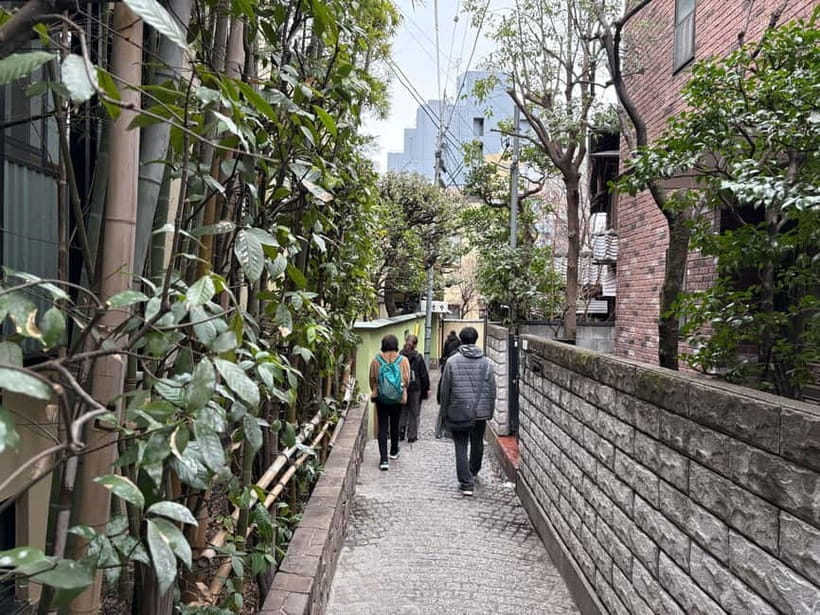
A snack is included during the Kagurazaka portion. The exact shop may change if the planned business is closed, so you should not book this expecting one fixed dish or one famous food stop.
That flexibility is reasonable for a neighborhood-based tour. It keeps the route connected to local businesses rather than forcing the group into one fixed venue. You get a taste of the area and a chance to see how Kagurazaka functions today.
The snack is a small part of the cost, but the larger value comes from knowing where to look. Without a guide, you could walk through Kagurazaka and notice the narrow streets without understanding their connection to the old teahouse district. The guide turns those lanes into part of a longer story.
The final stop is the FamilyMart Kagurazaka Sanchome store. This is a practical place to finish, especially if you want to continue exploring Kagurazaka on your own. The end time can run about 15 minutes late because of traffic or route conditions, so avoid booking a tight reservation immediately afterward.
Guide quality and the small-group advantage

The human side of this tour is a major reason to consider it. Shuntaro received especially strong praise for making the visit fun while explaining the sights in detail. Hiro was also singled out for local insight and useful suggestions for seeing more of Tokyo.
Those comments point to the tour’s real strength: conversation. With no more than eight people, you have a better chance of asking about Shogun history, shrine customs, food, or places to visit after the walk. A large group can make a historical tour feel like a speech. This format should feel more personal.
The guide can also respond to your interests. One guest specifically appreciated having questions answered and the route shaped around personal ideas. That does not mean every request can change the itinerary, but it suggests the guides are not simply reciting memorized facts.
The overall rating is 4.3 from eight reviews, with particularly positive comments about the guides and the interest of the sites. The sample is small, so I would focus less on the exact number and more on the consistent theme: the guide is the part most likely to make or break the experience, and the named guides have made a strong impression.
Is $51 good value for 210 minutes?
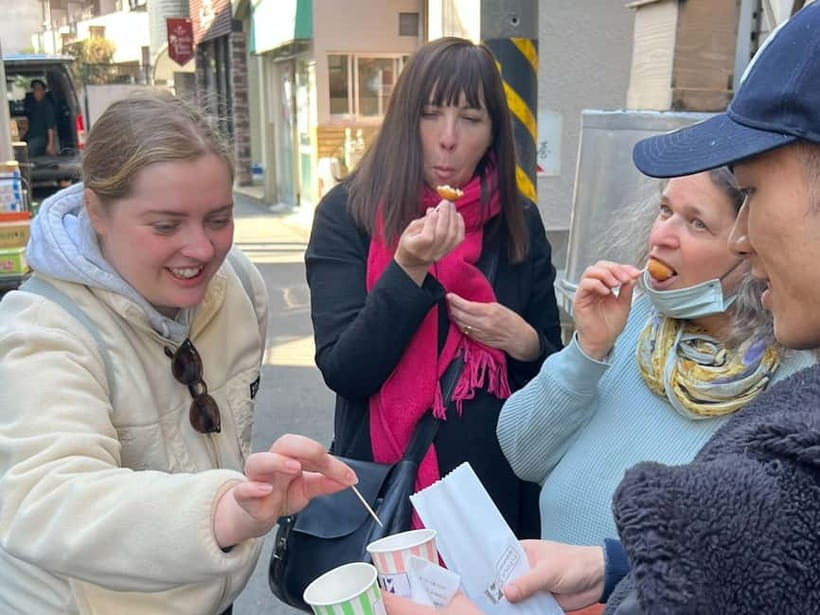
At $51 per person, the tour is fairly priced if you value structure and explanation. You receive 210 minutes with an English-speaking local guide, coffee or tea, a snack, and a route that links several areas without requiring you to plan the connections yourself.
The price is less attractive if you only want to see the palace from the outside and take a few pictures. You can visit parts of the Imperial Palace grounds independently, and Kagurazaka’s streets are open to anyone. The fee pays for the historical links, neighborhood interpretation, small group, and efficient use of your morning or afternoon.
I especially like the route design. Many palace visits end after the main walls and gardens, while this one continues into a part of Tokyo with a different character. The combination lets you compare official history with local life, which gives you more than a single landmark visit.
Who should book this walking tour?
I would recommend it to first-time Tokyo visitors who want a clear introduction to Edo history without spending an entire day in a museum. It also suits you if you like walking, small groups, photo stops, and short explanations that connect one neighborhood to another.
It is a good choice for anyone curious about the Shogunate, Japanese gardens, shrine customs, or the old geisha districts. The Kagurazaka section is particularly useful if you want something beyond Asakusa and Shibuya.
I would think twice if you have limited mobility, dislike outdoor walking, or need a perfectly fixed finish time. Pregnant women are listed as not suitable for this activity. Comfortable shoes and clothes are essential, and the tour may finish about 15 minutes late.
Cancellation is available up to 24 hours before departure for a full refund, and you can reserve now and pay later. Those terms help if your Tokyo schedule is still changing, but the bigger decision is whether you want a guided walk rather than independent sightseeing.
Should you book it?
Book this tour if you want Tokyo’s Imperial Palace to make sense, not just appear in your photo album. The palace walls, gardens, and castle ruins are worthwhile on their own, but the guide’s explanation gives them a clear place in Japan’s political past.
The best reason to choose this route is the second half. Kagurazaka brings you into old lanes, local shops, and a former geisha district that feels quite different from Tokyo’s famous visitor zones. At $51, the combination of a small group, two refreshments, and a well-planned historical route offers solid value.
Skip it if you want access to the inner palace, a food-focused tour, or a short sightseeing outing with little walking. For everyone else, this is a smart way to connect Tokyo’s grandest history with one of its more quietly distinctive neighborhoods.
FAQ
Where does the tour begin?
The meeting point is outside the Shin-Marunouchi Building, in front of STAND T cafe. Tokyo Station’s Marunouchi Central Exit is the closest exit, and the meeting point is about a two-minute walk from there. Look for the BEAMS sign on the second floor.
Where does the tour finish?
The tour finishes at FamilyMart Kagurazaka Sanchome in Kagurazaka.
How long does the tour last?
The tour lasts 210 minutes, or three and a half hours. The finish may be delayed by about 15 minutes because of traffic or route conditions.
Is the inner Imperial Palace included?
No. The inner palace is not open to the public. The tour visits the public Imperial Palace area, Ote-Mon Gate, Ninomaru Garden, Edo Castle ruins, and related historic sites.
What refreshments are included?
Coffee or tea is included during a short break at Aomi Coffee Kudanshita, and a snack is included later in the tour. The snack stop may change if the planned shop is not operating that day.
What language is the tour offered in?
The tour is offered in English with a live tour guide.
How large is the group?
The tour is limited to eight participants, making it a small-group experience.
What should I bring?
Bring comfortable shoes and comfortable clothes. Smoking, drones, alcohol, drugs, weapons, and sharp objects are not allowed.
Just added around Tokyo
- From the Imperial Palace to Odaiba : Time travel to Tokyo★ 5.0 · 5 reviews
- Tokyo Skytree, Asakusa, and Imperial Palace 1/2-Day Private Tour★ 5.0 · 3 reviews
- Tokyo Imperial Palace with Kagurazaka Alley Tour★ 5.0 · 54 reviews
- Imperial Palace Tour: Discover Samurai History with a Local Guide★ 5.0 · 20 reviews
- Tokyo’s Imperial Palace & Nihonbashi Tour★ 4.5 · 38 reviews
- Cherry Blossom Highlights, Asakusa, Ueno, Imperial Palace Garden★ 4.5 · 4 reviews
- Private Tour – History, Art and Nature at the Imperial Palace★ 5.0 · 24 reviews
- Tokyo Imperial Palace and Heritage of Edo Castle Private Tour★ 5.0 · 3 reviews
Royal Palace Tours, compared.

Royal Palace Expert Guided Tour with Skip-the-Line
Read our review →

Dubai To Abu Dhabi: Grand Mosque, Royal Palace & Etihad Towers
Read our review →
Madrid Essential: Historic Center, Plaza Mayor & Royal Palace
Read our review →

Abu Dhabi Day-Trip Grand Mosque, Royal Palace & Lunch
Read our review →
Browse the lists this tour appears in