
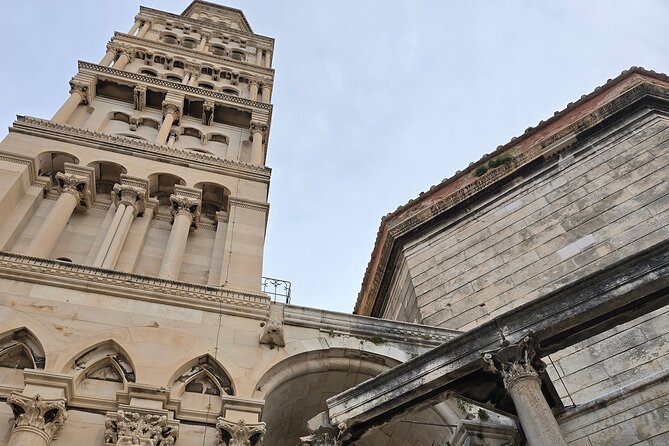
REVIEW · SPLIT
Private Roman Split tour: Diocletian Palace with a Professor
Ancient stone, living city. This private Split tour makes Diocletian’s Palace easier to understand by pairing its best-preserved Roman spaces with Professor Nebo’s clear, personal storytelling. I especially like the private format, which keeps the pace flexible, and the chance to see the palace cellars with a guide who connects Roman architecture to Croatia’s later rulers and modern life. The main drawback is the short length: two hours gives you a strong introduction, but not every corner of Split’s old center.
I also like the practical ending at the Golden Gate, the palace’s northern exit. You finish with your bearings instead of being left in a maze of old lanes. The price, $84.29 per person, is fair for a private English tour, particularly if your group values detailed explanation, but it is more than a basic group walk and may feel steep for anyone who prefers to explore independently.
Key points to know before booking
- The cellars receive the longest visit: You get about 45 minutes in Diocletian’s Substructures, with admission included.
- Professor Nebo is the main attraction: His talks cover Roman Split, later empires, Croatian culture, and the country’s 1990s conflicts.
- It is genuinely private: Only your own group takes part, so the tour can feel more like a conversation than a formal lecture.
- The route moves through four major palace areas: The Substructures, Peristyle, Vestibule, and Golden Gate.
- The schedule offers two daily windows: Tours run from 9:00 to 11:00 in the morning or 5:00 to 7:00 in the afternoon.
- It ends at the north side of the old town: The Golden Gate is a useful place to continue exploring after the tour.
Why Diocletian’s Palace needs a guide
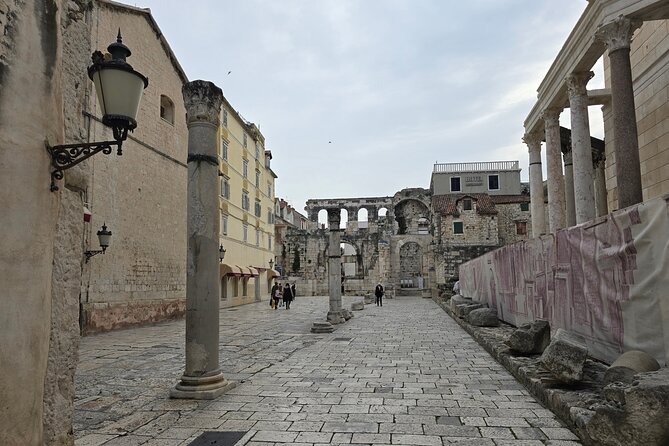
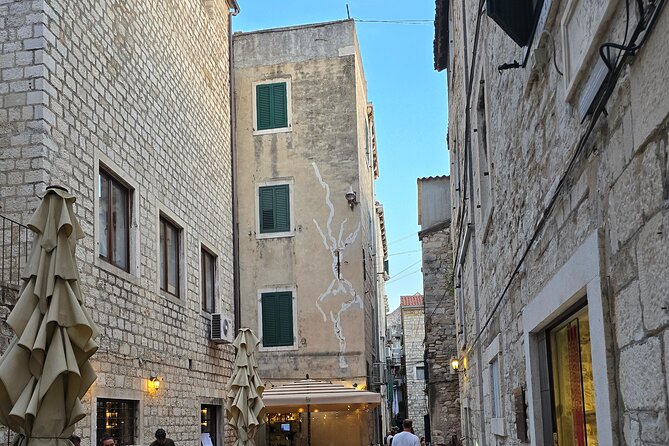
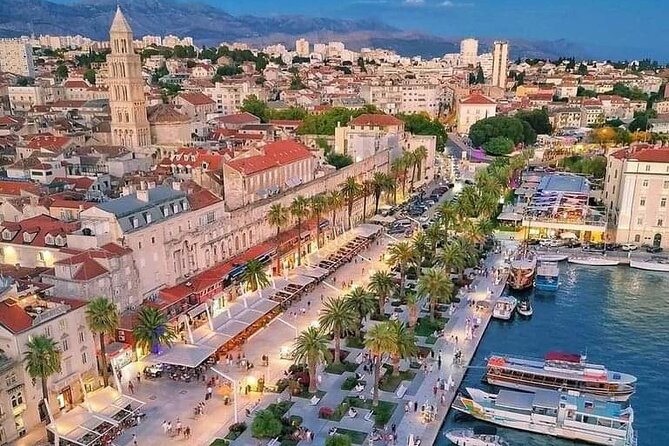
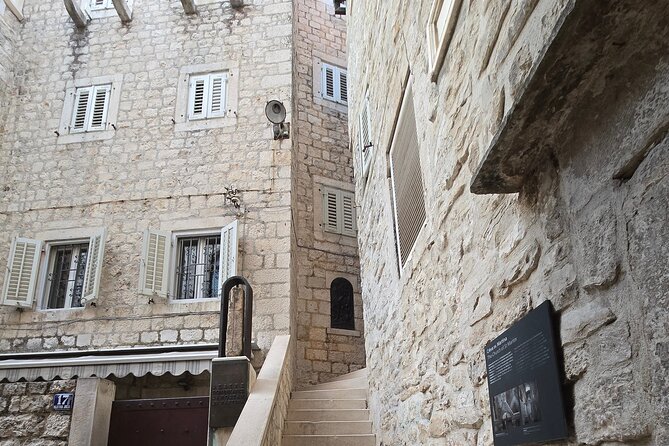
Diocletian’s Palace is not a fenced-off ruin sitting apart from daily life. It forms the core of Split’s old town, with homes, cafés, shops, churches, and narrow lanes built into and around the ancient Roman plan. That makes it exciting, but it can also make the site hard to read at first.
A self-guided walk shows you old columns and massive stone walls. A good guide explains why they are there, how the palace was arranged, and what happened after the emperor’s time. Professor Nebo appears to take that second role seriously. His style combines facts with stories, humor, and local context, which helps the stones feel connected rather than scattered.
The most useful part is the broad historical frame. You hear about Diocletian and the Roman palace, but also about the Austrian-Hungarian period, Ottoman influence, Venetian rule, and the modern history of Croatia. Nebo has also written a book about the conflicts of the 1990s, so his knowledge reaches well beyond ancient Rome.
That wider view matters in Split. The city is not simply a Roman monument. It is a place where different periods overlap, often in the same street or building. You might hear about an imperial residence, then see how later residents adapted it for ordinary life. That is the kind of connection a short guided walk can provide.
More Private Palace Tours in Croatia
- SPLIT-PRIVATE Walking Tour of Diocletian’s Palace & Old Town
★ 5.0 · 467 reviews - Split by Private Electric Rickshaw – Palace & Hidden Gems
★ 5.0 · 412 reviews - YOUR BEST PRIVATE TOUR – amazing Split and Diocletian’s palace
★ 5.0 · 83 reviews
Entering the Substructures after 1,700 years
The tour gives about 45 minutes to Diocletian’s Cellars, also called the Substructures. This is the longest stop, and rightly so. These underground rooms are among the best-preserved Roman structures of their kind in the world.
The cellars once supported the emperor’s private apartments above. They also served practical purposes, including storage and the daily operation of the palace. Their design gives you a useful clue about the residence that once occupied the upper level. As you walk through the lower rooms, the layout helps you picture how the imperial quarters were organized overhead.
I find underground spaces especially valuable at archaeological sites because they often retain the original shape more clearly than later rebuilt areas. Here, the walls, passageways, and supporting structures show Roman engineering in a direct way. You are not just looking at decorative fragments. You are seeing the working skeleton of a palace.
Nebo’s role is important here. Without explanation, the cellars can become a sequence of stone chambers. With context, they reveal how architecture supported status, security, storage, and ceremony. His approach also appears to suit different interests. A history enthusiast can enjoy the detail, while someone less drawn to ancient Rome can follow the human stories and practical questions.
One point to keep in mind: the cellars are underground and may feel less airy than the open palace spaces. The tour spends nearly half its time here, so book it if you want substance rather than a quick photo stop. If you mainly want to see Split’s streets and cafés, this emphasis may feel heavier than expected.
Admission to the Substructures is included, which helps the price. You do not need to arrange a separate ticket for this central part of the visit.
The Peristyle, where imperial power became theater
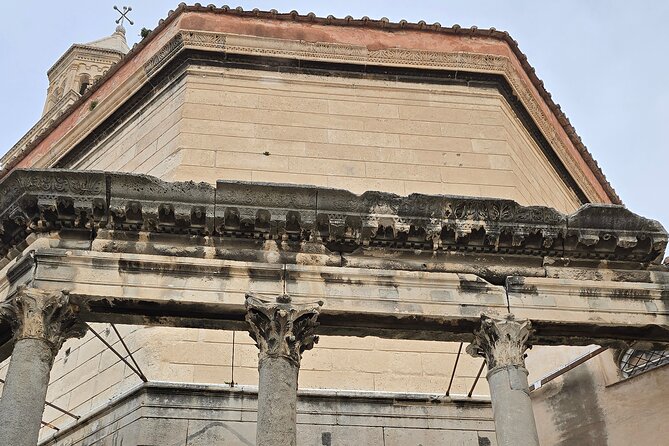
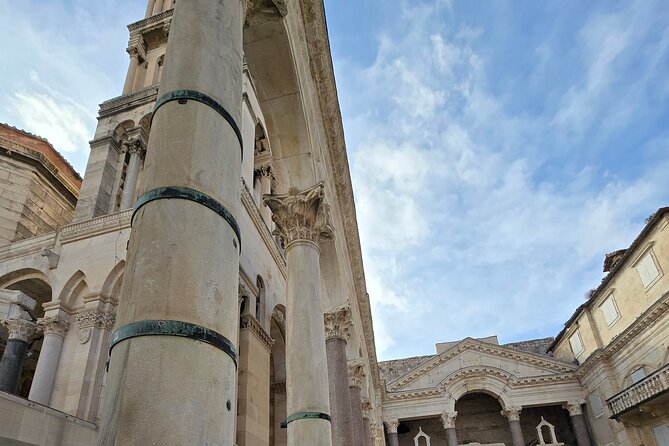
After the cellars, the route reaches the Peristyle, the central square of Diocletian’s Palace. This was the ceremonial heart of the residence, framed by grand colonnades and designed to impress anyone approaching the emperor.
The square was not simply an open courtyard. It was a stage for imperial authority. Diocletian appeared here as a living god, receiving worship from citizens. That detail changes the way you see the space. The columns and proportions were not chosen only for beauty. They helped create a setting in which political power looked almost divine.
You have about 20 minutes here. That is enough time for a focused explanation and for taking in the relationship between the open square, surrounding columns, and the palace buildings. It is not enough for a long architectural study, so listen closely while Nebo points out what matters.
Today, the Peristyle is part of the active historic center of Split. People pass through it, meet there, and use the surrounding area as part of ordinary city life. That contrast is one of the palace’s great pleasures. You can picture an emperor’s ceremony in the same place where modern residents and visitors move through their day.
The open setting also provides a break after the enclosed cellars. If you take the morning tour, the light may make the stone details easier to appreciate. The evening option offers a different mood, with the day winding down around the old center. The schedule gives you a choice between 9:00 to 11:00 in the morning and 5:00 to 7:00 in the afternoon.
The Vestibule and the palace’s private threshold
The Vestibule receives about 10 minutes, but its compact size does not make it unimportant. This circular entrance led from the public Peristyle toward the emperor’s private quarters. It marked a change from ceremonial space to restricted imperial space.
Its round shape and high dome create a strong sense of arrival. The acoustics are another feature to notice. Sound behaves differently in the chamber, and the space still conveys the drama that Roman design intended.
This is a good example of why context helps. On your own, you may see a round stone room and move on quickly. With an explanation of who passed through it and what transition it represented, the Vestibule becomes part of the palace’s social design. The building told people where they stood in relation to power.
The short stop means you should not expect a long demonstration or extended time inside. It works best as part of the larger sequence: public ceremony at the Peristyle, then the controlled approach to the emperor’s private quarters.
More Private Palace Tours in Split
- Jewish Heritage & Diocletian’s Palace Private Split Tour
★ 5.0 · 80 reviews - Split Palace & Old Town -Private walking tour- Entrance included
★ 5.0 · 77 reviews - Split Diocletian Palace Highlights – Private walking tour
★ 5.0 · 35 reviews - Chill Private Walking Tour of Diocletian’s Palace
★ 5.0 · 35 reviews
Finishing at the Golden Gate
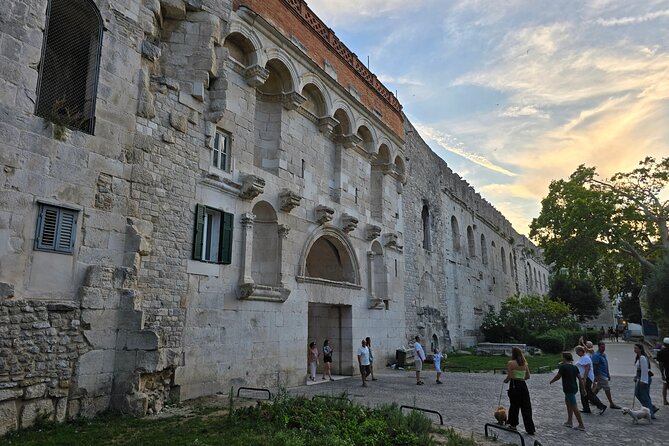
The Golden Gate is the final stop and the route’s northern exit from the old town. It was the palace’s main northern entrance, reserved for the emperor and important officials. Guard towers and defensive planning reinforced its role as a controlled gateway.
By ending here, the tour gives you a simple mental map of the palace. You have moved from the underground support structures through the ceremonial center and private threshold, then out toward the northern boundary. That sequence is more useful than seeing four unrelated sights.
The gate also makes a practical endpoint. You are not returned to the original meeting location, which means you can continue through Split from a new position. The stated end point is Dioklecijanova 7, 21000 Split, at the Golden Gate.
The gate itself is free to view, like the Peristyle and Vestibule. Its value comes from understanding how it fitted into the palace’s defenses and hierarchy. It was not just an attractive arch. It controlled access and announced imperial power.
Because this is the last stop, you may want to ask Nebo for suggestions before parting. His advice has included restaurants, sights, and beaches, giving the tour some value beyond the two-hour route.
What Professor Nebo adds
The guide’s name appears in several forms, including Nebo, Nebojša, Nibo, and Professor Nebo. The consistent picture is of an educated local guide with a strong interest in Roman art, Croatian history, and the culture of Split.
His most praised quality is his ability to make complex material easy to follow. He does not simply recite dates. He explains how the palace worked, why it was built as it was, and how people still live within its old Roman walls.
That is especially helpful for families or mixed-interest groups. A history enthusiast can ask for more detail, while a teenager or companion who did not expect to enjoy ancient sites can still follow the stories. His humor keeps the tone from becoming a classroom lecture.
Nebo also appears comfortable moving beyond the palace. He can discuss how Croatia was shaped by Roman, Venetian, Ottoman, and Austrian-Hungarian rule, as well as the conflicts of the 1990s. That range gives the tour a stronger local voice than a narrow Roman-only presentation.
Do not expect a silent photo walk. This is an explanation-heavy experience. If you want to hear stories, ask questions, and understand what you are seeing, that is a major advantage. If you prefer to wander alone with an audio guide, the private format may not be worth the extra cost.
Is $84.29 per person good value?
At $84.29 per person, this is not the cheapest way to see Diocletian’s Palace. You are paying for a private activity, an English-speaking guide, roughly two hours of instruction, and admission to the Substructures.
For a couple or small group that would otherwise book separate guiding, the cost can make sense. You get direct access to the guide and do not have to match the pace of a large group. The private setting also gives you room to ask about subjects that interest you, from Roman architecture to modern Croatian history.
The value is less clear if you are traveling alone and mainly want a quick orientation. Two hours is a short visit, and much of the palace can be walked through without paying for a guide. The tour earns its price through interpretation, not through a large number of included attractions.
I would also consider your schedule. If you have five days in Split, this can work well early in your stay because the guide can help you understand the old center and suggest places for later. If you book it on your last day, as one particularly enthusiastic participant did, it can still be rewarding, but you may wish you had more time afterward to follow up on what you learned.
Timing, meeting point, and practical details
The starting point is the Split sign at 21000, Grad, Split, Croatia. The tour ends at the Golden Gate, at Dioklecijanova 7. Since the route finishes at the north exit of the old town, plan your next stop from there rather than assuming you will return to the beginning.
The available time windows are 9:00 to 11:00 and 5:00 to 7:00, Monday through Sunday, for the stated operating period from June 23, 2025, through December 7, 2026. A morning start gives you the rest of the day for sightseeing. An evening start may suit you if you want to keep the hotter or busier part of the day free, though conditions inside and around the palace can vary.
The ticket is mobile and the tour is offered in English. It operates near public transportation, and service animals are allowed. Most people can participate, according to the supplied details, but the route moves through historic palace areas, so you should consider your own comfort with old stone surfaces and enclosed underground spaces.
Confirmation comes at booking. Free cancellation is available up to 24 hours before the start time for a full refund. Cancellations or changes made less than 24 hours before the start time are not accepted for a refund.
Who should book this private Split tour?
I would choose this for:
- A first visit to Split when you want the old town to make sense quickly.
- Anyone who enjoys Roman architecture and wants more than a photo stop.
- Families or couples with different levels of interest in history.
- Visitors who prefer a private conversation to a large walking group.
- People who want local suggestions for restaurants, sights, and beaches.
- Anyone interested in Croatia’s wider past, not only the Roman period.
I would hesitate if you have only a short time in Split and want to cover many separate sights. The tour focuses closely on Diocletian’s Palace and does not promise a broad city itinerary. I would also think twice if you dislike extended historical explanation or prefer to explore without a guide.
Should you book it?
Book it if you want Diocletian’s Palace explained by someone who can connect Roman power, Croatian history, and present-day Split. Professor Nebo’s strongest quality appears to be his ability to make the palace personal and understandable, even for someone who did not arrive as a history fan.
Skip it if you only need directions or a quick look at the main square. At $84.29 per person, the price is justified by the private format and the depth of the guiding, not by the number of stops. For the right audience, especially a small group that values stories and questions, this is one of the more worthwhile ways to meet Split’s ancient center.
FAQ
Where does the tour start?
It starts at the Split sign at 21000, Grad, Split, Croatia.
Where does the tour end?
The final stop is the Golden Gate at Dioklecijanova 7, 21000 Split, at the northern exit of the old town.
How long does the tour last?
The tour lasts approximately two hours.
What language is the tour offered in?
The tour is offered in English.
Is this a private tour?
Yes. Only your own group participates in the activity.
Is admission to the Diocletian’s Cellars included?
Yes. Admission to the Diocletian Palace Substructures is included.
What are the main stops?
The route includes Diocletian’s Palace Substructures, the Peristyle, the Vestibule, and the Golden Gate.
What time can I book the tour?
The available time windows are 9:00 to 11:00 and 5:00 to 7:00, Monday through Sunday, during the stated operating period.
Is the tour available with a mobile ticket?
Yes. A mobile ticket is provided.
Can I cancel for a full refund?
Yes, if you cancel at least 24 hours before the experience start time. Changes or cancellations made less than 24 hours before the start time are not accepted for a refund.
More Diocletian's Palace Tours in Split
- Split: Old Town and Diocletian Palace Walking Tour
★ 4.9 · 4,727 reviews - Walking Tour of Split and Diocletian’s Palace
★ 5.0 · 2,588 reviews - Split & Diocletian’s Palace Walking Tour
★ 5.0 · 1,125 reviews - Split: Diocletian Palace & Old Town Guided Walking Tour
★ 4.7 · 882 reviews
Just added around Split
- Wine Tasting in the Diocletian’s Palace★ 4.5 · 12 reviews
- Split & Diocletian Palace Historical Walking Tour★ 5.0 · 29 reviews
- Walking tour of Diocletian’s Palace in Split★ 5.0 · 60 reviews
- Split: Diocletian’s Palace Walking and Wine Tasting Tour★ 4.5 · 56 reviews
- SPLIT-History Tour of Diocletian’s Palace & Old Town with Daniela★ 5.0 · 76 reviews
- Diocletian Palace in Split and Trogir Private Heritage Tour★ 5.0 · 12 reviews
- Private Split: Visit Diocletian Palace & Taste Food at the Market★ 5.0 · 33 reviews
- Wonderful Split – Diocletian’s Palace Private Walking Tour★ 5.0 · 20 reviews
Diocletian's Palace Tours, compared.
Walking Tour of Split and Diocletian’s Palace
Read our review →

Diocletian Palace & Old Town Guided Walking Tour
Read our review →

Game of Thrones Tour with Diocletian’s Palace Cellar
Read our review →
Diocletian’s Palace and Old Town SMALL GROUP Walking Tour
Read our review →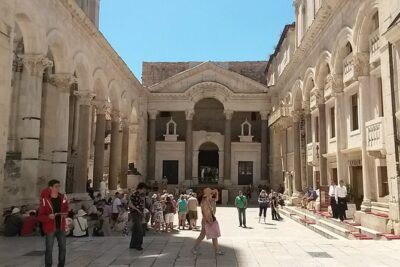
Browse the lists this tour appears in