

REVIEW · SPLIT
Essential Diocletian’s Palace Tour for First-Time Visitors
Ancient stones, living streets, one lively introduction. This 90-minute walk makes Split’s old center easier to understand, and I especially like the small group of up to 10 and Jelena’s mix of Roman history, local life, and humor. The Vestibule group selfie is a fun extra, while the restaurant vouchers and personal recommendations add value after the walk. One point to note: this is mainly an outdoor orientation tour, with limited interior access to the cathedral and palace cellars.
You meet beside the statue of Gregory of Nin, then follow a compact route through the Golden Gate, People’s Square, Jupiter’s Temple, Peristyle, Cathedral of Saint Domnius, Vestibule, and Diocletian’s Cellars before finishing on the Riva. I would choose it early in a Split visit, since the guide’s advice on food and sights can help shape the rest of your stay. The 90-minute length is efficient, though anyone wanting a slow museum visit or tower climb will need to do those separately.
Key points at a glance
- Jelena’s regional perspective: As a guide from Bosnia and Herzegovina who has lived in Split for years, she connects the palace to Dalmatia and the wider Balkans.
- A true first-visit route: You see the essential landmarks without spending half a day on a single monument.
- Small groups matter: With no more than 10 people, it is easier to hear, ask questions, and pause for shade or water.
- The selfie has a setting: The group photo takes place beneath the Vestibule dome, one of the route’s most memorable spaces.
- Useful after-tour help: You receive personal suggestions for restaurants, sights, and local activities, plus discount vouchers at selected restaurants and bars.
- Know the limits: The cathedral interior, bell tower, and museum section of the cellars are not included.
Why this 90-minute walk works for a first visit
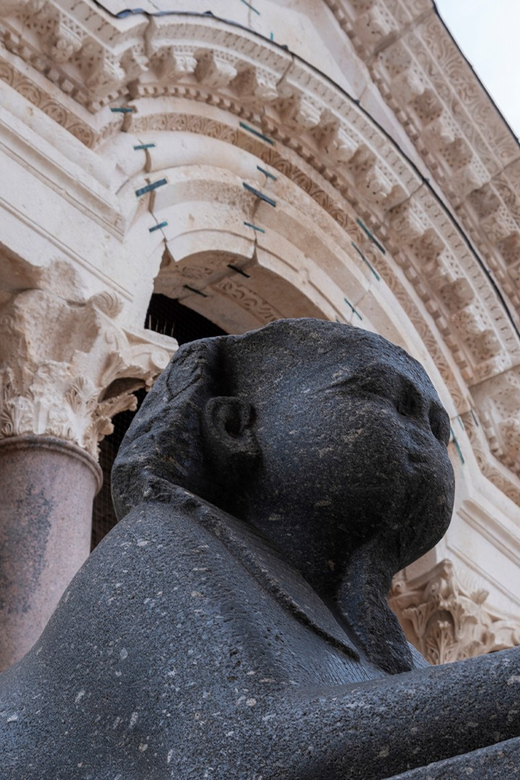
Split can feel confusing at first. The old town is not simply a preserved Roman site behind a fence. Modern shops, homes, cafés, laundry, churches, and lanes occupy the ancient palace walls. A good guide helps you see how those layers fit together.
That is the main strength of this experience. You are not given a string of disconnected dates. You are shown how Diocletian’s Palace shaped the modern center of Split, then how later residents adapted its rooms, gates, courtyards, and foundations for everyday use.
I like the balance between formal history and present-day advice. You learn about Emperor Diocletian and the palace, but you also hear about life in Split now. The guide’s background adds another useful angle. Jelena was born in Bosnia and Herzegovina and has lived in Split for many years, so she can place the city within the wider Balkan story rather than treating it as an isolated Roman monument.
The route is also manageable. Ninety minutes gives you a strong framework without asking you to devote an entire morning or afternoon. You will cover a lot of ground, but the walk is designed for orientation rather than exhaustive archaeological study.
More Diocletian's Palace Tours in Split:
- Split: Old Town and Diocletian Palace Walking Tour
★ 4.9 · 4,727 reviews - Walking Tour of Split and Diocletian’s Palace
★ 5.0 · 2,588 reviews - Split & Diocletian’s Palace Walking Tour
★ 5.0 · 1,125 reviews
Meeting Gregory of Nin at the Golden Gate
The meeting point is in front of the large statue of Gregory of Nin, near the Palace’s north entrance, called the Golden Gate. Look for the guide with a black umbrella. That detail matters in a crowded old town, where a precise meeting landmark is much easier to find than a vague street address.
The statue itself gives the tour a good beginning. Gregory of Nin was a medieval bishop, and touching his toe is a familiar Split ritual. The tour does not list this as a formal activity, so do not expect a long stop devoted to it, but the statue is an easy landmark and an immediate introduction to the city’s mixture of history and local custom.
From here, you enter through the Golden Gate. It was the grand northern entrance to Diocletian’s Palace, and its scale helps you picture the original imperial complex. The palace was not just a residence. It was a fortified compound with ceremonial spaces, service areas, religious buildings, and access points built into its plan.
The guide’s value here is helping you read what remains. Without context, a gate can look like another old stone opening. With context, you begin to see the palace as a working Roman settlement that later became the core of Split.
People’s Square and the palace turned city
The walk continues to People’s Square, or Pjaca, the main square of Split. This is one of the clearest places to understand that the tour is about both the palace and the city that grew around it.
Here, the Roman imperial setting gives way to a more civic urban space. You can expect Jelena to connect the square with Split’s later development and daily life. This is also a useful moment for questions, especially if you want to understand how the old center functions today rather than only hearing about its ancient past.
I appreciate this part of the route because it prevents the experience from becoming a Roman-only history lesson. Split’s identity comes from several periods, and the walk keeps moving between them. The guide also offers advice on what to see after the tour, which makes the square a helpful point for getting your bearings.
Jupiter’s Temple and the Peristyle
Jupiter’s Temple is one of the key religious sites on the route. The small temple helps explain the official Roman beliefs that shaped the palace and its ceremonial spaces. It also provides a contrast with the Christian buildings you see later.
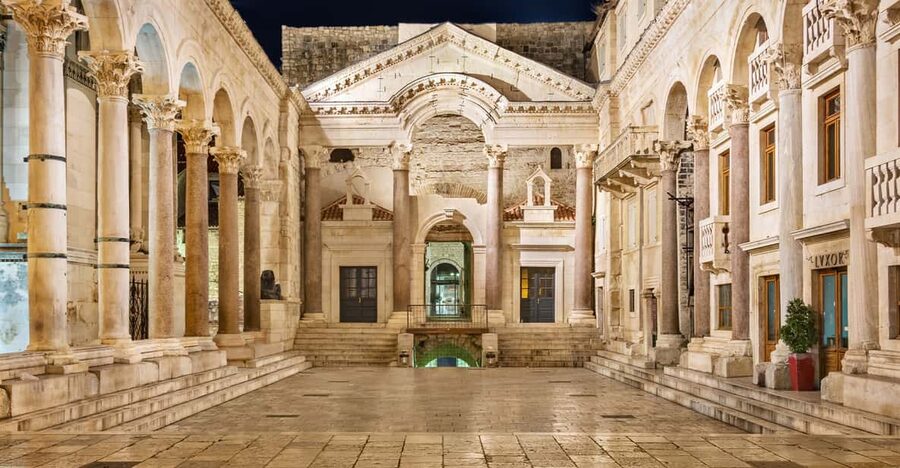
The next major stop is the Peristyle, the central ceremonial square and one of the most impressive open spaces in Diocletian’s Palace. This is where the palace’s imperial purpose becomes easiest to picture. Tall stone elements, formal alignment, and the surrounding buildings create a sense of ceremony even when the square is full of ordinary city activity.
A strong guide can make the Peristyle readable instead of merely photogenic. Expect explanations of how the space worked and why it mattered in the palace plan. You will likely also have time for questions, though the pace can vary with crowds and activity in the square.
This is one place where a small group makes a real difference. A group of 10 is easier to gather around a guide than a large tour of 30 or more. Several people specifically valued being able to hear the explanations and ask questions without the walk becoming unwieldy.
A few more palace visits around Split worth a look
- Split: Diocletian Palace & Old Town Guided Walking Tour
★ 4.7 · 882 reviews - Split Old Town and Diocletian’s Palace Tour
★ 4.8 · 716 reviews - Split: Game of Thrones Tour with Diocletian’s Palace Cellar
★ 4.8 · 545 reviews - Diocletian’s Palace and Old Town SMALL GROUP Walking Tour
★ 5.0 · 502 reviews
Saint Domnius and the limits of access
The Cathedral of Saint Domnius is built into the former mausoleum of Diocletian, making it one of the most striking examples of Split’s changing religious and political identity. A Roman imperial structure became part of a Christian cathedral complex, and that transition is central to understanding the old town.
You should be clear about what happens here. The tour explains the cathedral and mausoleum from outside, but it does not include entry into the cathedral’s interior or monastery and mausoleum areas. The bell tower is also not part of the experience.
That limitation will matter if your main aim is to climb the tower or study the interior. If you have only 90 minutes and want a clear explanation of the building’s place in Split, the exterior stop is still useful. You can use the guide’s orientation to decide if you want to return later and pay for separate admission.
The Vestibule selfie and Diocletian’s Cellars
The Vestibule is a memorable stop because of its unusual dome and circular form. It once served as a formal entrance area to the imperial apartments, and its shape creates a strong sense of space even in a brief visit.
This is where the tour includes its group selfie. It is a small touch, but it works well because the photo has a clear setting rather than being a hurried snapshot on an ordinary street. You leave with a simple record of the group beneath one of the Palace’s most distinctive structures.
The route then reaches Diocletian’s Cellars, also called the palace substructures. These lower spaces are important because their layout preserves the shape of the rooms above. They help you understand how the Palace was organized and how its foundations relate to the modern streets.
Be careful with expectations. The tour includes a visit to the cellar area, but not the museum section of the substructures. You should not expect a full archaeological exhibition or a long, self-guided visit through every underground room. The stop is best understood as an explanation of the Palace’s construction and layout.
Finishing on the Riva promenade
The walk ends on the Riva, Split’s famous waterfront promenade. This is a sensible finish because it shifts you from ancient stone to the city’s social center.
You can use the Riva as a transition point for the rest of your day. After the tour, you are already near places to sit, eat, or continue walking. The guide’s personal recommendations are particularly useful here, since the experience includes suggestions for restaurants, sights, and local activities.
The restaurant and bar vouchers may add extra value if you plan to use them. They are available for selected establishments rather than every place in Split, so treat them as a helpful bonus, not a guarantee of savings everywhere. The most useful part may be the combination of vouchers and personal advice, since a local recommendation can help you choose more confidently than a generic list.
What Jelena brings to the experience
The strongest praise for this tour centers on Jelena’s delivery. I would expect a guide who explains clearly, answers questions patiently, and uses humor to keep the history moving. Several comments describe the information as detailed without becoming boring, which is exactly the balance a 90-minute introduction needs.
Her English is described as clear and easy to follow, including for people who are still building confidence with the language. That matters in a tour filled with names, dates, religious changes, and architectural terms.
Jelena also appears attentive to practical needs. The tour can include pauses for water, shade, and bathroom breaks when needed. Those small choices matter in Split’s warmer months, when a stone-paved route can feel tiring even though the distance is modest.
The tone should suit a range of ages. A 13-year-old gave the experience a positive response, and the humor helps keep younger participants involved. At the same time, the content is substantial enough for adults who want more than a quick photo stop.
Price, group size, and practical value
At $41 per person, this is not the cheapest way to walk around Split. You are paying for a licensed English-speaking guide, a small group capped at 10, a structured route, and personal recommendations after the tour.
I think the price is fair if you value explanation and orientation. A self-guided walk can show you the same streets, but it will not explain why the cathedral occupies a Roman mausoleum, how the cellars relate to the palace above, or how the old center developed into modern Split.
The small-group limit is a major part of the value. You are less likely to lose the guide in a crowd, and questions are easier to handle. One tradeoff is that the tour does not include every paid interior attraction. If you want the cathedral, bell tower, or museum section of the cellars, budget extra time and admission separately.
You can cancel up to 24 hours in advance for a full refund, and you can reserve now while paying later. Those terms are useful if your Croatian itinerary is still changing.
Who should book this Split tour?
I would choose this walk if you are visiting Split for the first time, arriving on a short stay, or beginning a longer Dalmatian trip. It gives you a clear mental map and enough historical background to make later sightseeing more rewarding.
It also suits solo visitors, couples, families, and friends who prefer conversation over a large group lecture. The route is especially helpful if you want suggestions for meals and activities after the tour.
You may prefer another option if you need wheelchair access, since the experience is not suitable for wheelchair users. You may also want a longer specialist tour if your priority is archaeology, Roman military history, church interiors, or the full underground museum.
Wear comfortable shoes and bring water. The route is short, but much of Split’s center uses stone paving, and the guide may pause in exposed areas. Confirm the black umbrella meeting point before setting out, especially if you arrive during a crowded part of the day.
Should you book it?
Book this tour if you want a friendly, well-paced introduction to Split rather than a long academic lecture. The best reasons are the small group, Jelena’s clear storytelling, her connection to local life, and the practical advice that continues after the final stop on the Riva.
Skip it if you mainly want interior entry tickets, a bell tower climb, or a detailed museum visit. For most first-time visitors, though, $41 buys a useful framework for the city, a memorable Vestibule photo, and a better idea of where to spend the rest of your stay.
FAQ
How long does the Diocletian’s Palace tour last?
The tour lasts 90 minutes.
What language is the tour conducted in?
The live tour is conducted in English.
How many people can join the tour?
The group is limited to 10 participants.
Where does the tour meet?
The meeting point is in front of the large statue of Gregory of Nin, near the Golden Gate, the north entrance to Diocletian’s Palace. Look for a black umbrella.
Where does the tour finish?
The tour finishes at Split’s Riva promenade.
Does the tour enter the Cathedral of Saint Domnius?
No. The cathedral and its former mausoleum are explained from outside. The tour does not include entry to the cathedral interior or the bell tower.
Does the tour include the Diocletian’s Cellars museum?
The route visits the cellar area, but it does not include the museum section of the substructures.
Is the tour suitable for wheelchair users?
No. The experience is not suitable for wheelchair users.
What is included in the tour?
The experience includes interactive storytelling from a licensed guide, historical explanations, the Vestibule dome group selfie, personal recommendations, and access to selected restaurant and bar discount vouchers.
Can I cancel the booking?
Yes. You can cancel up to 24 hours in advance for a full refund. You can also reserve now and pay later.
Just added around Split
- Split: Old Town and Diocletian’s Palace Walking Tour★ 3.3 · 3 reviews
- Split: Old Town & Diocletian’s Palace Earlybird Walking Tour★ 4.0 · 12 reviews
- Diocletian’s Palace & Old Town Split Walking Tour★ 5.0 · 11 reviews
- Split: Palace & Old Town Private Walking Tour-Entrance incl.★ 4.8 · 8 reviews
- YOUR BEST PRIVATE TOUR – amazing Split and Diocletian’s palace★ 5.0 · 83 reviews
- Jewish Heritage & Diocletian’s Palace Private Split Tour★ 5.0 · 80 reviews
- Split: 1.5-Hour Walking Tour and Diocletian’s Palace★ 4.7 · 256 reviews
- Split: Diocletian’s Palace Virtual Reality Experience★ 4.4 · 308 reviews
Diocletian's Palace Tours, compared.
Walking Tour of Split and Diocletian’s Palace
Read our review →

Diocletian Palace & Old Town Guided Walking Tour
Read our review →

Game of Thrones Tour with Diocletian’s Palace Cellar
Read our review →
Diocletian’s Palace and Old Town SMALL GROUP Walking Tour
Read our review →
Browse the lists this tour appears in