
REVIEW · SPLIT
Diocletian’s Palace & Old Town Split Walking Tour
Split rewards curious walkers. This 90-minute tour links Diocletian’s Palace with the old town streets that grew around it, giving you a clear first look at the city’s past and present. I like the local perspective, especially because guide Lucija can explain not only Roman history but also everyday life in Split today. I also like the small-group format, which makes it easier to ask questions and keep the walk personal.
The main consideration is that entrance tickets to cultural and religious sites are not included. You’ll see and hear about the major places from outside, then decide what you want to enter later. The route also uses cobbled streets and is not suitable for wheelchair users, so comfortable shoes are important.
Key points to know before booking
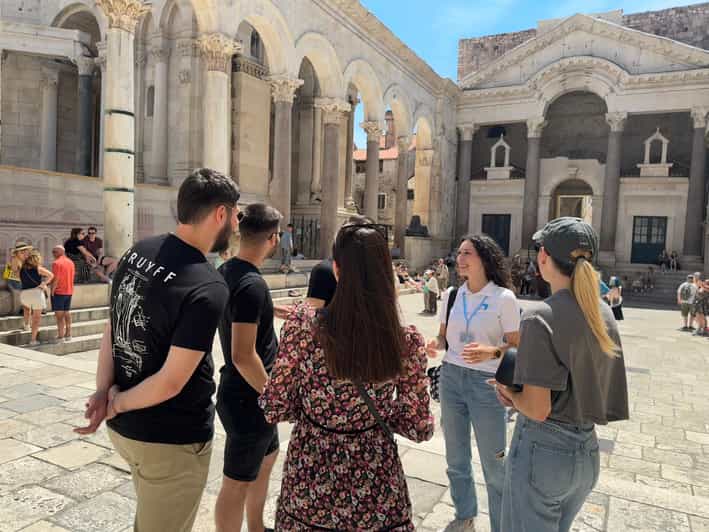
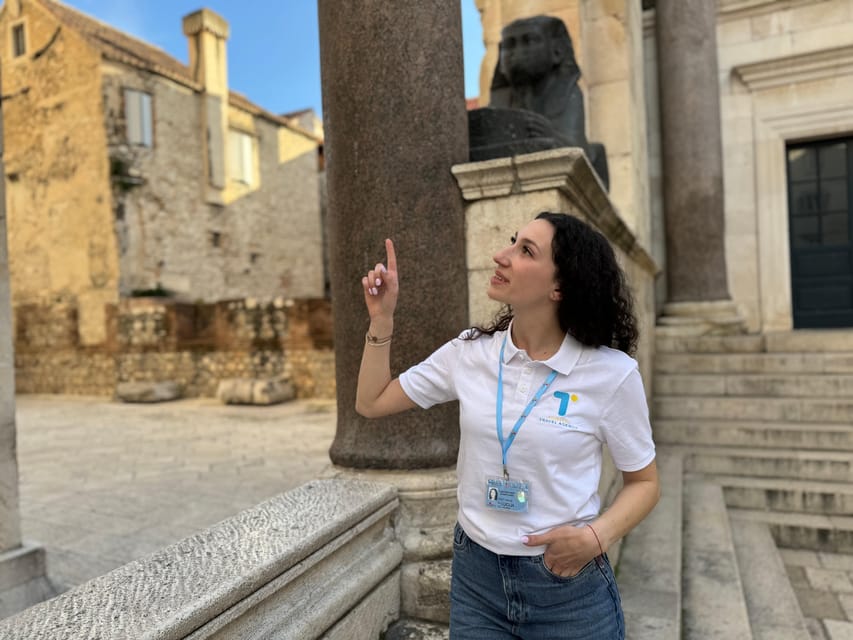
- A local guide gives the tour its character: Lucija’s connection to Split adds useful context about modern life, not just ancient stones.
- The route covers the city’s essential sights: You’ll walk from the Riva through Diocletian’s Palace, Peristil, the Golden Gate, People’s Square, and Fruit Square.
- It is a smart first activity in Split: The walk helps you understand the old town’s layout before exploring alone.
- The Palace is still part of daily life: This is not an isolated ruin. Streets, squares, and buildings continue to form the center of Split.
- The price is reasonable for a guided introduction: At $23 per person, the tour offers a focused history lesson and local orientation without taking up half a day.
- The outing stays in English: Children must remain with an adult, and weather can affect the schedule.
Why this 90-minute walk works so well in Split
Split can feel confusing at first. Roman walls, medieval lanes, cafés, shops, apartments, and waterfront promenades all overlap in a compact area. Diocletian’s Palace is not simply a monument you enter, admire, and leave. It forms the core of the old town, with modern life continuing inside and around its ancient structure.
That is why I like beginning with a guided walk. In 90 minutes, you get the basic map in your head. You learn where the Riva begins, how the palace fits into the city, and which squares deserve a closer look later.
The tour focuses on explanation rather than entry tickets. You will hear the stories behind the major sites and see them as part of one connected route. If a particular church, museum, or cultural building catches your eye, you can return afterward and pay for entry at your own pace.
At $23 per person, the value comes from orientation and interpretation. You are not paying for an all-day excursion or a long list of admissions. You are paying for a short, guided introduction that can save you from wandering past important details without understanding what you are seeing.
More Palace Walking Tours in Croatia
- Split: Old Town and Diocletian Palace Walking Tour
★ 4.9 · 4,727 reviews - Walking Tour of Split and Diocletian’s Palace
★ 5.0 · 2,588 reviews - Split & Diocletian’s Palace Walking Tour
★ 5.0 · 1,125 reviews
Starting beside Split’s historic-core model
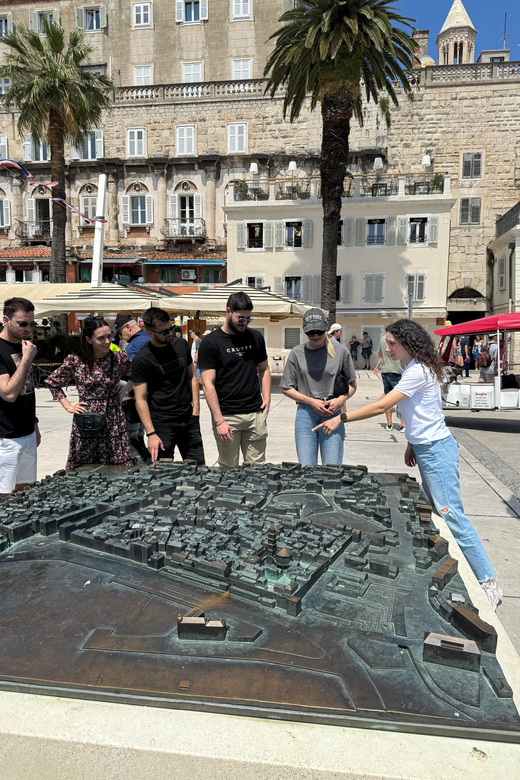
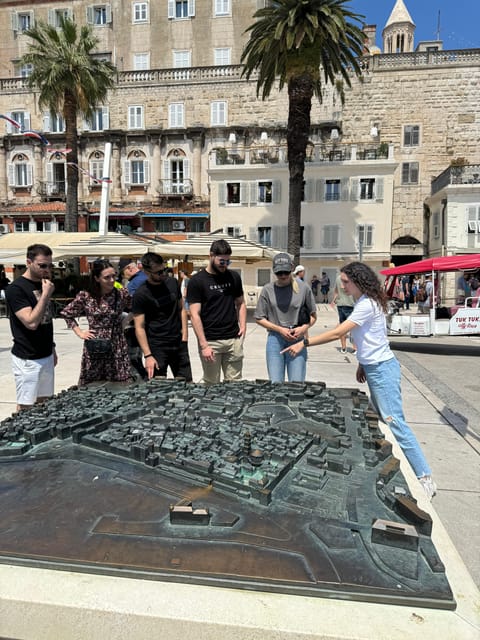
The walk begins from one of two possible meeting locations. One is beside the model of Split’s historical core at Obala Hrvatskog narodnog preporoda 22. The other is on the Riva, the waterfront promenade.
Check the exact meeting point for the option you book. This matters because the old town has several nearby squares and narrow passages, and a few minutes of confusion can be annoying if your start time is close.
The historic-core model is a useful place to begin because it gives you a bird’s-eye sense of the city. You can see how the palace and surrounding old town relate to the waterfront before you begin walking through the real streets.
The Riva offers a different opening. It places you beside the broad waterfront promenade, where Split’s connection to the sea is immediately clear. From there, the guide can lead you into the older quarters and explain how the city changes as you move inland.
The Riva: modern Split meets the old city
The Riva is more than a place for a waterfront stroll. It is the public face of Split, a natural starting point for understanding how the city works today. The promenade provides a sharp contrast to the stone lanes inside the old town.
I appreciate this contrast because it prevents the tour from treating Split as a museum piece. You begin in a place used for daily life, then move toward a palace built for a Roman emperor more than 1,700 years ago.
Your guide uses this part of the walk to set the scene for the city’s transformation. Diocletian chose this location for his luxurious residence, but the palace later became the foundation of a living city. The old town developed around and within its walls instead of leaving the complex frozen in the past.
This is also a good moment to ask practical questions about your stay. The guide can help connect the historical story with modern Split, something Lucija did particularly well according to the supplied feedback. Her local background allowed her to talk about life in the city beyond the standard dates and names.
Walking into Diocletian’s Palace

Entering the palace area is the central moment of the tour. The first thing to understand is its scale and purpose. This was not just a single grand building. It was a large complex designed as Diocletian’s residence, with imposing walls and carefully planned spaces.
The tour explains how the palace has changed from an imperial home into the heart of Split. That transformation is the key to enjoying the old town. You are not only looking at ancient construction. You are walking through streets shaped by many periods of city life.
The stone walls and narrow routes can make the palace feel maze-like. A guide helps you connect the pieces instead of seeing each arch or passage as a separate photo stop. You get a sense of how the complex was organized and why its architecture still controls movement through the center.
The short format is useful here. Ninety minutes gives you enough time for a strong introduction without turning the morning or afternoon into a full history course. If you want every architectural detail, you will need more time on your own. For a first orientation, the pace should suit most people who can comfortably walk on cobbled streets.
More Palace Walking Tours in Split
- Split: Diocletian Palace & Old Town Guided Walking Tour
★ 4.7 · 882 reviews - Diocletian’s Palace and Old Town SMALL GROUP Walking Tour
★ 5.0 · 502 reviews - SPLIT-PRIVATE Walking Tour of Diocletian’s Palace & Old Town
★ 5.0 · 467 reviews - 90-min Diocletian Palace Walking Tour
★ 5.0 · 323 reviews
Vestibul and the imperial entrance
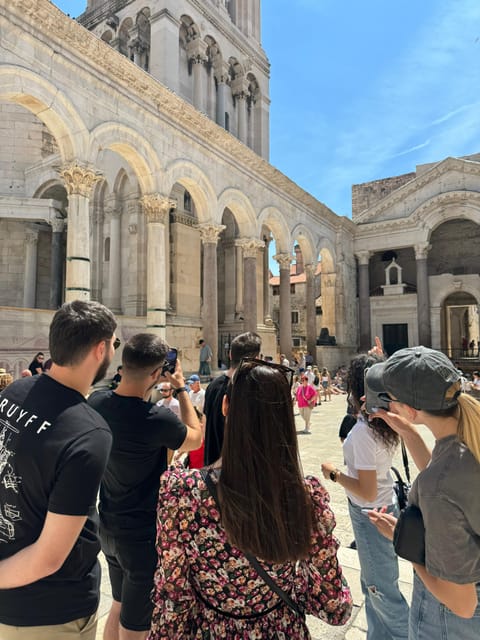
The Vestibul is one of the major stops inside the palace. It gives the route an especially strong sense of arrival, because this space connects the palace’s grand design with the narrower old town around it.
Here, the guide can explain how the area functioned within Diocletian’s residence and how later city life changed its meaning. This is where a local guide adds real value. The stonework matters, but the story of how people continued using and adapting the palace matters just as much.
You should expect a guided explanation rather than an interior admission experience. Entrance tickets to cultural and religious sites are not included, so the tour does not promise extended visits inside every landmark.
That arrangement suits me. I would rather get a clear overview first, then choose which places deserve a separate visit. It also keeps the cost at $23 rather than building in several admissions you may not want.
Peristil, the palace’s grand central square
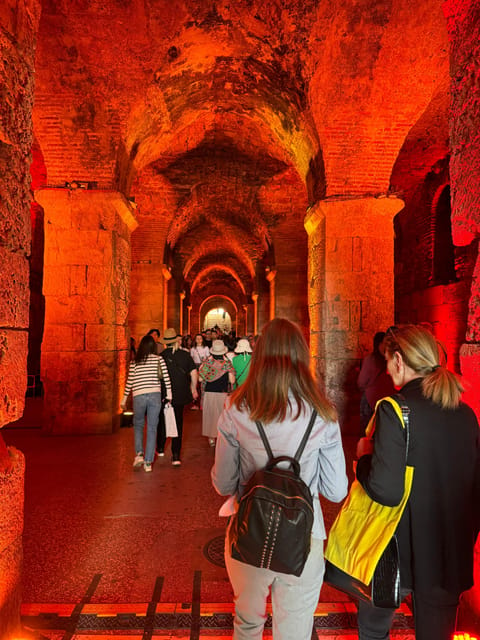
Peristil is one of the tour’s essential stops. Its scale helps you understand the power Diocletian wanted to project. After walking through tighter stone passages, arriving at a major open square gives the palace a different sense of proportion.
This is an important place to pause and listen. The guide can connect the square with the emperor, the palace plan, and the city that grew around the original complex. The setting also makes a useful lesson in layers of time. Roman design, later religious use, and present-day activity all meet here.
You may want to return to Peristil after the tour. A short guided stop can explain its importance, but you may prefer to spend more time looking closely at the surrounding architecture or simply watching the square change during the day.
The route does not include admission to religious or cultural sites. If you want to enter one of the buildings along the way, ask Lucija for practical information, then visit later at your own pace.
The Golden Gate and the palace walls
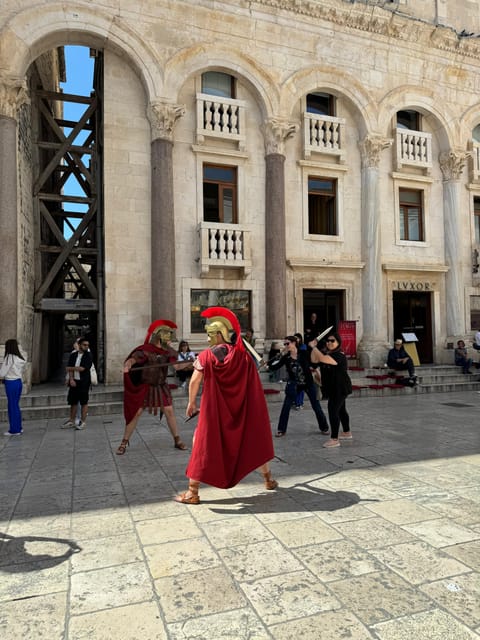
The Golden Gate shows the defensive side of Diocletian’s Palace. It is one of the most recognizable points on the route and helps you picture how the palace connected with the outside world.
The walls are a major part of the experience. They have remained for more than 1,700 years, but the tour is careful to present them as part of a changing city rather than as untouched ruins. That distinction makes Split special. The old town grew around the palace instead of abandoning it.
This is also a good stop for understanding orientation. Once you have seen the Golden Gate, the palace’s main routes become easier to follow. You can use the knowledge later when returning to shops, restaurants, museums, or other parts of the center.
The stone streets can be uneven, and the route is not suitable for wheelchair users. I would wear supportive shoes even if you normally manage city walks in casual footwear. This is not a strenuous hike, but hard surfaces can wear on your feet.
People’s Square and the city beyond Roman walls
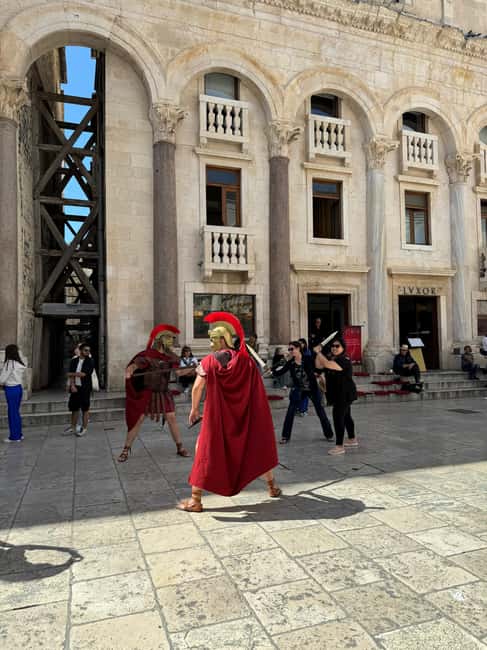
People’s Square takes you farther into Split’s broader old town. Here, the focus shifts from the palace as an imperial residence to the city that developed around it.
That change gives the tour a useful rhythm. You are not spending the entire 90 minutes on Roman history. You also see how Split’s public spaces expanded and how later periods shaped the center.
I like this part for first-time visitors because it helps you understand that the old town is more than Diocletian’s Palace. The palace is the anchor, but the surrounding squares and streets tell the story of a city that kept adapting.
The guide’s local knowledge is especially useful here. Lucija received repeated praise for her friendly manner, her clear explanations, and her ability to answer questions about life in Split. If you enjoy asking about local customs and present-day city life, you will likely get more from this tour than from a purely scripted walk.
Fruit Square and the final look at Split
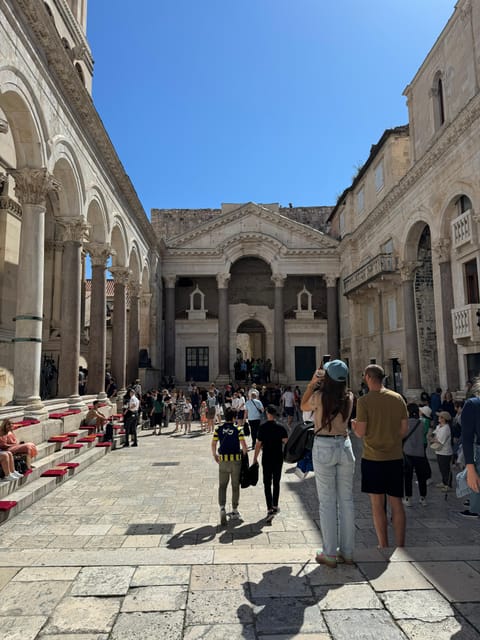
Fruit Square is the final listed sightseeing stop. It gives the walk another view of the old town’s public spaces and provides a natural place to reflect on how the palace and later neighborhoods fit together.
By this point, you should have a working mental map of the central area. You will have seen the waterfront, the palace, the Vestibul, Peristil, the Golden Gate, People’s Square, and Fruit Square. The route is compact, but it covers the essential first layer of Split.
The tour finishes at one of two drop-off locations, including the model of the historical core at Obala Hrvatskog narodnog preporoda 22. The exact end point depends on the option booked, so check those details before setting up a tight appointment afterward.
I would not schedule a major timed activity immediately after the walk. The tour is only 90 minutes, but a start or finish in a busy old-town area can make precise timing less comfortable.
What makes the guide important
The strongest feature here is the guide’s personal connection to Split. Lucija was born and raised in the city, and that background shapes the experience. She can explain the main historical points while also answering questions about how Split feels and functions now.
That local perspective came through clearly in the feedback. One visitor valued her ability to discuss life in Split beyond the historical material. Another described the small group as friendly and appreciated the chance to chat about local ways of life.
You should not expect a private lecture tailored entirely to your interests unless you book the private-group option. Still, the small-group setting should make conversation easier than on a large coach-style tour.
The guide’s warmth also matters. Several comments praised Lucija’s kindness, friendliness, and enthusiasm for her hometown. That can make the difference between simply collecting facts and feeling connected to the place you are walking through.
Is $23 a fair price?
I think $23 is fair for a short guided introduction to Split, especially if you are visiting for the first time. The price includes a licensed English-speaking guide and a route through the city’s most important central sights.
The tour does not include admissions, food, transport, or extended visits inside religious and cultural sites. That keeps the price lower, but you should budget separately if you plan to go inside places you see along the way.
The best value comes when you use the tour as a launchpad. Listen for practical orientation, note the buildings you want to revisit, and ask questions while you have a local guide beside you. Then spend the rest of your stay exploring the places that caught your attention.
A private group is available if you want a more personal arrangement. The supplied information does not specify the private-group price, so check the current amount before booking.
Who should book this Split walking tour?
I would recommend it most strongly to first-time visitors, cruise passengers with limited time, couples, families with older children, and anyone who wants context before exploring alone.
It also suits people who prefer a local voice over a large, formal group. The English-language format is clear, and the 90-minute length is easy to fit into a day of sightseeing.
You may want a different experience if you need wheelchair access, want admission to several sites included, or prefer a long, detailed architectural tour. This route is an overview, not a full-day study of every corner of the palace.
Children must be accompanied by an adult throughout the walk. The tour suits most travelers who can manage old-town streets, but weather can affect the schedule. If poor weather causes cancellation, you can reschedule or receive a full refund. You can also cancel up to 24 hours in advance for a full refund, and the reserve-now, pay-later option keeps your plans flexible.
Final verdict: a smart first step in Split
Book this tour if you want to understand Split before you start wandering. The route covers the city’s must-see center, the guide brings a personal connection to the story, and the $23 price is sensible for a focused 90-minute introduction.
I especially like the mix of Roman remains and modern city life. Lucija’s local perspective appears to be the feature that earns the strongest praise, so the experience is more than a list of dates and monuments.
Skip it only if you already know Split well, require wheelchair access, or want entrance tickets bundled into the price. For most first-time visitors, this is a practical way to get your bearings fast and choose what deserves a closer look later.
FAQ
How long does the Diocletian’s Palace and Old Town Split Walking Tour last?
The tour lasts 90 minutes.
What language is the tour conducted in?
The tour operates in English and includes a live English-speaking guide.
What sights are included on the walking route?
The route includes the Riva, Diocletian’s Palace, the Vestibul, Peristil, the Golden Gate, People’s Square, and Fruit Square.
Are entrance tickets included?
No. Entrance tickets to cultural and religious sites are not included, but the guide provides information so you can visit places later at your own pace.
Where does the tour begin?
There are two possible starting locations: the model of Split’s historical core at Obala Hrvatskog narodnog preporoda 22, or the Riva. The meeting point depends on the option booked.
Is the tour suitable for wheelchair users?
No. The tour is not suitable for wheelchair users.
Can I cancel the tour or change my plans?
Yes. You can cancel up to 24 hours in advance for a full refund. A reserve-now, pay-later option is also available. If poor weather causes cancellation, you can reschedule or receive a full refund.
More Diocletian's Palace Tours in Split
- Split Old Town and Diocletian’s Palace Tour
★ 4.8 · 716 reviews - Split: Game of Thrones Tour with Diocletian’s Palace Cellar
★ 4.8 · 545 reviews - Split: Diocletian’s Palace Virtual Reality Experience
★ 4.4 · 308 reviews - Split: 1.5-Hour Walking Tour and Diocletian’s Palace
★ 4.7 · 256 reviews
Just added around Split
- Split: Old Town and Diocletian’s Palace Walking Tour★ 3.3 · 3 reviews
- Essential Diocletian’s Palace Tour for First-Time Visitors★ 4.9 · 79 reviews
- Split: Old Town & Diocletian’s Palace Earlybird Walking Tour★ 4.0 · 12 reviews
- Split: Palace & Old Town Private Walking Tour-Entrance incl.★ 4.8 · 8 reviews
- Jewish Heritage & Diocletian’s Palace Private Split Tour★ 5.0 · 80 reviews
- YOUR BEST PRIVATE TOUR – amazing Split and Diocletian’s palace★ 5.0 · 83 reviews
- Split: 1.5-Hour Walking Tour and Diocletian’s Palace★ 4.7 · 256 reviews
- Split: Diocletian’s Palace Virtual Reality Experience★ 4.4 · 308 reviews
Diocletian's Palace Tours, compared.

Walking Tour of Split and Diocletian’s Palace
Read our review →

Diocletian Palace & Old Town Guided Walking Tour
Read our review →

Game of Thrones Tour with Diocletian’s Palace Cellar
Read our review →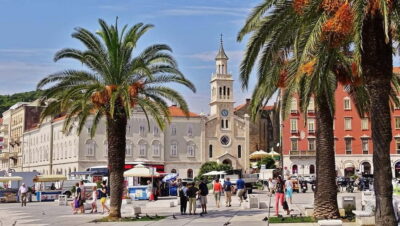
Diocletian’s Palace and Old Town SMALL GROUP Walking Tour
Read our review →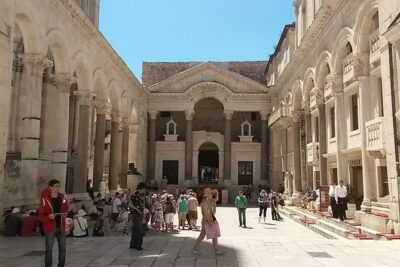
Browse the lists this tour appears in