
REVIEW · SPLIT
YOUR BEST PRIVATE TOUR – amazing Split and Diocletian’s palace
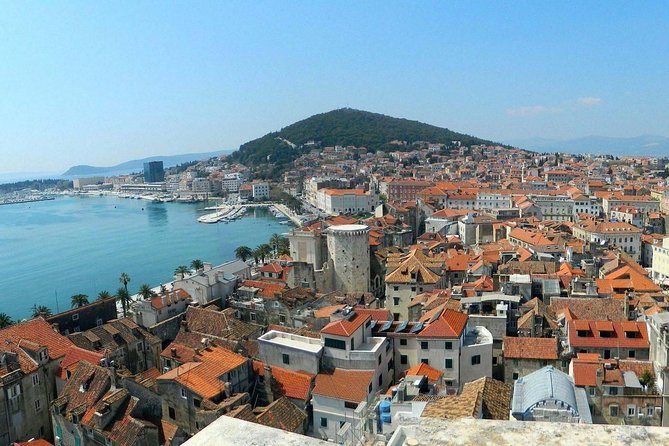
Split’s past is built into its present. This private walking tour brings you through Diocletian’s Palace, where Roman walls form the bones of a living city, and I like the flexible pace and the chance to ask a guide about exactly what interests you. The morning start is another smart touch, since the narrow streets and palace courtyards are easier to enjoy before the day gets busy. The main drawback is the price, $124.34 per person, with entrance fees extra.
I also like that the tour does more than circle the palace’s grandest monuments. You’ll visit the old Jewish quarter, a local chocolate shop, medieval squares, and the Riva promenade. Guides such as Matt, Stella, Gita, Mirjana, Peter, and Milos have been praised for clear storytelling, food tips, and adapting the route to each group. Still, this is a walking tour in warm, exposed streets, so an early start matters in summer.
Five details that shape the experience
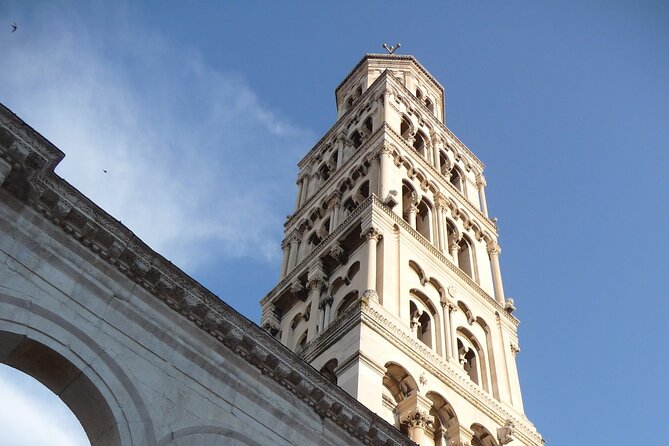
- A Roman palace that became a city: You walk through a 4th-century retirement residence that later became medieval Split.
- A genuinely private format: Your guide can adjust the route and pace around your interests and schedule.
- The best historical sequence: The substructures, Peristyle, Vestibule, gates, and streets explain how ancient and modern Split fit together.
- Local touches beyond the ruins: Nadalina chocolate, the old Jewish quarter, market connections, and restaurant suggestions add everyday Croatian life.
- A short but full introduction: The tour lasts about 1 hour 50 minutes to 2 hours 10 minutes, enough for a first look without taking your entire day.
Why a private walk makes sense in Split
Diocletian’s Palace is not a fenced-off monument sitting apart from town. It is the old center of Split, with homes, cafés, shops, squares, churches, and working streets inside and around the ancient walls. Without context, you can easily walk past a Roman column, a medieval palace, and a modern shopfront without realizing how much time has gathered in one place.
A private guide gives you a useful thread to follow. Instead of carrying a guidebook and stopping to decode each corner, you can ask why the palace was built, how it changed after the Roman period, and why people still live and work within its old plan.
The private setup is especially useful for families and small groups. One family praised Stella for keeping a middle-school student interested, while other groups appreciated guides who answered questions at length and offered advice for lunch and later sightseeing. This is not a fixed lecture delivered to a crowd. Your group can spend more time on Roman history, local life, food, or architecture, depending on the guide and your interests.
More Private Palace Tours in Croatia
- SPLIT-PRIVATE Walking Tour of Diocletian’s Palace & Old Town
★ 5.0 · 467 reviews - Split by Private Electric Rickshaw – Palace & Hidden Gems
★ 5.0 · 412 reviews - Jewish Heritage & Diocletian’s Palace Private Split Tour
★ 5.0 · 80 reviews
Starting on the Riva, Split’s front porch
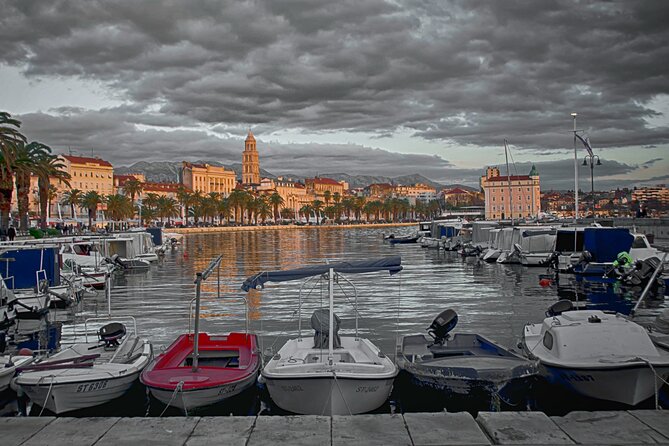
The tour begins at the Riva, the broad waterfront promenade often described locally as Split’s living room. This is a good orientation point. You get an immediate sense of the city’s position on the Adriatic, then turn toward the palace and the old streets behind it.
Your guide introduces Croatia, Split, and the plan for the walk. The opening is brief, about 10 minutes, but useful. If you are arriving from a cruise ship, pickup can take place at the port exit gate. If you stay in Split’s old center, the guide can collect you at your accommodation. Otherwise, you meet by the bronze model of Split’s historic core on the Riva.
The meeting point deserves attention. The model is at Obala Hrvatskog narodnog preporoda 23, about 20 meters toward the sea from the southern palace gate and the exit from the palace basements. Look for the bronze city model rather than relying only on a street number.
Diocletian’s Palace and the Roman plan
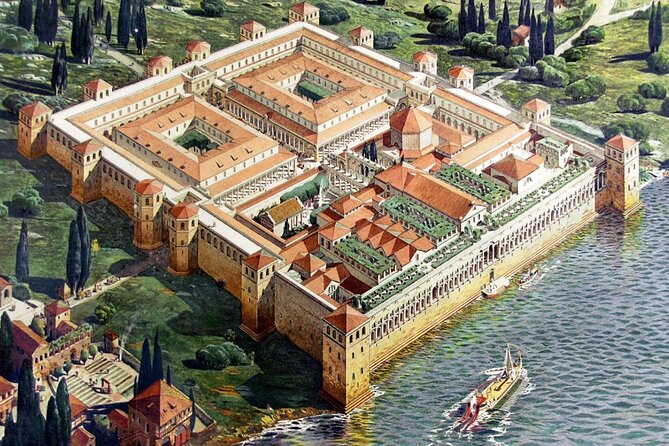
From the Riva, your guide gives a 10-minute introduction to Diocletian’s Palace. Emperor Diocletian built it in the 4th century AD as a luxury retirement residence. After his death and the decline of Roman power, the building did not simply become an abandoned ruin. In the 7th century, it turned into a medieval town, which later developed into modern Split.
That change is the heart of the tour. You are not only looking at Roman stone. You are seeing how later residents adapted old gates, chambers, streets, and walls for new needs.
The palace once followed a clear Roman plan, with military-style gates and intersecting roads. Today, buildings from different periods sit against one another. A cathedral bell tower rises near ancient columns. Medieval noble homes occupy Roman spaces. Contemporary shops operate inside structures first designed for an emperor.
This layering is one of the tour’s strongest features. A guide can point out what belongs to the imperial period, what was added in medieval times, and what is part of modern Split. Several groups praised this ability to explain the different periods without turning the walk into a dry history lesson.
The substructures: the clearest look at the original palace
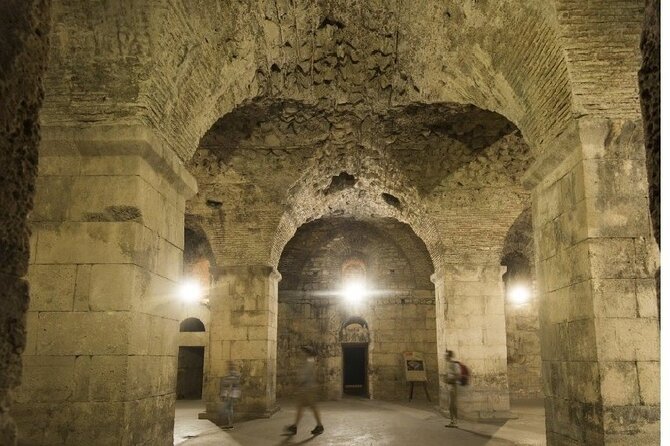
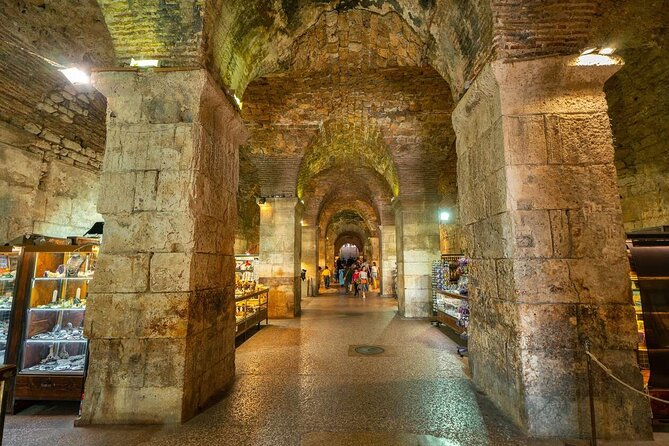
The palace basements are the main paid stop, and the entrance fee is not included in the tour price. Set aside room in your budget for that ticket. The substructures are among the best-preserved parts of the 1,700-year-old complex because they supported the rooms above them and were later filled in and preserved.
You enter through the Bronze Gate from the Riva side. In the basements, your guide explains Diocletian’s rise to power, his years as emperor, his decision to abdicate, and his retirement in Split. The story gives a human shape to the stone. This was not just a military ruler’s fortress. It was intended as a comfortable final home.
The guide also explains the palace’s construction and its architectural plan. Local Brač stone was used in the building, and the connection with nearby Salona is important. Salona was the Roman capital of the area, and its destruction by northern invaders helped push people into the palace in the 7th century. That population shift is what changed an imperial residence into a medieval town.
This section may be the most useful part for first-time visitors. On your own, the basements can look like a set of large stone rooms. With an explanation of how the rooms supported the palace above, they become a map of Roman planning and later urban survival.
More Private Palace Tours in Split
- Split: Palace & Old Town Private Walking Tour-Entrance incl.
★ 4.8 · 8 reviews
The Peristyle, the palace’s grand central square
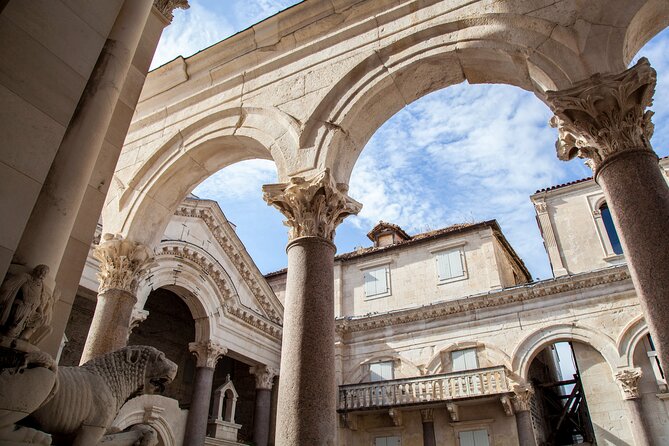
The Peristyle is the palace’s main ceremonial square. It is surrounded by an unusual mix of periods and styles, including Egyptian elements, Roman remains, medieval buildings, the cathedral bell tower, noble palaces, and later additions.
Your guide spends about 15 minutes here, which is enough to identify the major features while leaving time for questions. Look upward and around rather than only at the central pavement. The value of this square comes from the collision of forms. Ancient columns share the scene with a medieval bell tower and buildings still used today.
The Peristyle is also where the palace can feel most crowded. This is one reason I favor the morning departure. The square is easier to read when you are not trying to listen over a large mass of people.
The Vestibule and the sound of Dalmatia
The circular Vestibule was the entrance to Diocletian’s private rooms and served as a kind of imperial lounge. It is a compact stop, about seven minutes, but its shape makes it memorable.
At times, you may hear Dalmatian klape singers here. The information does not promise a performance on every tour, so treat it as a possible bonus rather than a scheduled feature. The rounded chamber can make singing especially striking, but the stop remains worthwhile even without music because it helps explain the transition from public palace space to the emperor’s private quarters.
Gates and streets that reveal the palace’s design
The Eastern, or Silver, Gate takes only a couple of minutes, but it marks the beginning of the main Decumanus street. Small stops like this are useful because they connect the palace’s physical layout to Roman town planning.
The Golden Gate receives more attention. It was the main entrance, and your guide explains the gate’s people trap design, along with the Roman Cardo and Decumanus streets. The route toward Salona also becomes part of the story.
These gates are easy to photograph, but their real value comes from understanding how they controlled movement. Roman palace architecture was not random. The roads, entrances, and fortified edges were arranged with purpose.
Chocolate, a bishop, and the old Jewish quarter
One of the tour’s pleasant surprises is Nadalina chocolate, a local producer inside the palace area. You receive a couple of small samples with Mediterranean fruit or herbal flavors. The shop is closed on Sundays, so that portion is skipped then.
This is a modest stop, but it breaks up the stone and history with a taste of present-day Dalmatia. One family specifically appreciated the chocolate visit, and several people valued the food advice they received from guides afterward.
The Grgur Ninski statue is another short stop. It honors the 10th-century Croatian archbishop and was created by Ivan Meštrović, Croatia’s most famous sculptor. Your guide can place both the religious figure and the artwork in a broader Croatian setting.
The walk then reaches Split’s 16th-century Jewish quarter. You can see the medieval ghetto, and if you are interested, the route can include Split’s synagogue, described as the third-oldest operating synagogue in Europe. This is an important reminder that Split’s story is not only Roman and Catholic. Different communities helped shape the old town.
Medieval Split beyond the imperial walls
Narodni Trg, or People’s Square, was the main square of medieval Split. The City Hall and several handsome palaces surround it. This stop helps you see the city after the palace became a town, when power shifted from an emperor’s household to civic and noble life.
Fruit Square, Trg Braće Radić, was once the medieval market. A statue of Marko Marulić occupies its center. Marulić was a 15th-century Croatian poet and humanist, often called the father of Croatian literature.
These squares are a good reason to book the private option instead of focusing only on the palace basements. You get a sense of how people used the old center over time. The route does not end with the Roman period. It follows Split into the Middle Ages and toward the city you see now.
The final suggested stop is Prokurative, a neoclassical square surrounded by neo-Renaissance buildings. It hosts cultural events and outdoor performances and is often compared with St. Mark’s Square in Venice. The stop is brief, only about three minutes, but it gives you a final look at Split’s later architectural style.
Guides, pace, and the value of local advice
The company assigns licensed guides, and the named guides praised for this experience include Matt, Stella, Gita, Mirjana, Peter, Milos, Boran, Lily, Natasa, Gythe, and Vicencia. The exact person matters because a private tour depends heavily on the guide’s ability to read your group.
Matt has been praised for explaining the palace’s historical layers, local food, and nearby activities. Stella has been singled out for making the city engaging for a younger visitor. Gita and Mirjana are associated with strong local recommendations and clear communication. Peter received praise for answering a wide range of questions about both ancient history and current issues.
You should tell your guide what you want early. Ask for more Roman detail if that is your priority. Ask for local food advice if lunch is next. If your group includes children, say so. The route is flexible, but flexibility works best when you use it.
The stated duration is about two hours. One negative account described a 90-minute finish, while the provider disputed that account and said the guest chose to stop. The practical lesson is simple: confirm your preferred route and expected finish with the guide at the start. Most of the available feedback describes a full, well-paced visit, but a private tour benefits from clear communication.
Price, entrance fees, and practical value
At $124.34 per person, this is not a budget introduction to Split. The price makes more sense for a small group that wants a private guide, a custom route, and direct access to local advice. For one or two people, it is a bigger spend. For a family or group of six, the cost may compare more favorably with several separate tickets or a large group tour, though you should still check your own numbers.
The palace substructures entrance fee is extra. Other listed stops are free, and the chocolate tasting is included. Children under 11 take the tour free, but they must be accompanied by an adult.
This is a walking tour with no general transport included. Wear shoes suited to uneven old-town streets, carry water, and choose the morning if you visit during hot weather. A Spanish-language review specifically noted the heat and suggested an evening route, though this experience is promoted with a morning start for easier sightseeing.
Free cancellation is available up to 24 hours before the start time. Changes or cancellations inside that window are not accepted for a refund.
Who should book this Split tour?
I would choose this tour if you want your first two hours in Split to make sense. It is particularly useful for first-time visitors, families, cruise passengers with limited time, and anyone who prefers asking questions to reading plaques.
It suits people who care about history but also want food suggestions, local context, and a look at the old town beyond the main palace square. The chocolate stop, synagogue, medieval squares, and Prokurative keep the walk from feeling like a single-monument visit.
I would skip it if you want a cheap, self-guided stroll or if your main goal is spending a long time inside one museum. You will pay more than you would for exploring the streets alone, and the substructures cost extra. The reward is a clearer understanding of how Roman, medieval, and modern Split occupy the same small area.
Should you book it?
Book this private tour if you value a flexible guide and a strong historical framework more than the lowest price. The best parts are the palace basements, the explanation of the city’s layered growth, and the chance to finish with practical advice for food and the rest of your day.
For the best experience, request a morning time, confirm the meeting point, ask who will guide your group, and tell the guide your priorities. If you are comfortable paying for personal attention, this is a useful and unusually broad introduction to Split.
FAQ
How long does the tour last?
The tour lasts approximately 1 hour 50 minutes to 2 hours 10 minutes.
Is the tour private?
Yes. Only your group participates, and the itinerary can be adjusted to your preferences.
What is included in the price?
The price includes a licensed tour guide, custom tour planning, and the listed chocolate tasting when Nadalina is open.
Are entrance fees included?
No. Entrance fees are not included, including the fee for the Diocletian’s Palace substructures.
Can children join the tour?
Yes. Children must be accompanied by an adult, and children under 11 years old tour free.
Where does the tour meet?
The main meeting point is by the bronze model of Split’s historic core on the Riva, at Obala Hrvatskog narodnog preporoda 23. Cruise passengers can be met at the port exit gate.
Is hotel pickup available?
Pickup is available only if you are staying in accommodation inside Split’s old town. If you stay outside the center, you meet at the Riva.
More Diocletian's Palace Tours in Split
- Split: Old Town and Diocletian Palace Walking Tour
★ 4.9 · 4,727 reviews - Walking Tour of Split and Diocletian’s Palace
★ 5.0 · 2,588 reviews - Split & Diocletian’s Palace Walking Tour
★ 5.0 · 1,125 reviews - Split: Diocletian Palace & Old Town Guided Walking Tour
★ 4.7 · 882 reviews
Just added around Split
- Split: Old Town and Diocletian’s Palace Walking Tour★ 3.3 · 3 reviews
- Essential Diocletian’s Palace Tour for First-Time Visitors★ 4.9 · 79 reviews
- Split: Old Town & Diocletian’s Palace Earlybird Walking Tour★ 4.0 · 12 reviews
- Diocletian’s Palace & Old Town Split Walking Tour★ 5.0 · 11 reviews
- Split: Palace & Old Town Private Walking Tour-Entrance incl.★ 4.8 · 8 reviews
- Jewish Heritage & Diocletian’s Palace Private Split Tour★ 5.0 · 80 reviews
- Split: 1.5-Hour Walking Tour and Diocletian’s Palace★ 4.7 · 256 reviews
- Split: Diocletian’s Palace Virtual Reality Experience★ 4.4 · 308 reviews
Diocletian's Palace Tours, compared.
Walking Tour of Split and Diocletian’s Palace
Read our review →

Diocletian Palace & Old Town Guided Walking Tour
Read our review →

Game of Thrones Tour with Diocletian’s Palace Cellar
Read our review →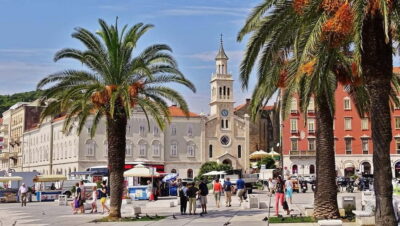
Diocletian’s Palace and Old Town SMALL GROUP Walking Tour
Read our review →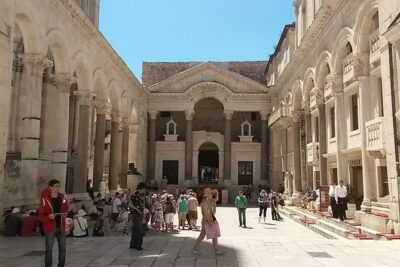
Browse the lists this tour appears in