
REVIEW · FLORENCE
Palazzo Vecchio Morning Guided Tour – Small Group
The Medici left clues everywhere. This morning visit brings you into Palazzo Vecchio, Florence’s old seat of power, with a local guide and a group capped at nine people. I like the small size, which gives you a fair chance to ask questions, and I like the mix of art, politics, symbols, and architecture. The main concern is value: at $145.75 per person, a tour that lasts closer to an hour than 90 minutes can feel expensive.
You meet at 11:30 a.m. in Piazza della Signoria, one of Florence’s grandest public spaces, then enter the palazzo for a guided visit. Guides such as Laura, Leonardo, Annette, Daniela Carboni, and Eleonora have earned especially warm praise for their storytelling and patience, including with children. Still, check the day’s pace at the start, since ticket collection once caused a serious delay for one group.
Key points to know before you book
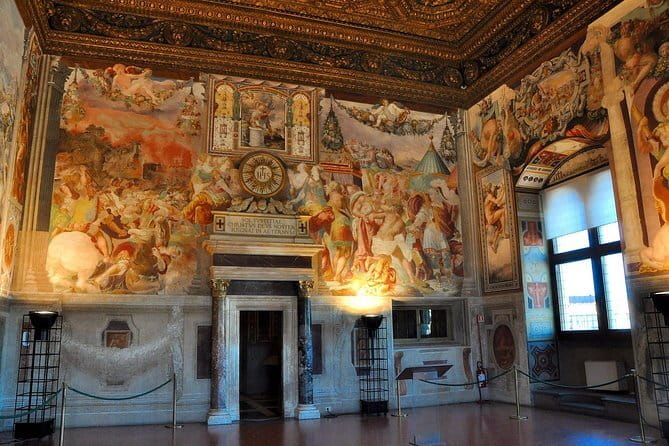
- The Salone dei Cinquecento is the centerpiece: See the enormous council hall linked to Michelangelo, Leonardo da Vinci, and Giorgio Vasari.
- The tour connects art with power: You learn how a medieval town hall became the Medici residence under Duke Cosimo I.
- The group is limited to nine people: That is a real advantage when you want to ask about a painting or follow a complicated political story.
- Dan Brown fans get a special thread: Look for Vasari’s Cerca e Trova inscription and other symbols connected with Inferno.
- The advertised duration needs attention: The experience is listed at about 90 minutes, but one account describes only about an hour of touring after a delayed start.
- The price is high for a short visit: It makes the most sense if you value a personal guide and want context rather than a quick look around.
Why Palazzo Vecchio matters in Florence
Palazzo Vecchio is not simply another ornate Italian building. It was the political heart of Florence for centuries, and its rooms were designed around government, authority, ceremony, and control.
The building was raised over ancient Roman ruins, then carried forward through Florence’s medieval and Renaissance periods. That layered past gives the tour more substance than a simple procession from room to room. You are looking at paintings and sculpture, but you are also seeing where decisions about the city were made.
I like this setting for visitors who want to understand Florence beyond its famous artists. The palazzo helps explain how the city’s political life, banking power, artistic culture, and Medici ambition all met under one roof.
Your guide begins with an introduction to the building’s role and past before taking you inside. That opening matters. Without it, the rooms can blur into a series of grand ceilings and expensive-looking decorations. With it, you have a reason to notice who controlled each space and why it was decorated so forcefully.
More Palazzo Vecchio and Pitti Palace Tours in Florence:
- Florence: Palazzo Vecchio Entrance Ticket & Audioguide
★ 4.4 · 4,822 reviews - Florence: Uffizi, Pitti Palace & Boboli Combined 5-Day Pass
★ 4.5 · 1,726 reviews - Florence: Palazzo Vecchio Guided Tour
★ 4.8 · 1,260 reviews
Meeting in Piazza della Signoria at 11:30
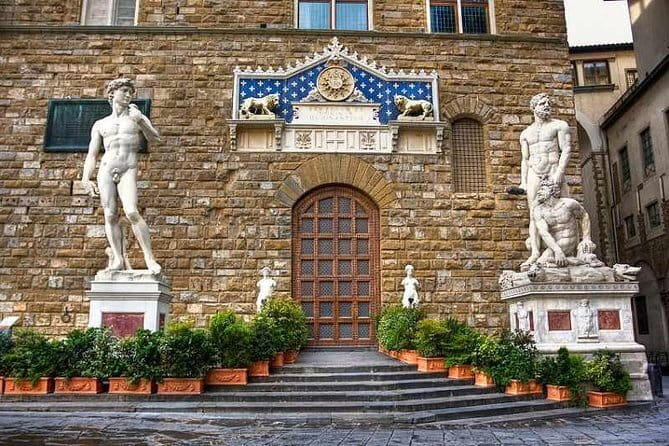
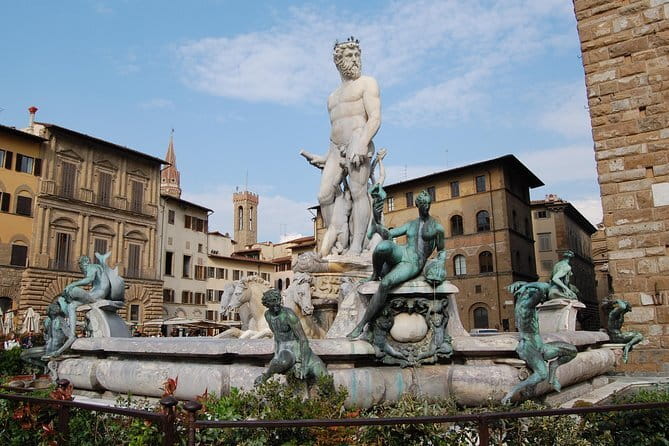
The meeting point is Palazzo Vecchio, Piazza della Signoria, 50122 Firenze. Your visit begins in the square, which is one of Florence’s most famous public places and an important part of the experience in its own right.
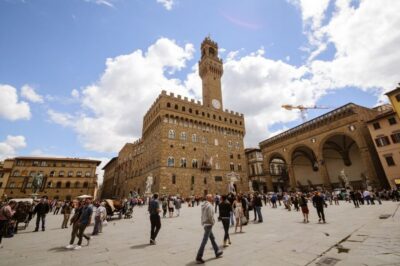
Arrive with enough time to find the guide and orient yourself. The square is a natural gathering point, but it can also be crowded and visually busy. The building’s clock tower helps identify Palazzo Vecchio, yet you should still keep your booking details ready when you check in.
The scheduled start is 11:30 a.m. That makes this a useful choice if you want a slower morning rather than an early museum appointment. It also leaves time beforehand for breakfast or a short walk through central Florence.
There is one practical warning. A previous group lost about 25 minutes while the guide collected tickets, then received a much shorter visit than expected. That may have been an isolated problem, but I would ask at check-in whether the group is ready to enter and how long the guided portion is expected to last.
The Salone dei Cinquecento and its unfinished rivalry
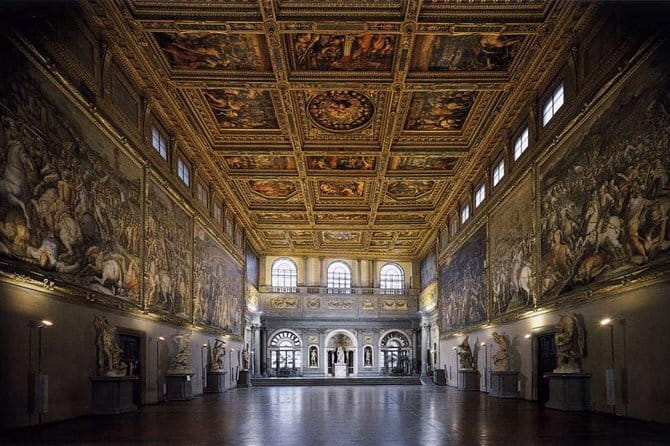
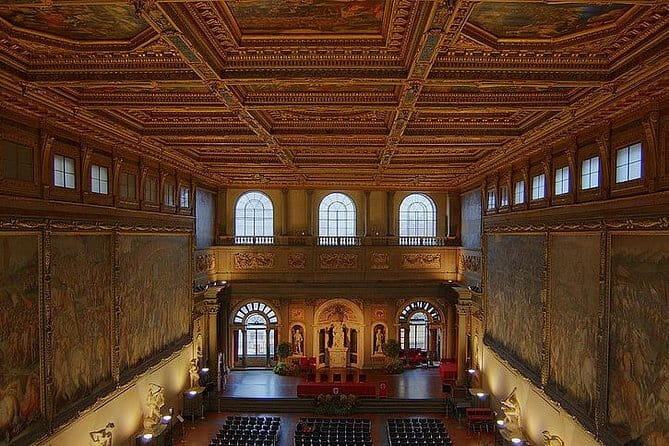
The Salone dei Cinquecento is the major room on this tour. Its scale is the first thing you notice. This enormous hall was built for Florence’s governing body, so it was meant to impress citizens and visiting dignitaries with the power of the state.
The room is also tied to one of the great artistic rivalries in European art. Michelangelo and Leonardo da Vinci were commissioned to create giant wall murals here. Their projects did not survive as completed works, but the story gives the room a memorable human edge: two celebrated artists, two ambitious scenes, and a political building seeking visual glory.
Your guide can help you separate what remains from what was planned. That is especially useful in a room where the size and decoration can overwhelm the eye. Instead of trying to take in every painted surface at once, you can focus on the relationship between art and civic power.
The hall also features work connected with Giorgio Vasari and other Renaissance artists. I would give this room your full attention rather than treating it as a quick stop. It is the place where the palazzo’s political purpose and artistic ambitions come together most clearly.
Michelangelo, Donatello, Vasari, and the Medici message
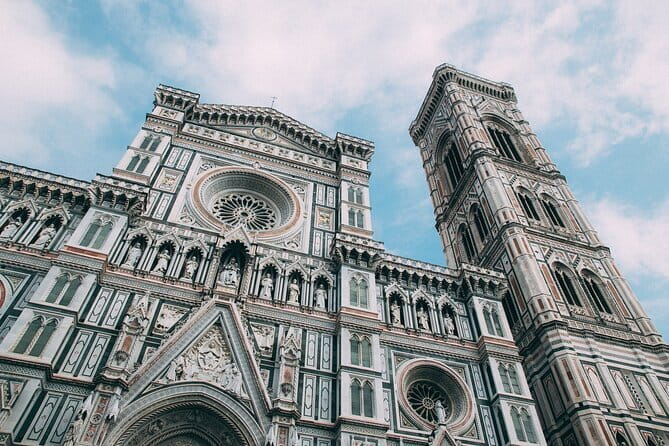
The tour continues through rooms containing works by Michelangelo, Donatello, Vasari, and other Renaissance masters. The value here is not just the chance to see famous names. Your guide can explain how the art functioned inside a working seat of power.
Donatello’s sculpture brings a different mood from the huge painted rooms. Michelangelo’s work carries the fame, but the wider collection helps show that Florence’s artistic culture was not built by one person. Each piece contributes to the story of patronage, competition, civic pride, and Medici influence.
The Medici connection becomes central as you learn how Palazzo Vecchio changed from a medieval town hall into the private residence of Duke Cosimo I de Medici in the 15th century. That shift changed the building’s purpose. It was no longer only a place where public business was conducted. It also became a residence shaped by court life and dynastic image-making.
I particularly like this part for families and first-time visitors. Children and teenagers can follow the power struggle more easily when the guide explains who lived where, who commissioned the art, and why a room needed to look imposing. Several guides, including Laura and Annette, have been praised for handling questions from younger visitors with patience.
More Early-Start Trips in Florence:
- Palazzo Vecchio 90-Minute Morning Guided Tour
★ 4.7 · 104 reviews - London: Parks and Palaces Guided Morning Bike Tour
★ 4.9 · 317 reviews - Taipei City Morning Tour with National Palace Museum entry
★ 4.0 · 232 reviews - Taipei: Morning City Tour with National Palace Museum Entry
★ 4.6 · 173 reviews
Following the Inferno clues
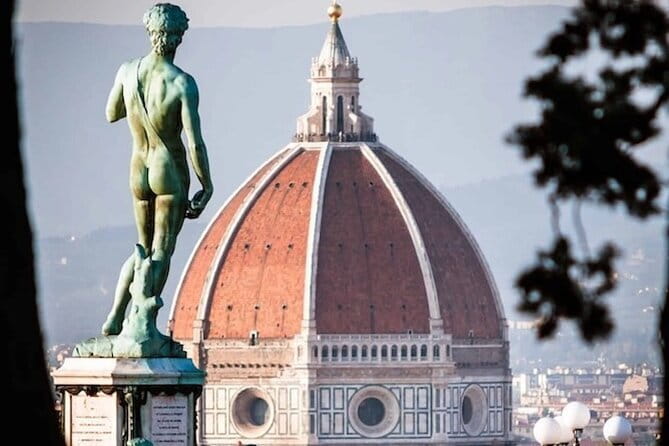
If you know Dan Brown’s Inferno, the palazzo offers a familiar set of visual clues. The best-known detail is the inscription Cerca e Trova, meaning seek and you shall find, written above a fresco by Giorgio Vasari.
The inscription is small compared with the grand decoration around it, which is part of its appeal. Your guide can point it out and explain why it became important to the novel and film. Without help, you could easily miss it.
This part of the visit works best when treated as an extra layer, not the main reason to enter. The real value of Palazzo Vecchio comes from its political and artistic story. The Dan Brown connection simply gives you another way to look at the paintings and symbols.
I would mention your interest in Inferno to the guide early in the tour. With a small group, there is a better chance of getting a clear answer about the inscription and the other mysterious details linked with the story.
Map room, terraces, and Arnolfo’s Tower
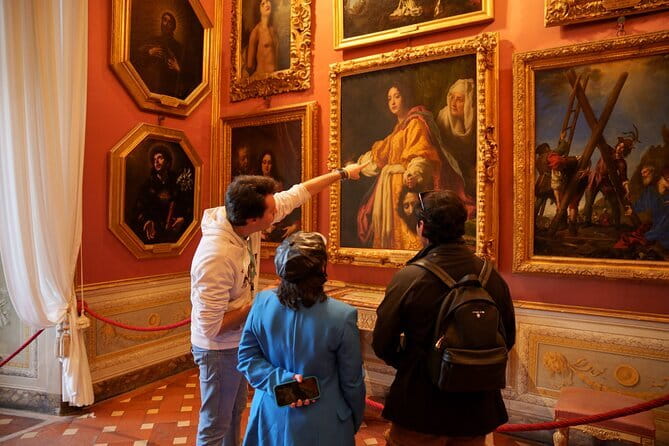
The visit is designed to cover every section of the palazzo, including the map room, terraces, and Arnolfo’s Tower. These spaces add variety after the main halls and painted rooms.
The map room offers a change of focus. Instead of looking only at portraits, sculpture, or decorative programs, you get a sense of how people in the palazzo pictured the wider world. Maps in a seat of government are never just decoration. They reflect curiosity, ambition, knowledge, and the limits of the period’s understanding.
The terraces provide a break from the enclosed rooms and add a different view of Florence. Arnolfo’s Tower rises above the city and gives the building its unmistakable profile. The tour information includes the tower among the areas visited, but the exact amount of time spent there may depend on the day’s schedule and the pace of the group.
That point matters because the whole visit is short. If ticket collection, questions, or crowd movement eat into the schedule, the later sections may receive less attention. Ask your guide at the beginning how the time will be divided if the tower or terraces is a priority for you.
What a group of nine really changes
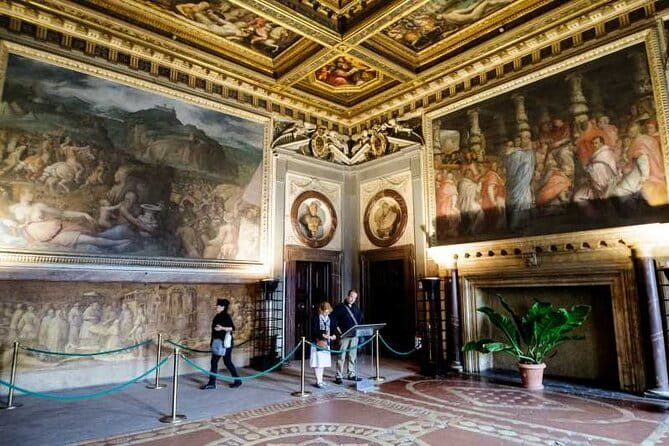
A maximum of nine people is one of the strongest features here. In a crowded museum, a small group lets you stand closer to the guide, hear explanations more clearly, and ask questions without stopping a large procession.
The personal element comes through in the strongest guide experiences. Laura has been praised for her command of Medici art and for connecting with younger visitors. Leonardo has been described as gracious, engaging, and able to handle a wide range of questions. Annette is especially appreciated for taking extra time with questions, while Eleonora has a talent for bringing the Medici period to life.
Daniela Carboni has also received warm praise for her explanations and her ability to lead a tour in German. The advertised language for this experience is English, so you should not assume another language is available on your date. Still, the range of guide styles suggests that the quality can depend partly on who leads your group.
There is an important contradiction in the supplied information. The tour is described as a small group of no more than nine, yet one account describes a group of roughly 35 people. I would treat the nine-person limit as the intended format, but confirm the arrangement if a small group is essential to your plans.
Is $145.75 a fair price?
At $145.75 per person, this is not a budget museum visit. You are paying for admission, a local guide, and a small-group format rather than simply entering Palazzo Vecchio on your own.
The price can make sense if you want the building explained in a clear sequence. The political shift from medieval town hall to Medici residence is easier to grasp with a guide, and the small group gives you room to ask about the artworks, symbols, and architecture.
The value weakens if the tour lasts only about an hour. The published length is approximately 90 minutes, while the detailed schedule gives the palazzo around 75 minutes. One delayed group received roughly an hour of guided time and felt that the cost did not match the shortened visit.
That is the key buying decision. If you care most about personal attention and interpretation, the price may be justified. If you mainly want time inside the building, compare the cost with other Palazzo Vecchio entry options before booking.
Group discounts are listed, but the available details do not state the discount amount or the required group size. Check the current terms if you are booking for several people.
Who will get the most from this visit?
I would recommend this tour to a first-time Florence visitor who wants the city’s politics and art explained together. It is also a good fit for families, since several guides have done well with children and teenagers.
History and art students should find plenty to discuss, especially in the Salone dei Cinquecento, the Medici rooms, and the map room. Fans of Inferno will enjoy spotting the Cerca e Trova inscription, though I would not book the tour for that detail alone.
The visit is less suitable if you dislike fixed group schedules or want to linger over individual paintings. The limited duration means you may need to accept the guide’s pace. It is also not the best choice for anyone expecting a two-hour exploration of every room.
Most people can participate, and the meeting point is near public transportation. The activity ends back at the meeting point, so you are left in central Florence rather than sent across the city.
Booking, cancellation, and timing advice
Confirmation is provided when you book, and mobile tickets are accepted. The tour is offered in English, begins at 11:30 a.m., and is often reserved well ahead of time, with an average booking lead time of 56 days.
Free cancellation is available up to 24 hours before the start time for a full refund. Cancellations or changes made less than 24 hours before the start are not accepted for a refund, and the cut-off follows local Florence time.
I would book early if you need a particular date, especially during a busy Florence visit. On the day itself, arrive ready to start and ask how long the guided portion will run. That simple question can help you set expectations before entering.
Should you book Palazzo Vecchio Morning Guided Tour?
Book it if you want a focused introduction to Florence’s political center, prefer a small group, and value a guide who can connect Renaissance art with Medici power. The Salone dei Cinquecento, the Cerca e Trova clue, the map room, terraces, and Arnolfo’s Tower give the visit plenty of variety.
Skip it if $145.75 feels high for a visit that may last only 60 to 90 minutes, or if you want to explore at your own speed. The experience earns its price through interpretation and personal attention, not through a long stay inside the building.
For most first-time visitors, I would choose it only after confirming the current group size and expected tour length. If those details line up, it is a useful way to understand why Palazzo Vecchio remains one of Florence’s most important buildings.
FAQ
Where does the tour begin?
It begins at Palazzo Vecchio in Piazza della Signoria, Florence, at P.za della Signoria, 50122 Firenze FI, Italy.
What time does the tour start?
The scheduled start time is 11:30 a.m.
How long does the tour last?
The tour is listed as approximately 1 hour and 30 minutes. The detailed timing gives about 1 hour and 15 minutes at Palazzo Vecchio, and one account describes a visit of about an hour after a delayed start.
What language is the tour offered in?
The tour is offered in English.
How many people can join the small group?
The stated maximum is nine people.
Is admission to Palazzo Vecchio included?
Yes. Admission to Palazzo Vecchio is included.
What parts of Palazzo Vecchio does the tour cover?
The tour includes the Salone dei Cinquecento, the map room, terraces, Arnolfo’s Tower, and other sections of the palazzo.
Does the tour include the Inferno symbols?
Yes. The tour highlights symbols and artworks associated with Dan Brown’s Inferno, including the Cerca e Trova inscription above a Vasari fresco.
Does the tour end at Palazzo Vecchio?
Yes. The activity ends back at the meeting point.
Can I cancel for a full refund?
Yes, if you cancel at least 24 hours before the experience start time. Cancellations or changes made less than 24 hours before the start are not accepted for a refund.
Just added around Florence
- the Medici family in Florence: Palazzo Medici and Medici Chapels★ 4.5 · 10 reviews
- Uffizi and Palazzo Vecchio Combo Private Tour★ 5.0 · 3 reviews
- The Pitti Palace private tour: Splendours of the Royal Residence★ 5.0 · 4 reviews
- FLORENCE: Uffizi Gallery + Palazzo Vecchio monolingual Guided Tour – Small Group★ 5.0 · 9 reviews
- Small-Group Palazzo Vecchio Secret Passages Tour with Lunch Or “Gelato”★ 4.0 · 92 reviews
- Pitti Palace, Palatina Gallery and the Medici: Arts and Power in Florence.★ 4.5 · 223 reviews
- Palazzo Vecchio Tales – into Medici’s secrets and mythology simbols★ 5.0 · 18 reviews
- The Medicis: The Movie, The Family, The Palace!★ 5.0 · 9 reviews
Palazzo Vecchio and Pitti Palace Tours, compared.
Uffizi, Pitti Palace & Boboli Combined 5-Day Pass
Read our review →
Palazzo Vecchio: Skip-the-Line Entry and Secret Passage Tour
Read our review →
Browse the lists this tour appears in