
REVIEW · SPLIT
Chill Walking Tour of Diocletian’s Palace
Split is a Roman palace with a city inside it. That is what makes Mili’s Chill Walking Tour of Diocletian’s Palace appealing: you are not just looking at ancient walls from behind a rope. You move through streets, squares, churches, alleyways, and working parts of Split while learning how the palace changed over 17 centuries. I especially like the use of 3D reconstructions, which help you picture the original Roman complex, and the relaxed pace, which leaves room for questions.
Mili, a lifelong resident of Split, brings local knowledge and light humor to the walk. The main drawback is that paid museums and interiors are not included, so you may want to budget extra if you wish to enter the cathedral, palace substructures museum, or other ticketed sites. Still, at $19.26 per person, the tour offers a strong introduction to Split at a modest price.
Key points to know before booking
- Nine stops connect the Roman palace with modern Split, from the Peristyle and substructures to Fruit’s Square and the Golden Gate.
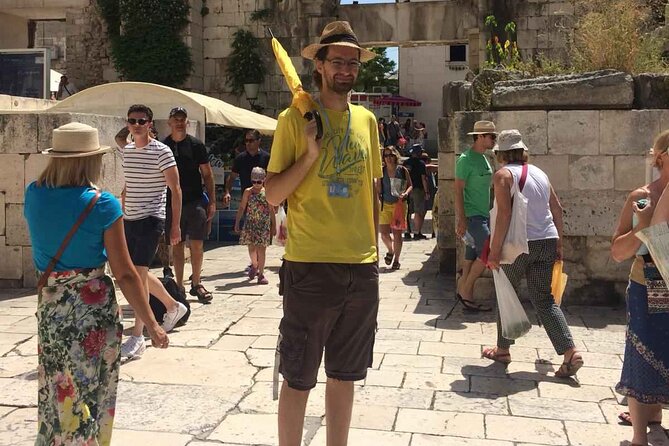
- Mili leads the walk personally, using clear explanations, humor, questions, and images of the palace as it may have looked 17 centuries ago.
- The tour begins at the Eastern, or Silver, Gate and ends at the Golden Gate by the statue of Grgur Ninski.
- No admission tickets are included, but the tour still covers many exterior and free-access areas.
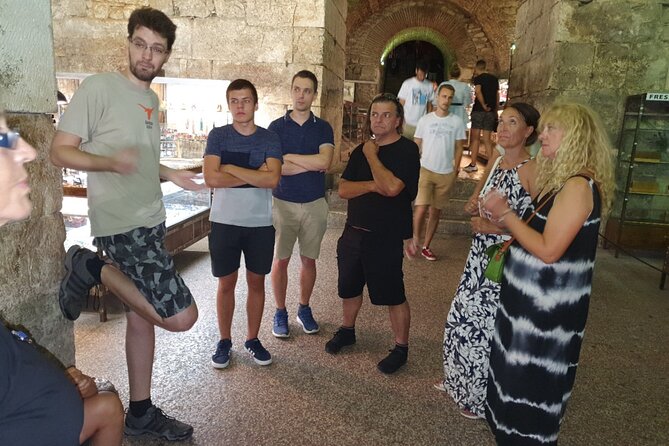
- The group can include up to 20 people, small enough for a personal feel while still being a group tour.
- Free cancellation is available up to 24 hours before the start time, and poor weather can lead to a new date or full refund.
Why Diocletian’s Palace needs a walking tour
Diocletian’s Palace can be confusing at first. It is not a single preserved building with one entrance and a clear route. It is a Roman complex woven into the center of Split, with homes, shops, churches, lanes, and squares occupying spaces that once served an emperor.
That mixture is the real attraction. You might be looking at a Roman column one moment, then walking along a medieval alley or standing outside a church built into an older structure. Without context, the palace can seem like a collection of disconnected ruins. Mili’s route gives those pieces a common story.
The tour focuses on Emperor Diocletian, the palace’s original plan, its defenses, and the way later generations reused its buildings. That last point matters. You are not only learning what the palace was. You are also seeing how people kept adapting it instead of simply preserving it as a dead monument.
Mili’s local connection should add useful detail. He has lived in Split all his life, and the tour is designed as an informal conversation rather than a formal lecture. I would choose this style if you enjoy asking questions, prefer plain explanations, and want an introduction that does not feel rushed.
More Palace Walking Tours in Croatia
- Split: Old Town and Diocletian Palace Walking Tour
★ 4.9 · 4,727 reviews - Walking Tour of Split and Diocletian’s Palace
★ 5.0 · 2,588 reviews - Split & Diocletian’s Palace Walking Tour
★ 5.0 · 1,125 reviews
Starting at the Peristyle, the palace’s grand center
The meeting point is by the Eastern, or Silver, Gate, at Poljana kraljice Jelene 5. From there, the walk reaches the Peristyle, the ceremonial heart of Diocletian’s Palace.
The Peristyle is where the Roman story begins. Here, Mili explains who Diocletian was and why he built such a large palace on the coast. The stop lasts about 20 minutes, making it the longest single opening lesson on the route.
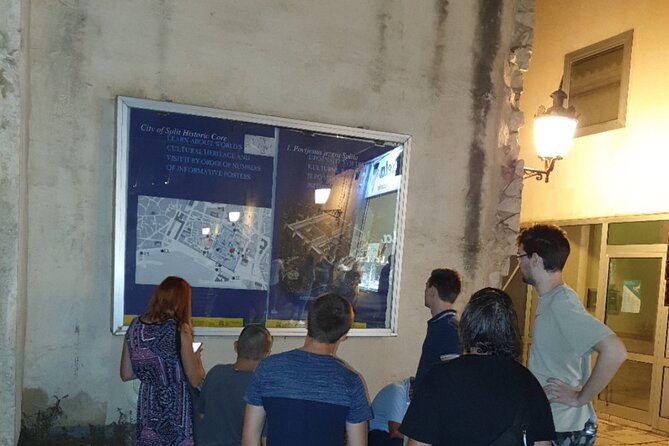
This is a good place for visual comparisons. The palace is not presented only as old stone. Mili uses images and 3D reconstructions to show how the setting may have looked 17 centuries ago. That can make a major difference when you are facing fragments, altered walls, and buildings that have changed purpose.
You should expect other people to be moving through this central area because it is part of Split’s city center. The tour’s small-group limit of 20 helps, but this is still an active public space rather than a quiet museum room.
The substructures reveal the palace beneath your feet
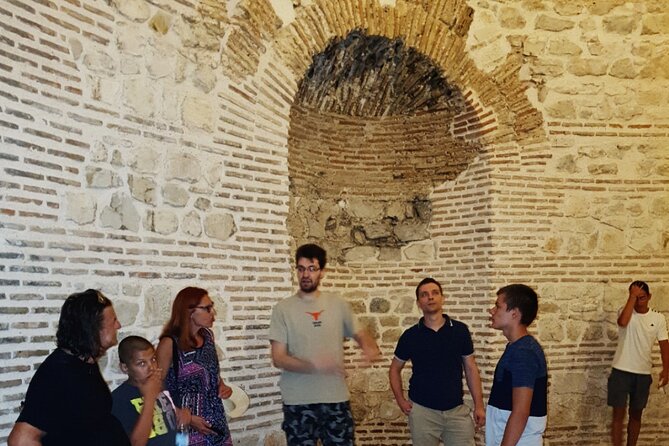
The next stop is the free section of Diocletian’s Palace substructures. The visit takes about 10 minutes and explains the architecture below the upper level of the palace.
The substructures are valuable because they help you understand the plan of the building. Ancient builders often repeated the arrangement of rooms and corridors between levels, so the lower spaces can offer clues about what once stood above them.
Only the free part is included. If you want to see the museum portion, you must buy a separate ticket. This is worth keeping in mind if you are trying to stick closely to the $19.26 tour price.
I like this part of the route because it connects the palace’s visible remains with its hidden support system. It also gives you a clearer sense that Diocletian’s complex was planned as a large residence and fortified compound, not simply a collection of grand entrances.
Saint Domnius shows how Roman buildings changed purpose
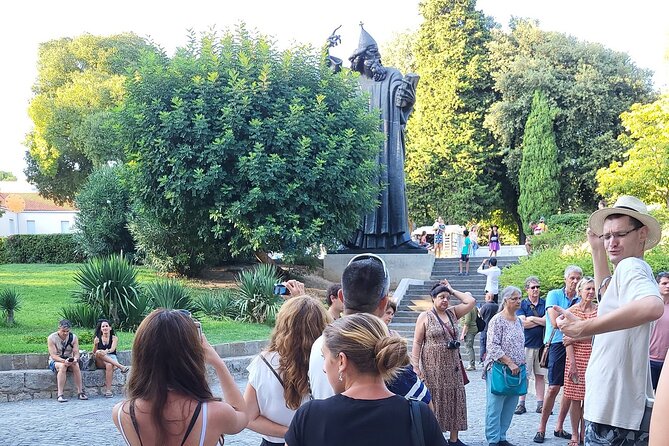
The Cathedral of Saint Domnius is another important stop. It began as part of Diocletian’s Palace and is described as one of the best-preserved Roman structures connected with the complex.
The tour spends about 10 minutes explaining the cathedral’s place in the palace story. The main walk does not include paid entry, but if you already have a cathedral ticket, you can go inside as part of the visit.
That arrangement gives you flexibility. You can take the basic tour without paying for extra sites, then decide on the day if you want more. If seeing interiors is a priority, check the ticket situation before booking so you understand that admission is separate.
Saint Domnius helps explain one of the palace’s most interesting changes. A building created for an emperor was later given a religious role. The structure survived in part because it continued to matter to the city, even as its purpose changed.
More Palace Walking Tours in Split
- Split: Diocletian Palace & Old Town Guided Walking Tour
★ 4.7 · 882 reviews - Diocletian’s Palace and Old Town SMALL GROUP Walking Tour
★ 5.0 · 502 reviews - SPLIT-PRIVATE Walking Tour of Diocletian’s Palace & Old Town
★ 5.0 · 467 reviews - 90-min Diocletian Palace Walking Tour
★ 5.0 · 323 reviews
The Temple of Jupiter and the palace’s religious past
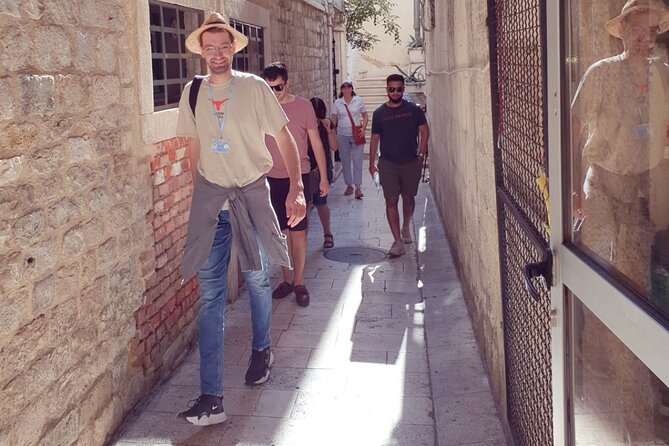
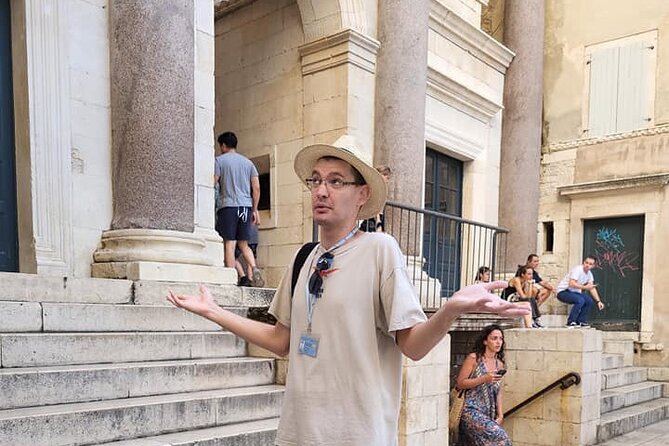
The Temple of Jupiter is a short but important stop. It was dedicated to Jupiter, the chief Roman deity, and has also been repurposed by the church.
As with the cathedral, Mili explains the site from outside during the standard tour. If you have a ticket for the interior, you may be able to go inside. The scheduled discussion lasts about 10 minutes.
This stop works well beside Saint Domnius because the two sites show different forms of reuse. The palace was not frozen in its imperial period. Later residents and religious institutions adapted its structures, helping preserve parts that might otherwise have disappeared.
The temple is also a reminder that the palace was a complete Roman environment. It included ceremonial, residential, defensive, and religious spaces. The tour’s value comes from showing how those functions fit together.
Triklinij offers a partial reconstruction
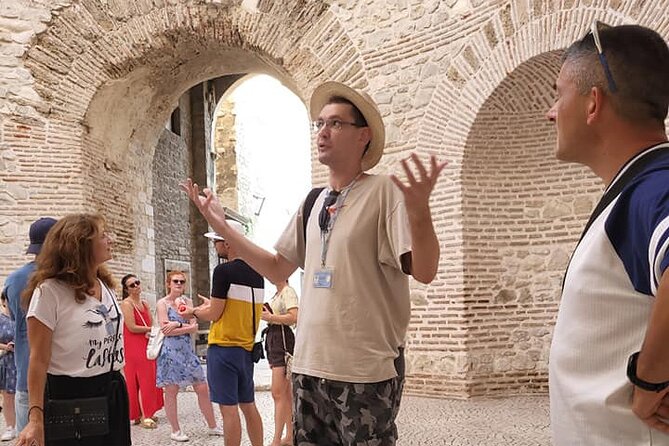
At Triklinij, in the southeastern corner of the palace, much of the original area has been destroyed. Yet the construction method allowed for an accurate partial reconstruction, giving you an impression of how Diocletian may have experienced the space.
This stop lasts about 15 minutes. It is a useful counterpoint to the better-preserved monuments because it shows that understanding ancient Split does not depend only on perfect ruins.
I would pay attention here if you enjoy seeing how historians and archaeologists work with incomplete evidence. The site cannot give you the full original building, but the partial reconstruction helps turn an absent structure into something you can picture.
Mili’s visual material should be especially helpful at this point. Roman ruins often require imagination, and an image of the original form can explain more in a few minutes than a long list of dates.
Papalićeva Street brings the palace down to street level
Papalićeva ulica is an alleyway in the northern half of the palace. The tour spends about 15 minutes here, using the passage to share smaller facts about the palace and its later development.
This is where the walking format becomes especially useful. You are not moving from one isolated monument to another. You are walking through the ordinary urban fabric that grew inside and around the imperial complex.
An alleyway may seem less grand than the Peristyle or Golden Gate, but it helps you see the palace as part of daily life. The ancient structure is not just a backdrop for photographs. It shapes the route people take through the city.
This stop may suit you if you prefer local atmosphere to a string of major monuments. It also provides a change of pace after the more formal explanations at the cathedral and temple.
Fruit’s Square connects the palace with Croatian history
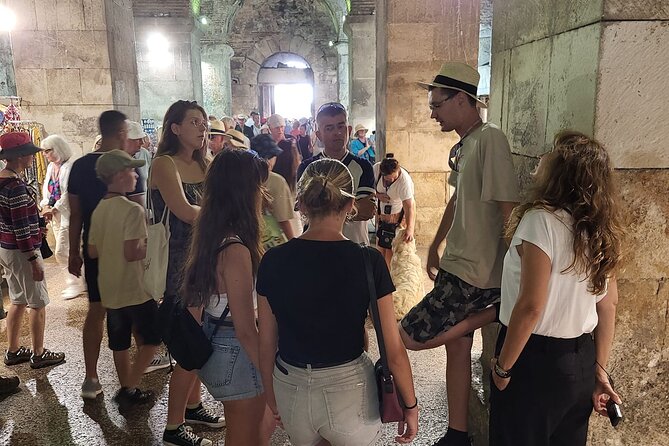
Fruit’s Square, or Trg Brace Radic, lies outside the palace. Here, the tour turns toward an important period of Croatian history and shows how the old palace was incorporated into newer buildings.
The stop takes about 15 minutes. Its main value is perspective. Diocletian’s Palace is not an isolated Roman island. Its walls and spaces helped shape the wider city, and later buildings grew against, around, and sometimes into the older structure.
This is also a useful point for understanding Split’s layers. The palace began as an imperial project, but it became part of a living city. The square lets you look beyond Roman times and see how the area continued to change.
I would not expect a long stop inside a museum here. The tour is designed to explain the setting while walking through it, so the emphasis remains on connections between old and new.
The Golden Gate explains the palace defenses
Near the end of the tour, you reach the Golden Gate, the northern entrance to Diocletian’s Palace. The stop lasts about 10 minutes and focuses on the palace’s fortifications.
The gate is a fitting final monument because it makes the palace’s defensive purpose easy to read. Mili explains how the fortifications changed from their original construction to the present day, helping you separate the Roman design from later alterations.
The tour ends outside this gate at Dioklecijanova 7. That is practical if you want to continue exploring northern Split after the walk. It also means you do not return to the original meeting point, so plan your next activity from the Golden Gate rather than the Silver Gate.
Grgur Ninski closes the walk with a Croatian landmark
The final stop is by the bronze statue of Grgur Ninski, just outside the northern gate. The statue represents an important Croatian bishop and provides a final link between the Roman construction and later Croatian identity.
Mili uses this 15-minute stop to bring the palace story together. You have seen the emperor’s ceremonial center, the lower structures, religious buildings, a reconstructed section, later streets, a city square, and the fortifications. The statue gives the ending a broader national and local setting.
This is a useful final location because it is outside the palace itself. You finish by looking back at the Roman complex as part of Split, rather than as a sealed archaeological site.
What the $19.26 price delivers
At $19.26 per person, the tour is priced as an affordable guided introduction rather than an all-inclusive palace experience. Your payment covers Mili’s time, explanations, route planning, and visual comparisons. It does not cover museum or monument admission.
That distinction matters. If you want a guide to orient you before exploring alone, the price is appealing. You get about 90 minutes to two hours of context across nine locations, including several free-access areas.
If you plan to enter every paid site, your total cost will be higher. The tour can still be useful because Mili explains what you are seeing before you decide where to spend extra money. You are not forced to buy an entry ticket at every stop.
The maximum group size is 20. That is not a private tour, but it is limited enough that questions should fit naturally into the walk. Mili’s light humor and relaxed delivery are likely to appeal if you find formal lectures tiring.
Timing, pace, and practical planning
The route is described as lasting about one hour and 30 minutes to two hours. The listed stops add up to roughly two hours, so allow the fuller amount when planning another activity.
The pace is meant to be pleasant rather than hurried. That suits the palace, where narrow lanes and layered buildings reward a slower look. You should wear comfortable shoes and leave room in your schedule for pauses, questions, and possible crowd movement, though the supplied information does not specify walking distance or terrain.
The tour requires good weather. If poor weather causes cancellation, you are offered another date or a full refund. You can cancel for a full refund up to 24 hours before the start time, but cancellations or changes inside that window are not refunded or accepted.
Confirmation is provided at booking. The tour is near public transportation, service animals are allowed, and most people can participate. These details make it a practical choice for many city visitors, though no specific accessibility route is promised.
Who should choose Mili’s relaxed palace walk?
I would choose this tour if you want the basic story of Diocletian’s Palace without committing to a long, formal sightseeing program. It fits first-time visitors who want to understand Split’s center before exploring on their own.
It also suits you if you like asking questions. Mili invites questions and can add further detail when something catches your interest. His lifelong connection to Split is a useful advantage when you want the city explained as a living place, not just an ancient monument.
Families and mixed-age groups may appreciate the humor and short stops. History fans who want extensive archaeological detail or long interior visits may find the tour too limited, especially since paid sites are not included.
The route is also a good fit for budget-conscious visitors. You can learn the layout, decide which extra sites matter to you, and avoid paying for a broad package of admissions you may not use.
Should you book the Chill Walking Tour?
Book it if you want a friendly orientation to Split’s Roman core, clear explanations, visual reconstructions, and a walk that connects ancient ruins with modern streets. The strongest reasons are Mili’s local perspective, the calm pace, and the way the route covers both famous monuments and less obvious corners such as Papalićeva ulica and Triklinij.
Skip it if your main goal is a detailed tour of every interior or a private guide with a custom schedule. You will need separate tickets for paid areas, and the group can reach 20 people.
For $19.26, this is a sensible first look at Diocletian’s Palace. It gives you the framework you need, then leaves you free to return to the places that deserve more time.
FAQ
Where does the tour begin?
The tour begins at the Eastern, or Silver, Gate, at Poljana kraljice Jelene 5 in Split.
Where does the tour end?
It ends outside the Golden Gate at Dioklecijanova 7, by the bronze statue of Grgur Ninski.
How long does the tour last?
The experience lasts approximately one hour and 30 minutes to two hours.
Are admission tickets included?
No. Admission tickets are not included, and the tour does not enter museums or paid sites as part of the standard experience.
Can I visit the cathedral or other paid areas during the tour?
If you already have a ticket for the Cathedral of Saint Domnius, the substructures museum, or another paid site mentioned during the walk, you may be able to enter it during the relevant stop. Those tickets must be purchased separately.
What is included in the experience?
The tour includes an experienced guide and comparisons of selected locations with 3D reconstructions showing how the palace may have looked 17 centuries ago.
How many people can join the tour?
The maximum group size is 20 people.
Can I cancel for a full refund?
Yes. You can cancel at least 24 hours before the experience start time for a full refund. Cancellations or changes made less than 24 hours before the start are not refunded, and poor-weather cancellations offer a different date or a full refund.
More Diocletian's Palace Tours in Split
- Split Old Town and Diocletian’s Palace Tour
★ 4.8 · 716 reviews - Split: Game of Thrones Tour with Diocletian’s Palace Cellar
★ 4.8 · 545 reviews - Split: Diocletian’s Palace Virtual Reality Experience
★ 4.4 · 308 reviews - Split: 1.5-Hour Walking Tour and Diocletian’s Palace
★ 4.7 · 256 reviews
Just added around Split
- Walking tour of Diocletian’s Palace in Split★ 5.0 · 60 reviews
- Wine Tasting in the Diocletian’s Palace★ 4.5 · 12 reviews
- Split & Diocletian Palace Historical Walking Tour★ 5.0 · 29 reviews
- Split: Diocletian’s Palace Walking and Wine Tasting Tour★ 4.5 · 56 reviews
- SPLIT-History Tour of Diocletian’s Palace & Old Town with Daniela★ 5.0 · 76 reviews
- Diocletian Palace in Split and Trogir Private Heritage Tour★ 5.0 · 12 reviews
- Private Split: Visit Diocletian Palace & Taste Food at the Market★ 5.0 · 33 reviews
- Wonderful Split – Diocletian’s Palace Private Walking Tour★ 5.0 · 20 reviews
Diocletian's Palace Tours, compared.

Walking Tour of Split and Diocletian’s Palace
Read our review →

Diocletian Palace & Old Town Guided Walking Tour
Read our review →

Game of Thrones Tour with Diocletian’s Palace Cellar
Read our review →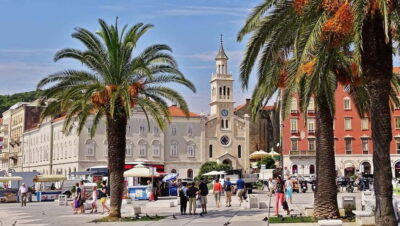
Diocletian’s Palace and Old Town SMALL GROUP Walking Tour
Read our review →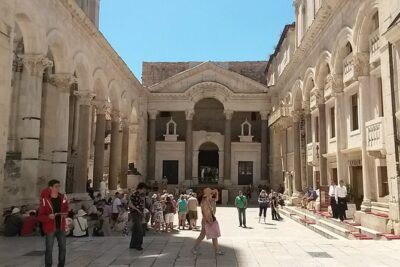
Browse the lists this tour appears in