
REVIEW · FLORENCE
Guided tour of Palazzo Pitti: Botticelli, Caravaggio, and Raphael compared
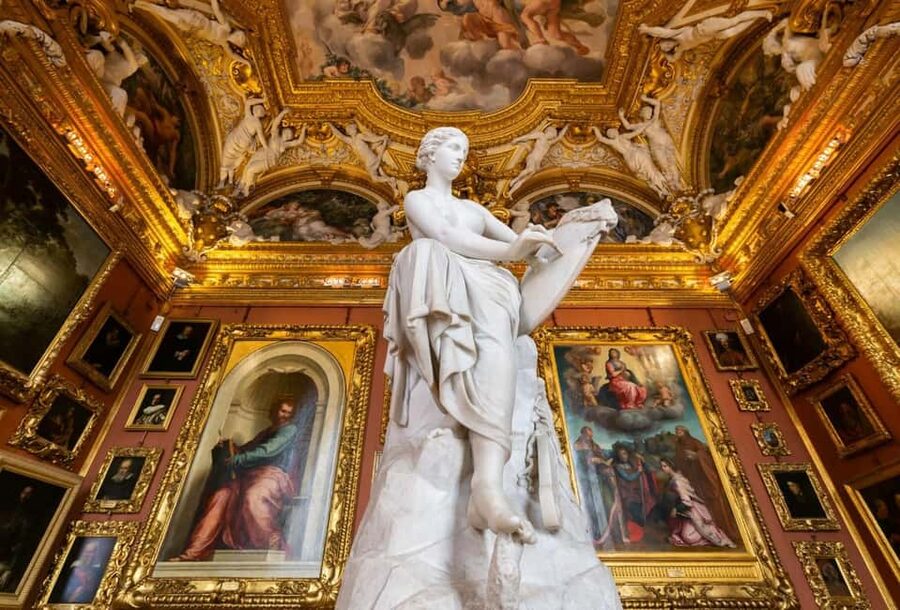
Art gets better when the stories connect. This 90-minute visit to Florence’s Palatine Gallery brings Botticelli, Raphael, Caravaggio, Titian, Rubens, and Van Dyck into one focused tour. I like the licensed guide, who turns a crowded collection into a clear story, and I like the chance to see the Medici palace, Boboli Gardens, and Oltrarno in one compact visit. The main limitation is that the tour is conducted in Italian, so it is best for Italian speakers or anyone comfortable following art commentary in that language.
At $28 per person, the price is reasonable if you want more than a walk through grand rooms. Admission to the museum is free on the first Sunday of the month, so the fee here pays for the guided visit rather than the entry ticket. The visit is family-friendly, wheelchair accessible, and supported by audio equipment that makes it easier to follow the guide.
Key points to know before you go
- The tour lasts 90 minutes: That is enough time for a guided overview of the Palatine Gallery without taking up your entire Florence day.
- The main focus is comparison: You will see how Botticelli’s sweetness, Raphael’s grace, and Caravaggio’s drama differ when placed in the same palace.
- A licensed guide leads the visit: The company has more than 10 years of experience organizing guided visits in Italy.
- The language is Italian: Some material is presented in its original language, so check that the format suits you before booking.
- The palace gives you more than paintings: You will also hear about the Pitti and Medici families and look toward Boboli Gardens and the Oltrarno.
- The first Sunday changes the value equation: Museum entry is free that day, while this booking covers the 90-minute guided visit.
Arriving at Piazza de’ Pitti
The meeting point is directly in front of Palazzo Pitti, at Piazza de’ Pitti, 1. You should arrive 10 minutes early because the tour starts promptly. That small cushion matters in Florence, where a short walk can take longer than expected on crowded streets.
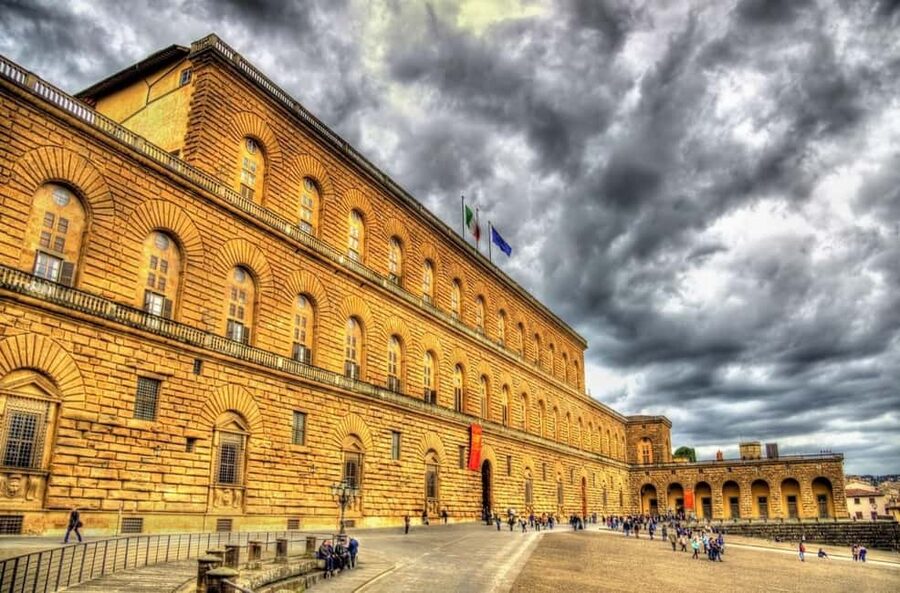
Piazza de’ Pitti gives you an immediate sense of the palace’s scale. You are not meeting beside a small museum door or a modern ticket office. The large stone facade fills the square, making the meeting point fairly easy to identify.
I suggest using the minutes before the start to look at the building rather than rushing straight inside. The palace began as a 15th-century residence for the Pitti family. The Medici later acquired and transformed it, with Bartolomeo Ammannati responsible for the elegant Mannerist courtyard.
That courtyard is an important opening chapter. It gives you a visual link between the building’s original residential purpose and the grand court life that followed. You will not just be entering a gallery. You will be entering a former power center.
More Palazzo Vecchio and Pitti Palace Tours in Florence:
- Florence: Palazzo Vecchio Entrance Ticket & Audioguide
★ 4.4 · 4,822 reviews - Florence: Uffizi, Pitti Palace & Boboli Combined 5-Day Pass
★ 4.5 · 1,726 reviews - Florence: Palazzo Vecchio Guided Tour
★ 4.8 · 1,260 reviews
The Mannerist courtyard and the palace story
A guided visit works especially well at Palazzo Pitti because the building can otherwise feel like a series of impressive rooms without a clear thread. Your guide helps explain how the Pitti family, Medici family, architecture, and court decoration fit together.
The courtyard is not the main art stop, but it prepares you for the rooms upstairs. Its design reflects the Mannerist taste for order, proportion, and elegant visual effect. Once you understand that this was a residence shaped by wealth and status, the decorated interiors make more sense.
The palace also tells a story about changing taste. Its rooms were not designed as a neutral museum setting. They were living spaces associated with rulers and elite families. Paintings, stucco, frescoes, furniture, and views all helped create an image of authority.
That context is one reason I would choose a guided visit over wandering alone. The guide can point out how the setting affects the art. A dramatic Caravaggio looks different in a former royal residence than it does on a white museum wall.
Entering the Palatine Gallery
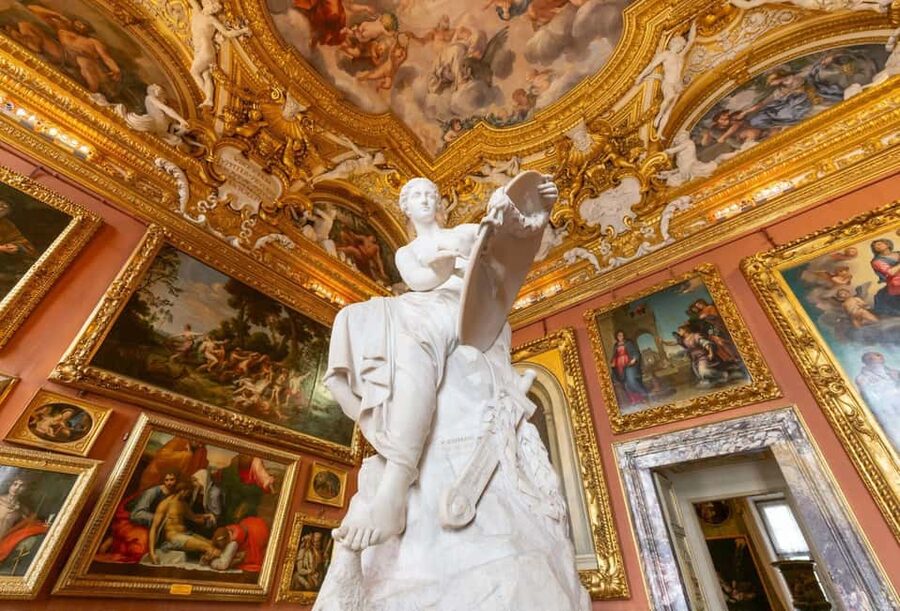
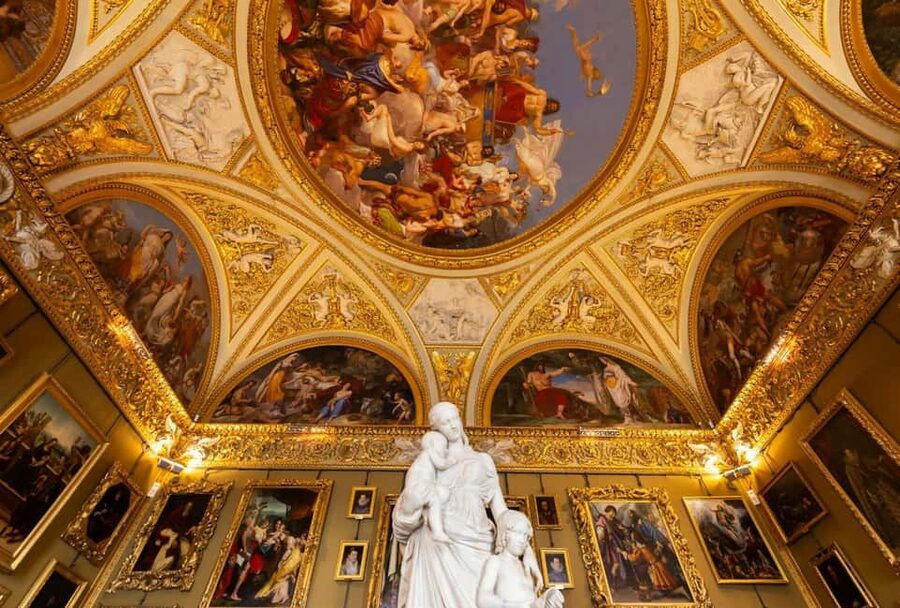
The central part of the tour takes place in the Palatine Gallery on the main floor. Here, paintings hang among stucco work and Baroque frescoes. The rooms themselves are part of the experience, and they can be as important as any single canvas.
Do not expect the calm, spare arrangement of a modern gallery. The Palatine Gallery has the feel of a palace collection, with art and decoration competing for your attention. That can be visually thrilling, but it also means you may need help finding the main works and understanding why they matter.
This is where the guide’s role becomes valuable. A good explanation gives you a route through the visual noise. Instead of trying to remember every name, you can focus on a handful of contrasts: softness and severity, movement and stillness, religious feeling and courtly display.
The tour promises a complete visit of the Palatine Gallery within 90 minutes. That length suits people who want a strong introduction rather than a full-day art study. If you already know the collection well, you may wish for more time at individual paintings. For a first visit, the short format keeps the experience manageable.
Botticelli and Filippo Lippi: gentle faces and careful detail
The early Renaissance works associated with Botticelli and Filippo Lippi bring a softer mood to the tour. Their paintings are known here for sweet faces and graceful figures, which create a clear contrast with the heavier drama found elsewhere in the palace.
Botticelli is often the name that draws people in, and understandably so. His figures can feel elegant and idealized, with a line that gives the faces and hair a refined quality. The value of seeing his work here is that you can compare that controlled beauty with artists who aim for stronger physical impact.
Filippo Lippi adds another layer to the discussion. His work helps show how Florentine painting developed through careful attention to faces, gesture, and devotional feeling. I would listen closely during this part of the tour if you are interested in how Renaissance artists made sacred subjects feel human and approachable.
These works also provide a useful starting point for families. Younger visitors may respond more easily to recognizable faces and stories before moving into the darker or more complex scenes later in the tour.
A few more palace visits around Florence worth a look
- Florence: Palazzo Vecchio Entry Ticket with Audio Guide
★ 4.4 · 837 reviews - Florence: Pitti Palace and Boboli Gardens Ticket & eBook
★ 4.5 · 835 reviews - Florence: Pitti Palace, Boboli Garden, Palatine Gallery Tour
★ 4.9 · 558 reviews - Florence: Palazzo Vecchio Skip-the-Line Entry Ticket
★ 4.2 · 349 reviews
Raphael: balance, grace, and polished beauty
Raphael gives the tour one of its clearest points of comparison. His reputation rests partly on balance and grace, and those qualities become easier to understand when you see his work near artists with very different aims.
Look for composure in the figures and a sense that every part of the image has been carefully controlled. Raphael’s paintings can appear effortless, but the effect comes from close attention to arrangement, expression, and proportion.
I like this section because it moves beyond simply naming a famous painter. You are encouraged to ask what makes a Raphael look like a Raphael. The guide can direct your attention to the calm structure and refined beauty rather than leaving you with only a famous name to remember.
If you are visiting Florence with someone who says they do not understand art, Raphael is a useful meeting point. The pictures can be approached through simple questions: Where does your eye go first? Why does the scene feel balanced? How do the figures relate to one another?
Caravaggio: drama that demands attention
Then comes the sharp change in mood. Caravaggio brings powerful contrast, intense emotion, and a more immediate physical presence to the gallery.
His approach can feel startling beside the elegance of Raphael or the delicacy associated with Botticelli. Light becomes an active force. Faces and bodies seem to emerge from darkness, and the scene can feel close enough to touch.
This is a good moment to pay attention to the guide’s storytelling. Caravaggio’s work is not just about dark backgrounds. It is about how light directs your eye and how ordinary human presence can make a religious or historical subject feel urgent.
The comparison is the real pleasure. If you see Caravaggio in isolation, you may admire the drama. If you see him after Raphael and Botticelli, you can better understand how deliberately different his visual language is.
You should not expect the tour to turn you into a specialist in 90 minutes. What it can do is give you a practical way to look. Afterward, you may find yourself noticing light, gesture, and emotional force in other paintings around Florence.
Titian, Rubens, and Van Dyck broaden the picture
The collection does not stop with Florentine artists. Titian adds the sensual richness of Venetian painting, while Rubens and Van Dyck bring the energy of northern European court art.
Titian is useful in this comparison because color and surface become central. His work can feel warmer and more physical than the paintings that rely mainly on line and precise drawing. The change helps you understand that the Italian Renaissance was not one fixed style.
Rubens brings movement and force. His figures often seem full of energy, and that liveliness fits the grand scale of a palace collection. Van Dyck offers another view of elegance, especially in the way aristocratic presence is presented.
These artists make the Palatine Gallery feel broader than a museum devoted only to Florence. You get a sense of how elite collectors assembled art across regions and periods. The tour connects local history with a larger European story without requiring you to visit several separate museums.
Looking beyond the paintings: Boboli Gardens and Oltrarno
One of the nicest details of the visit is easy to miss. Look out the windows.
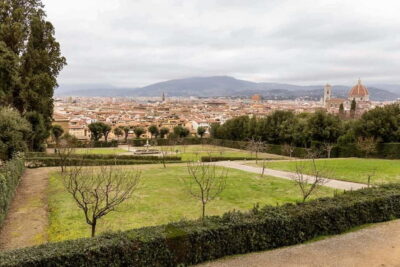
On one side, you see the green expanse of the Boboli Gardens. On the other, the roofs and workshops of the Oltrarno, Florence’s artisan district. The two views offer a useful contrast: formal palace grounds in one direction, the everyday working heart of the city in the other.
These views also remind you that Palazzo Pitti is not an isolated art container. It is tied to the city around it. The palace faced power and ceremony, while the Oltrarno retained a more local and practical character.
If you are planning a longer visit to the area, the tour gives you a good reason to connect the palace with Boboli Gardens and the surrounding neighborhood. The booking described here covers the guided visit, not a full day exploring every nearby sight, so plan extra time if you want to continue outside after the tour.
How the audio equipment affects the visit
A recent Italian-language visit received particular praise for the guide’s competence and for the audio equipment used during the explanation. That detail matters in a decorated palace, where sound can carry poorly and attention can be pulled in several directions.
The audio tools should make it easier to follow the guide without standing directly beside the speaker at every moment. That is helpful when the group is moving through large rooms or when other people are visiting at the same time.
The equipment does not change the language. The live guide is Italian, and some content is presented in its original language. If you understand Italian, this should make the tour easier to follow. If you do not, you should not assume that the audio system provides translation.
Guide Stefano has also been praised for his clear and capable presentation. Since guide assignments can vary, I would not book solely on the expectation that he will lead your time slot. Still, his name is worth noting if he is listed for your visit.
Is $28 a fair price?
At $28 per person, I see this as a fair price for a guided introduction to one of Florence’s major palace collections. The value comes from the explanation, the historical connections, and the help comparing several major artists in one sitting.
The first Sunday of the month is a special case. Museum admission is free that day, so you are paying for the guided service rather than entry. That can still be worthwhile if you want structure and interpretation, but you should understand what the fee covers.
On other days, the price may feel stronger because you are receiving a planned guided visit with a licensed professional. The tour lasts 90 minutes, which keeps the cost from taking over your day. You can still have lunch in the Oltrarno, visit nearby sights, or spend more time in the gardens.
I would not choose this tour if your main goal is to wander alone at your own speed. I would choose it if you want someone to explain why the paintings differ and how the palace’s owners shaped the collection.
Who should book this Palazzo Pitti visit?
This tour suits you if you want a clear first look at the Palatine Gallery without committing to several hours of art study. It is also a sensible choice for families because the guide combines stories, famous names, and visual contrasts rather than expecting everyone to already know Renaissance art.
Italian speakers will get the most from the live commentary. You may also find it useful if you are comfortable with Italian and prefer a guide-led visit to reading labels on your own.
Art students and repeat visitors may appreciate the comparisons, but 90 minutes may not satisfy anyone wanting a painting-by-painting study. The tour is an overview with meaningful detail, not a specialist seminar.
The wheelchair-accessible format is another practical benefit. You should still arrive early and confirm the exact start time when booking, since the group begins promptly.
Should you book it?
Book this visit if you want licensed guidance, strong artist comparisons, and a manageable 90-minute schedule. The best part is not simply seeing famous names. It is seeing Botticelli, Raphael, Caravaggio, Titian, Rubens, and Van Dyck in a setting where their differences become easier to spot.
Think carefully about the Italian-only format. If that works for you, $28 is a reasonable way to add shape and meaning to your Palazzo Pitti visit. If you prefer complete independence or need commentary in another language, visiting on your own may be the better choice.
FAQ
How long does the Palazzo Pitti guided tour last?
The guided visit lasts 90 minutes.
Where does the tour meet?
The meeting point is in front of the entrance to Palazzo Pitti, Piazza de’ Pitti, 1, 50125 Florence, Italy.
What language is the tour conducted in?
The live tour guide conducts the visit in Italian. Some content is shown in its original language.
Is museum admission included?
The booking covers the guided visit. On the first Sunday of the month, admission to the museum is free.
Is the tour wheelchair accessible?
Yes, the activity is listed as wheelchair accessible.
Can I cancel and receive a refund?
Yes. You can cancel up to 24 hours in advance for a full refund. You can also reserve now and pay later.
Just added around Florence
- Palazzo Vecchio Secret Passages Tour & Lunch or “Gelato”★ 4.3 · 16 reviews
- Palazzo Vecchio Small Group Tour★ 4.9 · 10 reviews
- Palazzo Vecchio: Private Guided Museum Tour & Tower Tickets★ 4.7 · 18 reviews
- Palazzo Vecchio 90-Minute Morning Guided Tour★ 4.7 · 104 reviews
- Florence: Palazzo Vecchio Museum★ 4.6 · 56 reviews
- Florence:Palazzo Vecchio Skip-the-line Ticket & Audio Guide★ 4.3 · 95 reviews
- Florence: Pitti Palace Guided Tour With Entry Tickets★ 4.4 · 3 reviews
- Florence: Pitti Palace Small Group Tour★ 4.5 · 39 reviews
Palazzo Vecchio and Pitti Palace Tours, compared.
Uffizi, Pitti Palace & Boboli Combined 5-Day Pass
Read our review →
Palazzo Vecchio: Skip-the-Line Entry and Secret Passage Tour
Read our review →
Browse the lists this tour appears in