
REVIEW · FLORENCE
Florence: Uffizi Gallery Tour with Palazzo Vecchio Entry
Florence reveals its power through art. This 1.5-hour small-group Uffizi tour connects Botticelli, Leonardo, and Michelangelo with the Medici family’s political home nearby. I like the limited group size of up to nine people, and I like the useful bonus: priority entry to Palazzo Vecchio after the gallery.
The main consideration is time. The guided portion covers only the Uffizi, while Palazzo Vecchio is self-guided. You should allow about four hours in all if you want to see both places without rushing. At $91 per person, the value depends on how much you want expert help in the gallery and how seriously you plan to explore the palace.
Key points to know before booking
- Small groups capped at nine: You get a better chance to hear the guide and ask questions than on a large museum walk.
- The Uffizi receives the guided attention: The 1.5-hour tour covers major works by Giotto, Botticelli, Leonardo, and Michelangelo.
- Palazzo Vecchio is self-guided: Your priority ticket gets you inside, but no guide accompanies you through the palace.
- Two Medici buildings, one story: The Uffizi was their working office, while Palazzo Vecchio was their seat of power.
- The meeting point is precise: Find the guide under the Leonardo da Vinci statue in the Uffizi courtyard, opposite Door 3.
- The terrace adds a welcome pause: Views include Palazzo Vecchio’s tower, the Duomo, and the Tuscan hills.
Why this Uffizi and Palazzo Vecchio pairing works
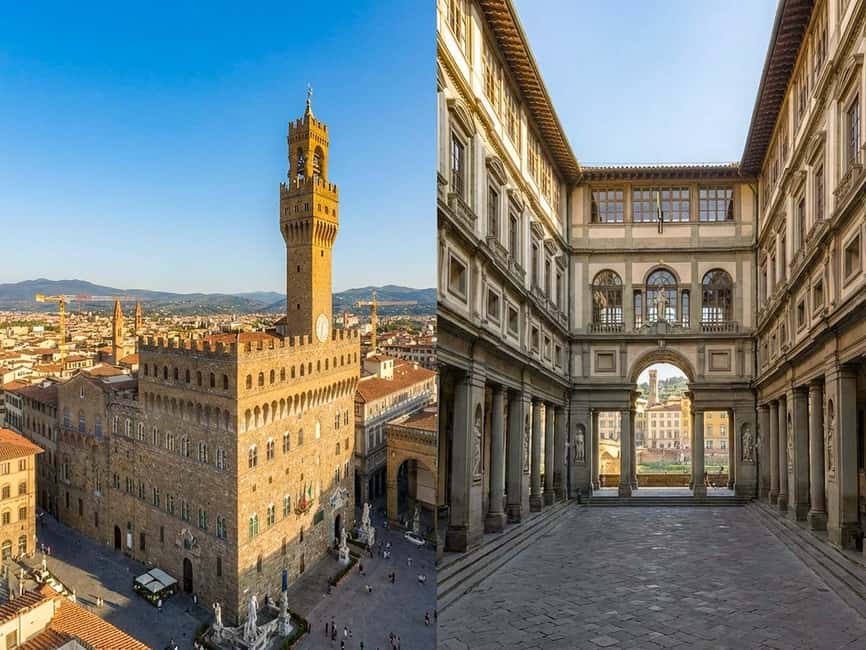
The clever part of this experience is the connection between the two buildings. In 1560, Duke Cosimo I de’ Medici asked Giorgio Vasari to help reshape Florence into a center of culture and power.
Vasari designed the Uffizi to house the Medici art administration and collection. He also worked on Palazzo Vecchio, the family’s political base. The two buildings were linked by the Vasari Corridor, a private passage that let the ruling family move between work, government, and home without walking through the streets.
You do not visit the Vasari Corridor on this experience. Still, knowing about that link gives the day a clear shape. At the Uffizi, you see the art the Medici collected and supported. At Palazzo Vecchio, you see the rooms and symbols that helped display their authority.
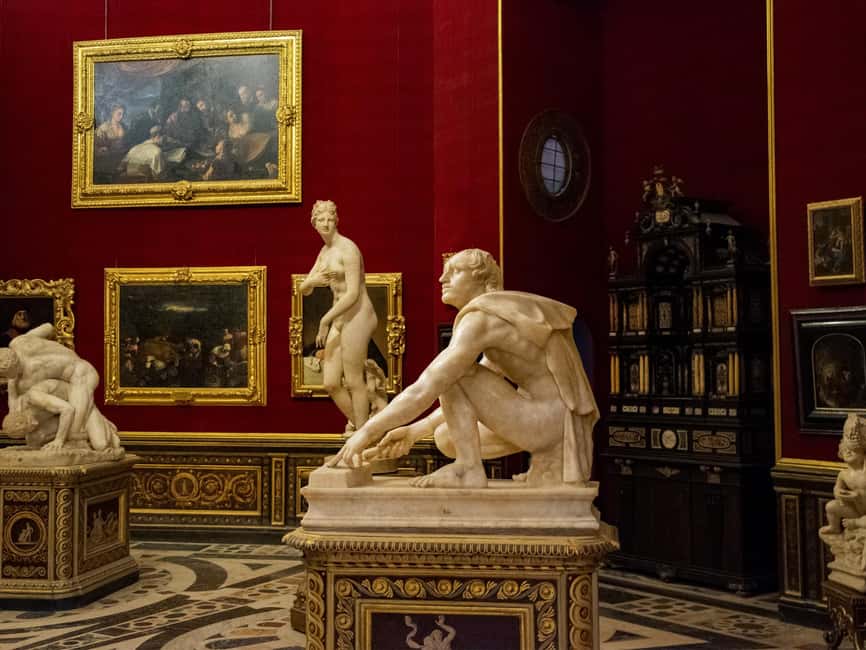
I like this pairing because it avoids treating the Uffizi as a collection of famous paintings with no wider story. You see how art, politics, banking, family ambition, and public image worked together in Renaissance Florence.
More Palazzo Vecchio and Pitti Palace Tours in Florence:
- Florence: Palazzo Vecchio Entrance Ticket & Audioguide
★ 4.4 · 4,822 reviews - Florence: Uffizi, Pitti Palace & Boboli Combined 5-Day Pass
★ 4.5 · 1,726 reviews - Florence: Palazzo Vecchio Guided Tour
★ 4.8 · 1,260 reviews
Meeting under Leonardo’s statue at Door 3
The meeting point is in the Uffizi courtyard at Piazzale degli Uffizi 1. Your host waits on the right side of the entrance, under the statue of Leonardo da Vinci, opposite Door 3.
Look for a representative carrying a Florence with Locals Tours flag. This is a useful landmark in a busy part of Florence, but give yourself enough time to find the courtyard. The Uffizi sits in a large open complex, and a few extra minutes can prevent a stressful start.
The tour includes headsets, which matter inside a crowded museum. You can listen to the guide without needing to stand shoulder to shoulder with the group. The group limit is nine participants, although one booking in January 2026 resulted in a private experience for Anna S, the guide, and one guest. That kind of situation cannot be promised, but a small group gives you better odds of personal attention.
The tour is conducted in English. It is wheelchair accessible, and the meeting point is central, so you do not need hotel transport or a separate vehicle.
The Uffizi begins with the birth of a new style
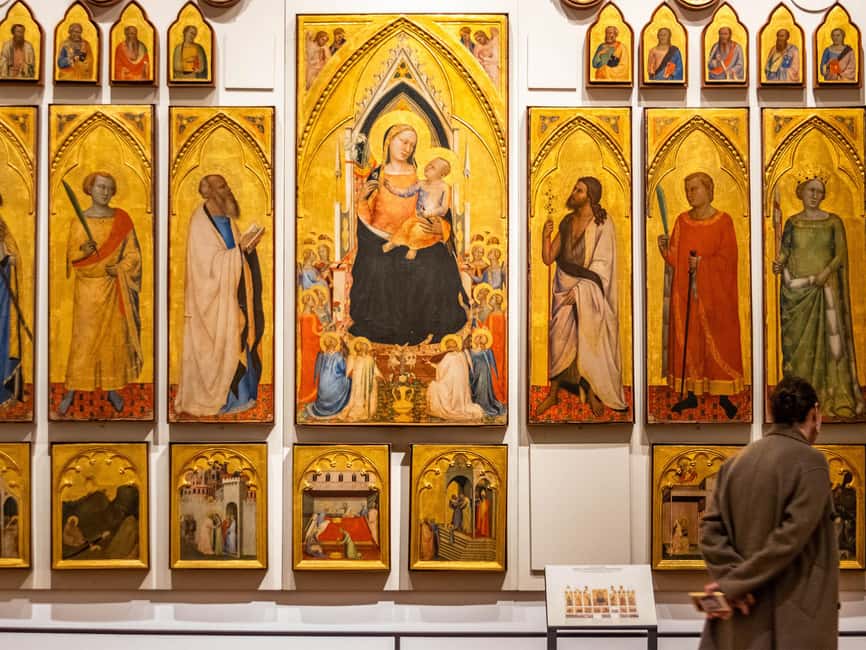
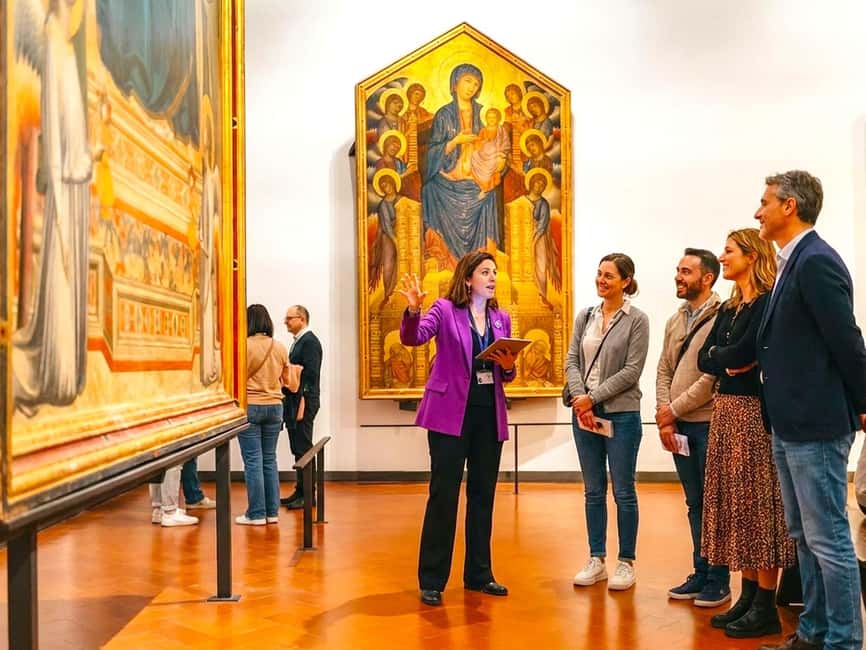
The guided route starts with the early development of Italian painting. You begin with Giotto, an artist who helped move painting away from the flat, formal Byzantine style.
From there, the guide introduces Early Renaissance figures such as Masaccio and Paolo Uccello. These rooms are important because they show the gradual change toward human figures, believable space, and stronger emotion. If you know only the headline artists, this early section helps you understand what made the later works so radical.
Piero della Francesca’s portraits bring another major shift. His careful use of perspective and controlled presentation helped change how artists represented people and space. The paintings may look quiet beside the famous Botticelli rooms, but I would not rush past them. They show the technical progress that made the later Renaissance possible.
A guide is particularly useful here. Museum labels can tell you dates and names, but a clear explanation can show how one artist’s method led toward another’s. In a short tour, that connection is more useful than trying to memorize every painting in the room.
Botticelli’s rooms contain the big moments
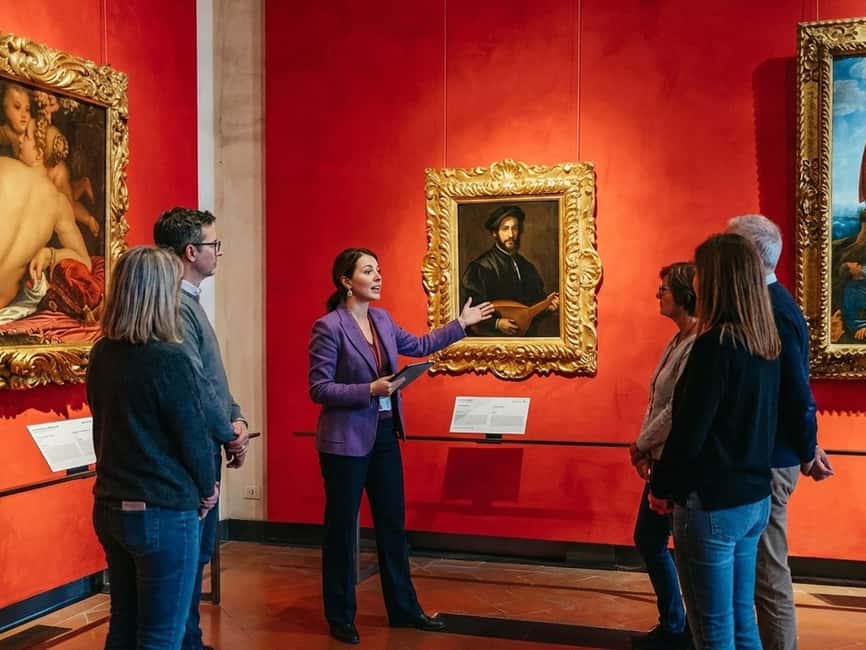
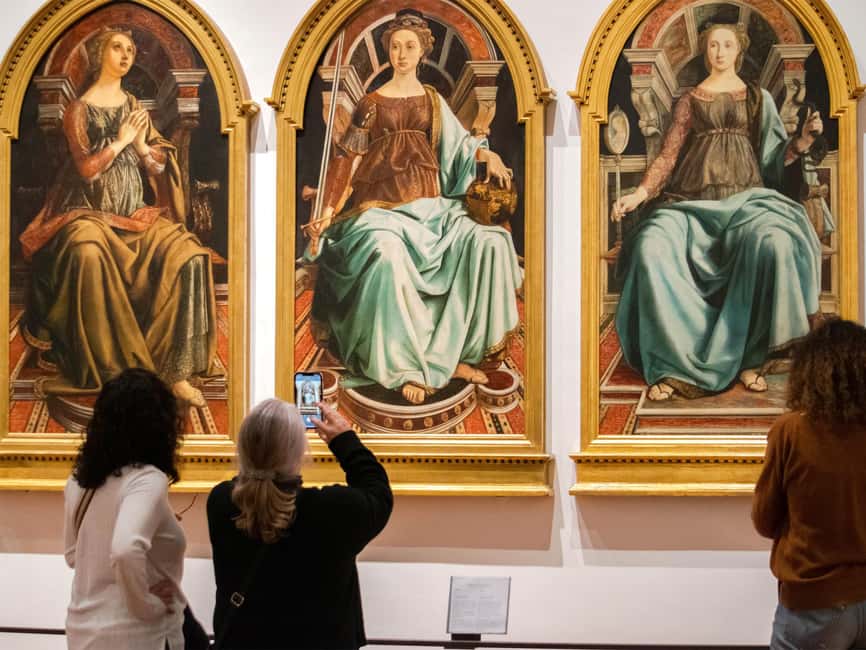
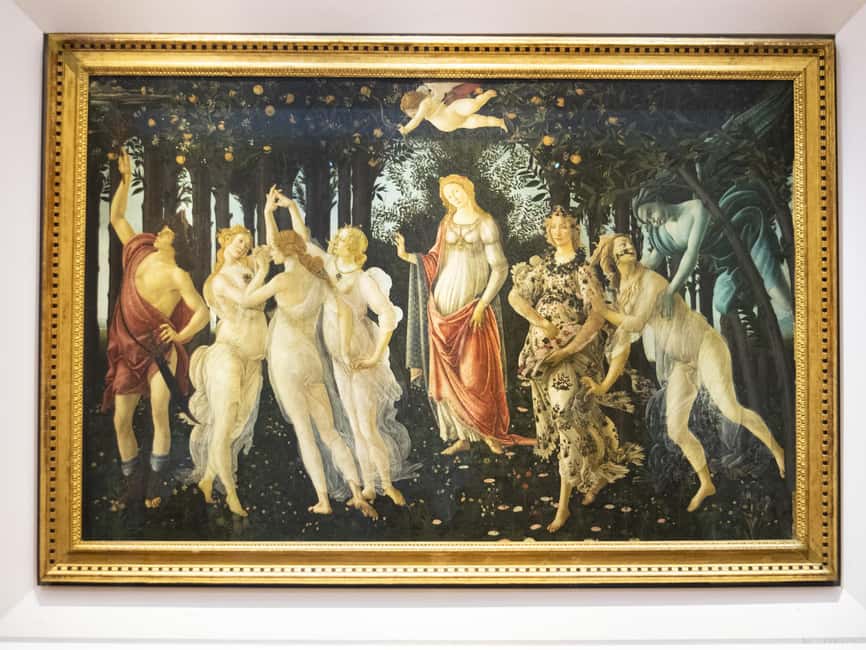
The emotional center of the visit is the Botticelli section. You see The Birth of Venus and Primavera, two of Florence’s most recognizable paintings.
These works reward a little context. The guide explains the Neoplatonic ideas and symbols often linked to the paintings, along with the story of how a banker’s commission connected to a family wedding became part of the history of Western art.
The Birth of Venus can be difficult to take in because so many people know the image before they see the original. In person, the scale, surface, and details give you more to consider than a reproduction can. Primavera also invites close looking, with its figures, flowers, gestures, and uncertain meanings.
The guide’s role here is not simply to point out the famous names. It is to help you look at the pictures with a question in mind. Why are the figures arranged this way? What ideas might the original patron have wanted to express? Which details are symbolic, and which remain open to interpretation?
You will not have unlimited time in each room. A 1.5-hour visit is enough for a guided introduction to the highlights, but not enough for a slow inspection of the entire Uffizi. If you already know you want to study lesser-known works, you should return independently.
More Museum Visits in Florence:
- Florence: Pitti Palace, Boboli Garden, Palatine Gallery Tour
★ 4.9 · 558 reviews - Pitti Palace, Boboli Garden & Palatina Gallery Guided Tour
★ 5.0 · 264 reviews - Florence: Pitti Palace and Palatina Gallery Ticket and Tour
★ 4.9 · 255 reviews - Florence: Palatina Gallery and Pitti Palace Guided Tour
★ 4.6 · 158 reviews
Leonardo and Michelangelo show two different directions
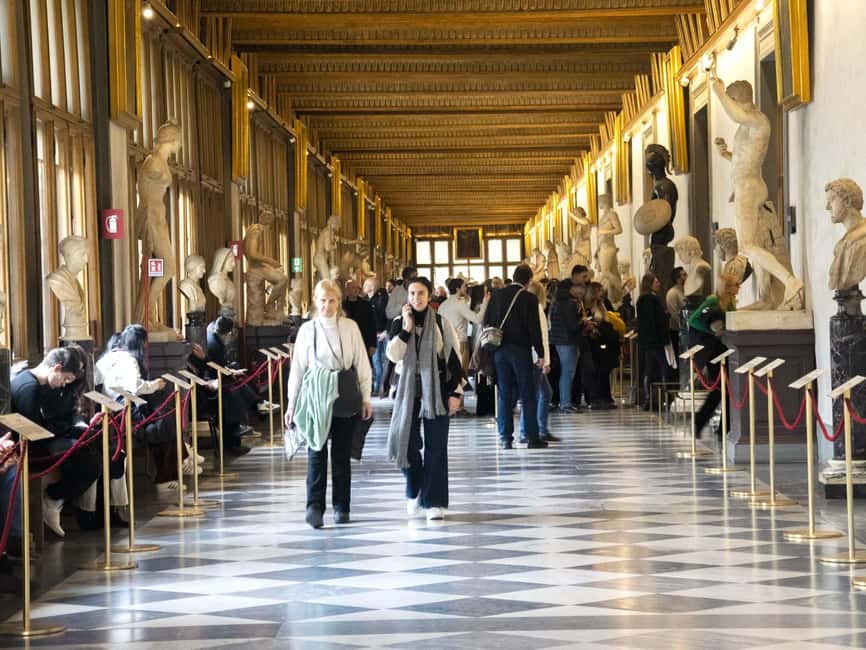
Leonardo da Vinci’s Annunciation is another major stop. It was painted when Leonardo was about 20, and the guide points out the optical effects built into the work.
This is a good example of why seeing the original matters. Leonardo was interested in how the eye reads distance, light, and form. His painting is not only a religious scene. It also shows an artist testing how perception works.
The route then reaches Michelangelo’s Tondo Doni, described as his only easel painting in Florence. Its intense color and twisting figures point toward the later Mannerist style.
The contrast between Leonardo and Michelangelo makes this part of the tour especially useful. Leonardo’s painting encourages you to study atmosphere and visual effects. Michelangelo’s work is more forceful, with bodies and colors that seem to push beyond the calm balance of the Early Renaissance.
I appreciate that the tour focuses on a manageable group of major works rather than trying to name everything in the museum. You get a story of change: from Giotto’s break with older conventions, through experiments with perspective, to the bold styles of Leonardo and Michelangelo.
The Uffizi terrace gives you a needed pause
The Uffizi terrace offers views across central Florence. You can see Palazzo Vecchio’s tower, the Duomo, and the Tuscan hills beyond.
This is more than a photo stop. A museum visit can become tiring, especially when you are standing in rooms filled with famous works and trying to absorb dates, names, and symbols. The terrace gives you a moment to reset before moving on.
It also helps you understand the relationship between the two parts of the experience. From the Uffizi, you can look toward the building you will visit next. The walk across Piazza della Signoria takes about two minutes, so the transition is simple.
Palazzo Vecchio is a bonus, but not a guided tour
After the Uffizi, your priority ticket lets you enter Palazzo Vecchio independently. The palace has dominated Piazza della Signoria since 1299 and served as Florence’s center of political power.
The main highlight is the Salone dei Cinquecento, or Hall of Five Hundred. Five hundred citizens once gathered there to govern the Florentine Republic. Later, Vasari transformed the enormous hall for Duke Cosimo I, covering it with large scenes celebrating Medici victories.
This is where you need to manage expectations. The ticket gives you priority entry, but there is no guide inside Palazzo Vecchio. You receive access, not a second guided tour. For some people, that freedom is ideal. You can move at your own pace, spend longer in the hall, and pause whenever you wish.
For others, the lack of guidance may feel like a gap. The palace contains political symbols, Medici references, and layers of decoration that can be easy to miss without explanation. I recommend reading a little about the building before arrival or using the available information inside to create your own route.
The palace also connects with a famous mystery. Vasari’s Battle of Marciano fresco includes the inscription Cerca Trova, meaning Seek and You Shall Find. The phrase has helped fuel the idea that Leonardo da Vinci’s lost Battle of Anghiari may be hidden behind or near the later decoration.
The experience does not include the Arnolfo Tower climb. If climbing the tower is important to you, you should treat that as a separate concern rather than expecting it to be part of standard entry.
Plan four hours, not just 90 minutes
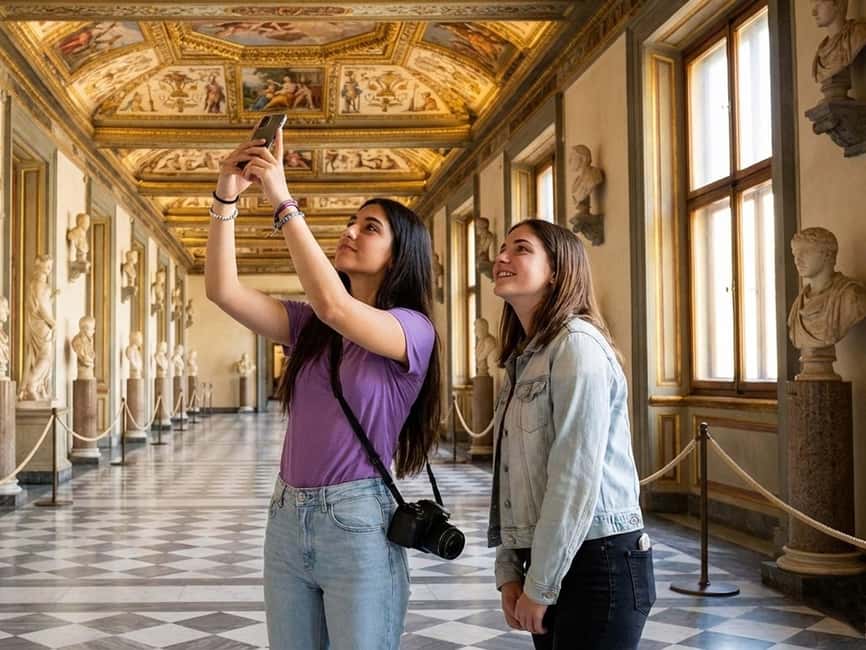
The advertised duration of the guided tour is 1.5 hours. That figure applies to the Uffizi portion, not the full outing.
You should allow around two additional hours for Palazzo Vecchio if you want to explore properly. Add time before the meeting point and for the short walk between the buildings, and a four-hour block is the sensible plan.
That timing matters in Florence. If you schedule a lunch reservation, train, or another museum too soon after the Uffizi, you may end up treating Palazzo Vecchio as a quick ticket collection rather than part of the experience.
The Uffizi visit itself is tightly focused. It works well for first-time visitors who want an introduction to the museum’s best-known works. It is less suitable for someone who wants to see many galleries in detail during one visit.
Is $91 good value?

At $91 per person, this is not a bargain basement museum ticket. You are paying for skip-the-line Uffizi access, a licensed English-speaking guide, a small group, headsets, reservation fees, and priority entry to Palazzo Vecchio.
The value is strongest if you want structure and context. The Uffizi can feel overwhelming, and a short guided route helps you spend your limited energy on major works instead of wandering without a plan. The second ticket also saves you from arranging Palazzo Vecchio separately.
The value is weaker if you prefer to explore museums alone. In that case, you may not want to pay for a guided introduction, especially since the palace portion is self-guided.
The small group is an important part of the price. A guide can speak directly to nine people far more easily than to a large crowd. Anna S was specifically praised for being pleasant, attentive, and competent, while another booking praised the guide’s informative and friendly manner. Communication through WhatsApp also helped when one tour time needed to be rearranged.
The rating shown for the experience is 5 out of 5 from three verified bookings. That is encouraging, but it is still a small sample. I would treat the praise as a positive sign about guide quality and organization, not as proof that every departure will feel identical.
Who should book this experience?
I would choose this tour if you are visiting Florence for the first time, want the major Uffizi highlights, and prefer someone to explain what you are seeing. It is also a good fit if you want to connect Renaissance art with Medici power instead of visiting the two buildings as unrelated sights.
Families and couples may appreciate the short guided format and the freedom to explore Palazzo Vecchio alone afterward. The wheelchair-accessible setup is another practical advantage.
I would think twice if you are an experienced art museum visitor who wants several hours inside the Uffizi. The guided route is selective by design. You may prefer a ticket that lets you set your own pace from the beginning.
Should you book the Uffizi and Palazzo Vecchio tour?
Book it if you value a clear introduction, a small English-speaking group, and a practical two-site plan. The strongest feature is the guided Uffizi visit, especially the sequence from Giotto to Botticelli, Leonardo, and Michelangelo.
Do not book it expecting two guided tours. Palazzo Vecchio is a self-guided add-on, and the full experience needs about four hours. If you accept that arrangement, the combination offers a useful way to see Florence’s art and Medici politics in one stretch.
FAQ
How long is the guided Uffizi tour?
The guided Uffizi portion lasts 1.5 hours.
How much total time should I allow?
You should plan for at least four hours in total, including about two hours to explore Palazzo Vecchio at your own pace.
Is Palazzo Vecchio guided?
No. The experience includes a priority entrance ticket to Palazzo Vecchio, but that visit is self-guided.
Is entry to Palazzo Vecchio included?
Yes. A bonus priority entrance ticket to Palazzo Vecchio is included.
Is the Arnolfo Tower climb included?
No. The standard entry does not include the Arnolfo Tower climb.
Where is the meeting point?
Meet at Piazzale degli Uffizi 1, in the courtyard on the right side of the Uffizi entrance, under the Leonardo da Vinci statue opposite Door 3.
How do I find the tour representative?
Look for a representative holding a Florence with Locals Tours flag under the Leonardo da Vinci statue.
What language is the guided tour in?
The live guided tour is in English.
How large is the group?
The group is limited to nine participants.
Is the experience wheelchair accessible?
Yes, the experience is listed as wheelchair accessible.
Just added around Florence
- Palazzo Vecchio Secret Passages Tour & Lunch or “Gelato”★ 4.3 · 16 reviews
- Palazzo Vecchio Small Group Tour★ 4.9 · 10 reviews
- Palazzo Vecchio: Private Guided Museum Tour & Tower Tickets★ 4.7 · 18 reviews
- Palazzo Vecchio 90-Minute Morning Guided Tour★ 4.7 · 104 reviews
- Florence: Palazzo Vecchio Museum★ 4.6 · 56 reviews
- Guided tour of Palazzo Pitti: Botticelli, Caravaggio, and Raphael compared★ 5.0 · 2 reviews
- Florence:Palazzo Vecchio Skip-the-line Ticket & Audio Guide★ 4.3 · 95 reviews
- Florence: Pitti Palace Guided Tour With Entry Tickets★ 4.4 · 3 reviews
Palazzo Vecchio and Pitti Palace Tours, compared.
Uffizi, Pitti Palace & Boboli Combined 5-Day Pass
Read our review →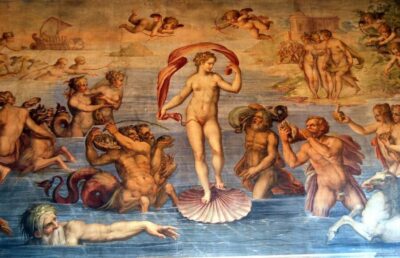
Palazzo Vecchio: Skip-the-Line Entry and Secret Passage Tour
Read our review →
Browse the lists this tour appears in