
REVIEW · MEXICO CITY
Exploring Mexican Muralism: A Journey through Bellas Artes Palace
Art can explain a country fast. This 90-minute tour of Mexico City’s Palacio de Bellas Artes uses its grand architecture and famous murals to show how Mexican artists addressed revolution, work, mythology, and social change. I especially like the small group of no more than six people, which gives you room to ask questions, and the guide’s focus on meaning rather than quick photo stops. The main consideration is time: one hour and 20 minutes inside the palace can feel short if you want to study every mural closely.
The tour is led in English by Mercedes Iriondo, whose approach comes across as warm, patient, and generous with her time. I also like that the walk begins outside with the building itself, not just the paintings. Still, this is best for you if you want historical and artistic context, not a broad Mexico City sightseeing tour.
Key points at a glance
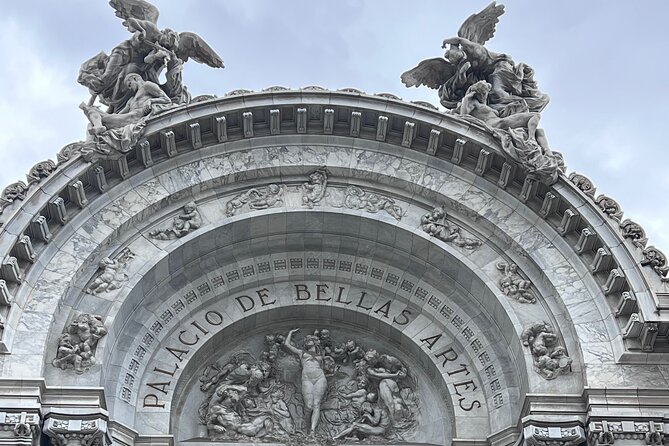
- A 10-minute look at the palace exterior: Start with the façade, its unusual design details, and features that make the building distinctive.
- Major muralists in one place: See works by Diego Rivera, José Clemente Orozco, David Alfaro Siqueiros, and Rufino Tamayo.
- History told through art: The murals address the Mexican Revolution, labor struggles, mythology, industrialization, and social change.
- A genuinely small group: With a maximum of six people, the guide can respond to individual questions and adjust the discussion.
- A focused 90-minute visit: You spend about 10 minutes outside and 80 minutes inside the Palace of Fine Arts.
- A strong English-language option: The tour suits visitors who want a clear explanation of Mexican muralism without handling the subject alone.
Why Bellas Artes makes a strong first stop
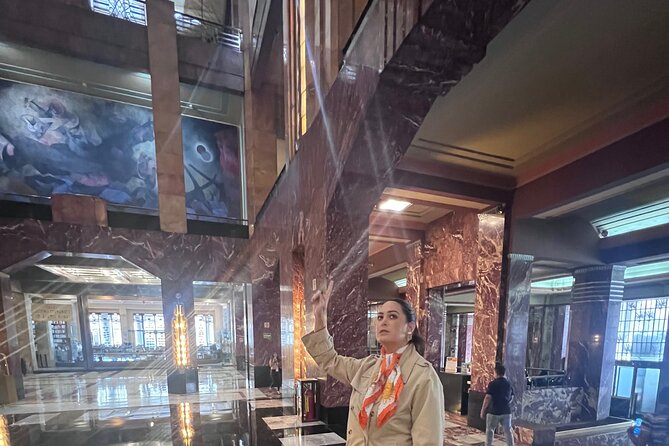
The Palacio de Bellas Artes is more than a handsome building with famous paintings inside. It gives you a compact setting for understanding a major part of Mexican cultural identity. The tour begins at the Madero Monument in Centro, then moves to the palace for a short exterior introduction before entering.
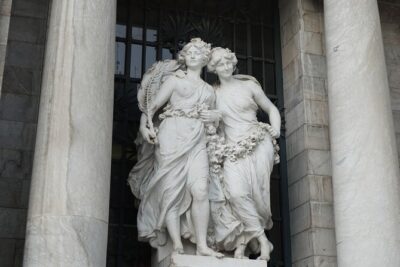
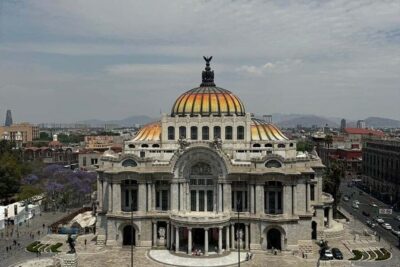
That opening matters. If you walk straight through the doors, you can miss the architectural details that make the palace unusual. The guide points out elements of the façade and explains why the building has such a distinct appearance. You get a sense of the palace as a work of art before turning your attention to the murals.
The outside portion lasts about 10 minutes, so it will not exhaust your patience or steal much time from the interior. It also gives you a moment to get oriented. The meeting point is near public transportation, and the activity ends back at that same meeting point.
Do not expect a long architectural lecture. This is a short introduction, designed to prepare you for what follows. If you already know the building well, the exterior stop may feel brief. For a first visit, though, it prevents the palace from becoming just a container for paintings.
A few more palace visits around the world worth a look
- Venice: Doge’s Palace Reserved Entry Ticket
★ 4.6 · 42,716 reviews - Paris: Versailles Palace and Gardens Full Access Ticket
★ 4.6 · 41,579 reviews - Granada: Alhambra & Nasrid Palaces Tour with Tickets
★ 4.7 · 19,801 reviews
Inside the Palace: murals as a lesson in Mexico
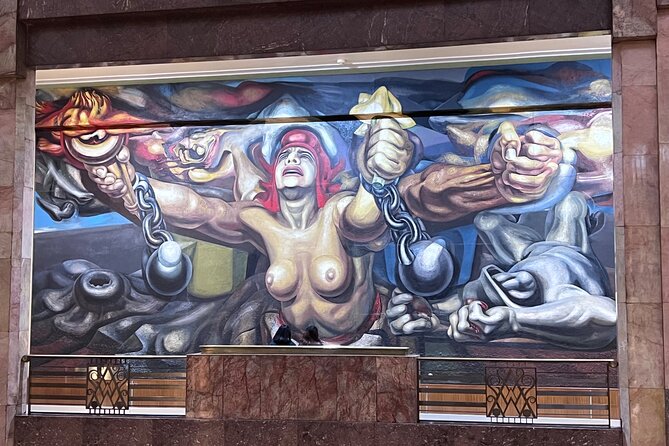
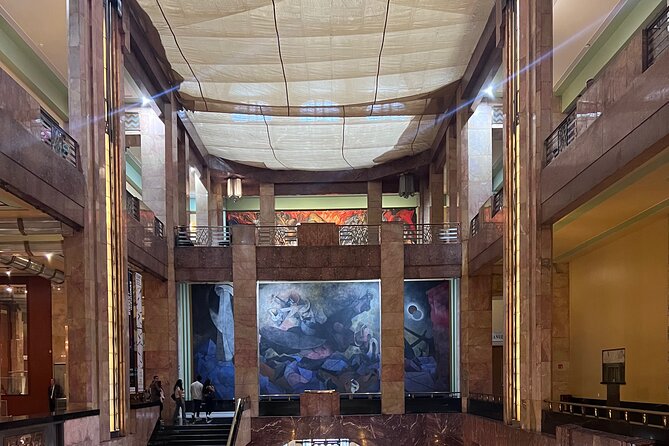
The main part of the experience takes place inside the Palacio de Bellas Artes. Here, large murals by several major Mexican artists cover the walls, turning the building into a visual account of the country’s past and changing society.
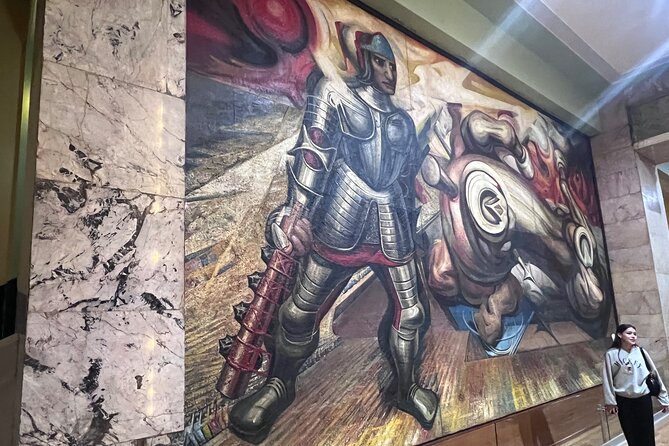
You will see work by Diego Rivera, José Clemente Orozco, David Alfaro Siqueiros, and Rufino Tamayo. The value of having a guide is that these paintings can be hard to read on your own. Figures, symbols, political references, and historical scenes may seem dramatic but confusing until someone explains the setting around them.
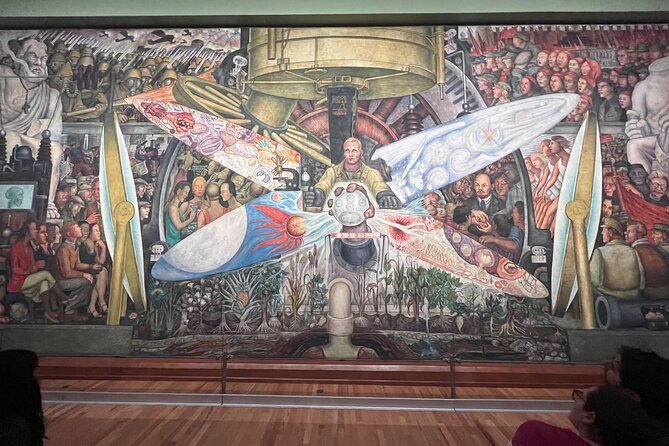
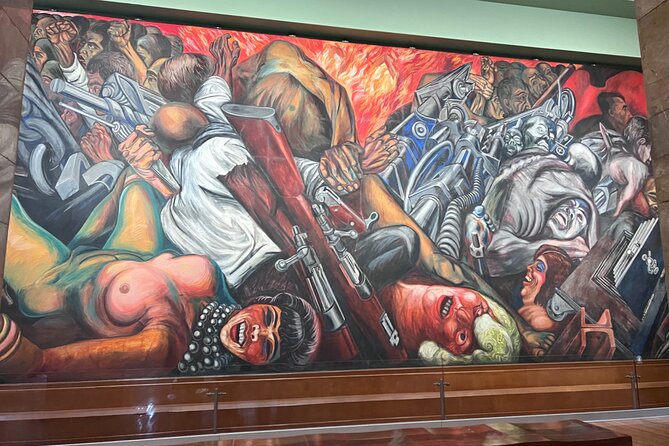
The discussion connects the murals to the Mexican Revolution, labor struggles, mythology, and social development. It also shows how the artists approached similar national questions in different ways. One painter may focus on workers and political conflict, while another looks toward mythology, rural life, or the movement from a pre-Hispanic past into a modern industrial society.
I like this chronological approach because it gives the visit a clear path. You are not simply moving from one large painting to the next. You are watching Mexico change through images of rural life, cities, industry, nature, and political struggle.
The murals also present Mexico as a country pulled in several directions at once. Indigenous and pre-Hispanic traditions appear beside modern industry. Rural scenes sit near urban life. Social progress is presented alongside conflict and inequality. The best part of the tour is learning to notice those tensions rather than treating the paintings as colorful decoration.
Four artists, four ways of seeing
A visit to Bellas Artes becomes more useful when you pay attention to differences between the artists. The tour’s value lies partly in showing how each muralist developed a distinct visual language.
Diego Rivera is often associated with large public scenes of workers, political change, and Mexican society. His murals can feel direct and crowded with information. The guide can help you sort out the people, symbols, and historical references instead of leaving you with only a general impression of scale.
José Clemente Orozco brings another tone. His work is tied to conflict, human struggle, and the difficult consequences of political change. If you prefer art with a sharp edge, his murals may hold your attention longest.
David Alfaro Siqueiros is known for forceful compositions and a strong sense of motion. His work adds another view of revolution, labor, and public life. Looking at Rivera, Orozco, and Siqueiros together lets you compare not only their subjects but also their moods and methods.
Rufino Tamayo broadens the picture. His work brings mythology, identity, and a more personal approach into the conversation. His presence helps show that Mexican muralism was not one fixed style with one political message. It was a wider artistic movement with room for different ideas and visual choices.
You do not need to arrive with art-school training. The guide is there to explain the major themes in plain language and answer questions. The small group makes that more practical. With only six people at most, you are less likely to feel like you are listening from the back of a crowd.
The guide makes the difference
Mercedes Iriondo receives especially warm praise for her energy, patience, and command of the subject. Her strength is not simply knowing facts. She connects the murals to politics, culture, economics, and the changes Mexico experienced as a nation.
That broader context is important. A tour that only identifies artists and dates can become a recital of names. Here, the emphasis is on why the murals were made and what they say about Mexican life. You learn to see the paintings as arguments about society, not just grand images on a wall.
Mercedes also welcomes questions. That is useful in a place where a single mural can raise more questions than you can answer alone. You might want to know why a particular figure appears, how a symbol relates to Mexican history, or how two artists treated the same subject differently. The format allows those questions to shape the conversation.
Her patience is another advantage for visitors who are new to muralism. You are not expected to recognize every historical figure or understand every reference right away. The tone is friendly and personal, with an evident affection for Mexico City.
Because the tour is offered in English, it is a practical choice if you want a serious art discussion without relying on your Spanish. That said, the experience is still centered on explanation and conversation. If you prefer to wander alone at your own pace, a guided visit may feel more structured than you want.
Same place, a different set of state rooms:
- Sintra: Pena Palace and Park Entrance Ticket
★ 4.2 · 17,410 reviews - Granada: Alhambra and Nasrid Palaces Entry Ticket
★ 4.6 · 15,130 reviews - Madrid: Royal Palace Fast-Access Admission Ticket
★ 4.6 · 13,856 reviews - Doge’s Palace & St. Mark’s Basilica with Terrace Access Tour
★ 4.7 · 10,697 reviews
Is $60 a fair price?
At $60 per person, this is not the cheapest way to enter Bellas Artes. The value comes from the guide, the small group, and the amount of historical interpretation packed into 90 minutes.
You are paying for more than admission. The first 10 minutes give you a focused architectural introduction, and the next 80 minutes turn the palace into a lesson in Mexican history and art. The guide helps you compare four important muralists and connects their work to revolution, labor, mythology, and social change.
That is a fair trade if you would otherwise walk through the palace, take photographs, and leave with only a general sense that the murals are important. It is less compelling if you already know Mexican muralism well or if you are happy using your own guidebook.
The maximum group size is a major part of the calculation. Six people allows for direct questions and a conversation that can respond to the interests of the group. A large, impersonal tour would offer less value at the same price.
The tour is also short enough to fit neatly into a day in Centro. You will not lose half a day, and the meeting point at the Madero Monument gives you a clear starting location. Since the activity ends back at the meeting point, you can continue exploring the area afterward.
What the 90-minute schedule feels like
The schedule is compact and clear:
- You meet at the Madero Monument at 11:00 a.m.
- About 10 minutes are spent outside the palace, looking at the façade and its special architectural details.
- About 80 minutes are spent inside with the murals and their historical context.
- You finish back at the original meeting point.
The timing works well for a focused introduction. You receive enough explanation to understand the main ideas without committing to a long academic lecture. I would allow extra time before or after the tour if you want to study the building independently, since the scheduled visit itself is tightly organized.
The main drawback is that 80 minutes inside may not satisfy you if you want to linger over every work. Bellas Artes contains more visual information than any short guided visit can cover. You will need to accept that the guide is selecting themes and examples rather than presenting everything.
That is not a flaw so much as a choice. The experience is designed to give you a clear framework. Once you understand how the murals relate to Mexican politics, identity, and social change, you can return to individual works with sharper eyes.
Who will get the most from this tour?
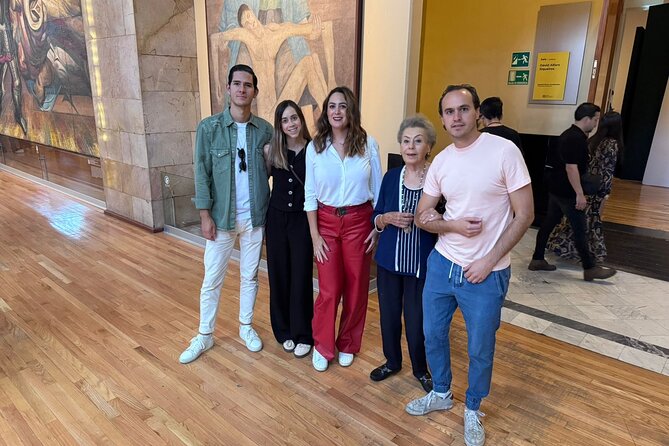
I would recommend this experience to you if you enjoy museums more when someone explains the setting around the art. It is also a good match if Mexican history is unfamiliar and you want a structured introduction rather than a long general lecture.
The tour should suit:
- First-time visitors to Mexico City who want cultural context
- Art lovers interested in Rivera, Orozco, Siqueiros, and Tamayo
- Visitors who prefer English-language guiding
- Couples or small groups who like asking questions
- Anyone curious about the connection between art, politics, and national identity
It may not suit you if you want a broad tour of the whole palace, a long architectural study, or a completely independent visit. The focus is firmly on the building’s exterior details and the murals inside.
Most people can participate, and the group is capped at six. The supplied information does not provide further details about specific mobility accommodations, so you should confirm any particular needs before booking.
A practical way to prepare
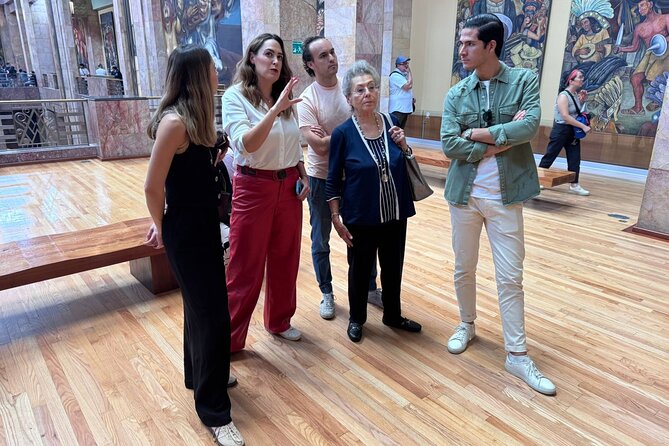
You do not need special background knowledge. It helps to arrive ready to look past the surface. Notice who appears in the murals, how workers and communities are presented, and how the artists connect past traditions with modern life.
Bring questions. The guide’s patient, open style is one of the strongest reasons to choose a small-group visit. Ask about symbols, historical events, differences between the artists, or the way the murals portray social change.
Plan around the 11:00 a.m. start and use the Madero Monument as your reference point. The meeting point is in Centro and near public transportation, which makes it practical to reach from other parts of Mexico City.
The cancellation terms are flexible if your plans change early: you can receive a full refund by canceling at least 24 hours before the start time. Changes or cancellations made inside that 24-hour window are not accepted for a refund.
Should you book Exploring Mexican Muralism?
Book it if you want Bellas Artes to make sense, not merely look impressive. The best reason to choose this tour is the combination of a very small group and Mercedes Iriondo’s clear, enthusiastic explanation of the art and the national story behind it.
The $60 price is easiest to justify if you are new to Mexican muralism, value a personal guide, and want to ask questions. It is harder to justify if you already know the major artists or prefer to explore museums without a set pace.
For most first-time visitors interested in culture, this is a focused and worthwhile introduction. Just remember that 90 minutes gives you a strong framework, not a complete study of every work in the palace.
FAQ
How long does the Bellas Artes mural tour last?
The experience lasts approximately 1 hour and 30 minutes. About 10 minutes are spent outside the palace and about 1 hour and 20 minutes inside.
What time does the tour start?
The tour starts at 11:00 a.m.
Where does the tour meet?
The meeting point is the Madero Monument in Colonia Centro, Centro, Cuauhtémoc, Mexico City.
Where does the activity end?
The activity ends back at the meeting point.
Which artists’ murals can I see?
The tour includes murals by Diego Rivera, José Clemente Orozco, David Alfaro Siqueiros, and Rufino Tamayo.
What subjects do the murals explore?
The murals address the Mexican Revolution, labor struggles, mythology, social evolution, rural and urban life, industrialization, and the relationship between Mexico’s pre-Hispanic past and modern society.
Is the tour offered in English?
Yes. The experience is offered in English.
How many people can join the tour?
The group has a maximum of six participants.
Can I cancel for a full refund?
Yes, if you cancel at least 24 hours before the experience starts. Cancellations or changes made less than 24 hours before the start time are not accepted for a refund.
Just added around the world
- Wine Tasting near Royal Palace of Turin★ 4.5 · 24 reviews
- Reggia di Venaria and Stupinigi Hunting Palace★ 5.0 · 5 reviews
- Stupinigi Hunting Palace & Sacra di San Michele★ 4.5 · 13 reviews
- Royal Palace and Sacra di San Michele★ 4.0 · 9 reviews
- Turin Royal Palace Private Guided Tour with Skip-the-Line Entry★ 5.0 · 5 reviews
- Private Turin Royal Palace Tour with Holy Shroud Chapel★ 4.5 · 73 reviews
- Turin: Royal Palace Guided Tour★ 5.0 · 4 reviews
- Skip-the-Line Ticket and Guided Royal Palace of Turin Group Tour★ 4.5 · 10 reviews
Mexico City Palace Tours, compared.
EXCLUSIVE TOUR to Palacio de Bellas Artes – small groups
Read our review →

Mexico City Downtown Centro private tour+ Palacio de Bellas Artes
Read our review →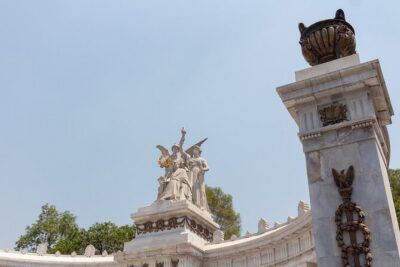
Guided Tour Zócalo to Palaces, Churches and Pyramids
Read our review →
Enjoy the Folkloric Ballet at the Palacio de Bellas Artes
Read our review →
Browse the lists this tour appears in