
REVIEW · MARRAKECH
Best of Marrakech: Guided Bahia Palace & Ben Youssef Medrasa Tour
Marrakech reveals itself one courtyard at a time. This 3 to 4 hour walk links the Koutoubia Mosque, Jewish Mellah, Bahia Palace, Ben Youssef Medersa, working souks, and Jemaa el-Fna in a sensible route through the old city. I like the way it mixes major sights with ordinary medina streets, so you get more than a quick palace checklist.
I also like that admission to Bahia Palace and Ben Youssef Medersa, a licensed English or French-speaking guide, and bottled water are included. Guide Youssef receives especially warm praise for his clear explanations and for adjusting the pace around a group member with limited mobility. The main consideration is the amount of walking on uneven old-city streets, plus the fact that Koutoubia Mosque is viewed from outside with limited access.
Five things to know before booking
- Two major interiors included: Skip-the-line entry covers Bahia Palace and Ben Youssef Medersa.
- A small group format: The maximum group size is 12 people, which should allow more room for questions than a large coach tour.
- A useful historical route: The walk connects the Koutoubia area, Mellah, palace quarter, medina souks, and Jemaa el-Fna.
- A guide-led introduction: You get context on Marrakech’s layout, Muslim practice, Jewish heritage, architecture, and traditional education.
- A practical finish: The tour ends at Jemaa el-Fna, where you can continue exploring after the guided portion.
Why this route works in Marrakech
Marrakech can feel confusing at first. Its narrow lanes twist through shops, homes, workshops, shrines, food stalls, and small squares, and the medina does not offer a neat sightseeing grid. Starting with the Koutoubia area gives you a useful frame for the city before the walk turns into the maze.
The route also has a good rhythm. You begin with broad historical orientation, move into the Mellah and Bahia Palace, cross through less polished neighborhoods, then reach Ben Youssef Medersa and the main souks. The finish at Jemaa el-Fna gives you a lively public square rather than leaving you beside a museum or at an unclear roadside point.
At $58.86 per person, this is not the cheapest way to walk around Marrakech. Still, the price includes two important admission tickets, a guide, bottled water, and skip-the-line access at the two central sights. If you would otherwise pay for those entries and hire separate help to make sense of the medina, the cost is reasonable.
The value depends on what you want. If you enjoy finding your own way and reading up before you arrive, you may prefer to visit independently. If you want the city’s main monuments connected by a clear route, with explanations along the way, this half-day format makes practical sense.
More Bahia Palace and Marrakech Tours in Marrakech:
- Marrakech: Bahia Palace, Saadian Tombs, Souk and Medina Tour
★ 4.7 · 4,974 reviews - Marrakech: Bahia Palace, Saadian Tombs, & Koutoubia Mosque
★ 4.5 · 2,529 reviews - Marrakech: Bahia Palace, Madrasa Ben Youssef and Medina Tour
★ 4.7 · 1,347 reviews
Koutoubia Mosque gives you the city’s opening chapter
The meeting area is listed around Koutoubia Mosque, with the start address given as Kubba Fatima Zohra. Confirm the exact meeting point when booking, since the mosque and the supplied address are both used in the tour information.
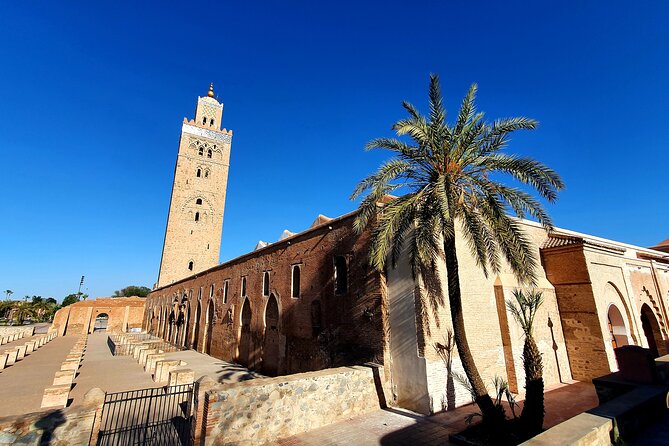
Koutoubia is introduced as a Moorish monument from the 12th century, built on a sacred site tied to the foundations of Marrakech. The tour also points out the city’s first road and defensive gate, helping you see the old city as a planned settlement rather than a random collection of lanes.
Do not expect an interior visit here. Access is limited, and the mosque is viewed from outside. That is a small drawback if you hoped to see several major interiors, but the exterior stop still matters because Koutoubia is one of Marrakech’s key visual and historical reference points.
The opening talk is especially useful if this is your first morning in the city. You get basic orientation before entering the medina, where signs can be scarce and streets can look remarkably similar.
The Mellah connects Marrakech with Jewish Morocco
The walk continues into the Mellah, Marrakech’s historic Jewish quarter. This stop adds an important layer to the city’s story and keeps the tour from presenting Morocco through only one religious or cultural lens.
The visit lasts about 20 minutes and includes a walk through colorful spice markets. Here, the focus is not just buying souvenirs. You learn about Morocco’s Jewish heritage and see how the old quarter connects with trade, food, and daily life.
The spice market is also a good place for a camera pause. Expect strong colors, displayed ingredients, and plenty of visual detail. The tour describes a stop at the colorful spices square for photographs and an introduction to local beauty and cooking secrets.
The market setting can be busy and distracting, so stay close to the guide. If you want to shop, save serious bargaining for after the tour. A guided walk is more useful when you can listen rather than compare prices at every stall.
Bahia Palace rewards a slow look upward
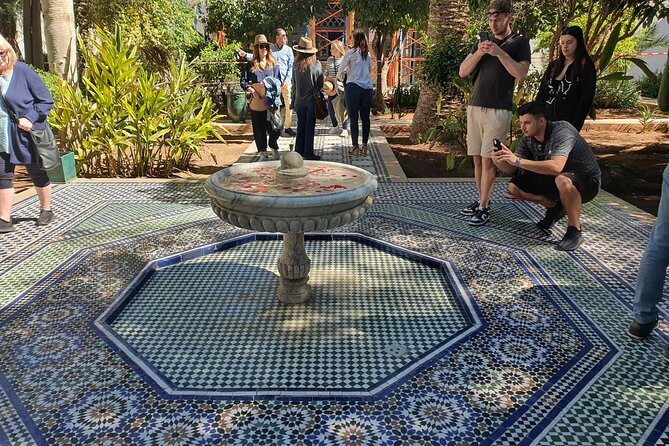
Bahia Palace is the first major paid sight, with about one hour set aside for the visit. It was once home to the kingdom’s grand vizier and his household, including his harem. Today, you move through residential riads, gardens, reception rooms, and formal areas built to impress.
This is a place where details matter more than size. Look for zellij mosaics, stucco arabesques, carved cedar gates, painted ceilings, and fountains. The design depends on patient craft, with repeated patterns and carefully balanced surfaces doing much of the talking.
I like that the schedule allows free time within the palace. A guide can explain the people connected with the building and the stories behind its decoration, then you can slow down in the courtyards and gardens. That balance is better than being hurried from one room to the next.
The palace is described as the only real palace open to visitors on this route. That makes the stop central to the experience, not a quick photo from the street. The included entry and line-skipping access also add real value here, especially when the entrance is busy.
Keep your expectations measured. This is a historic palace complex, not a furnished royal residence with every room preserved as it once was. Its appeal comes from the architecture, decoration, open courtyards, and sense of ceremonial space.
A few more palace visits around Marrakech worth a look
- Marrakech: Bahia Palace Guided Tour with Skip-the-Line Entry
★ 4.7 · 811 reviews - Marrakech: Palace, Museum, Madrasa & Medina Highlights Tour
★ 4.7 · 706 reviews - Marrakech: Saadian Tombs, Bahia Palace, Medina and Souk Tour
★ 4.7 · 673 reviews - Marrakech: Bahia Palace, Ben Youssef Medersa, & Souks Tour
★ 4.3 · 554 reviews
The medina walk shows the city between monuments
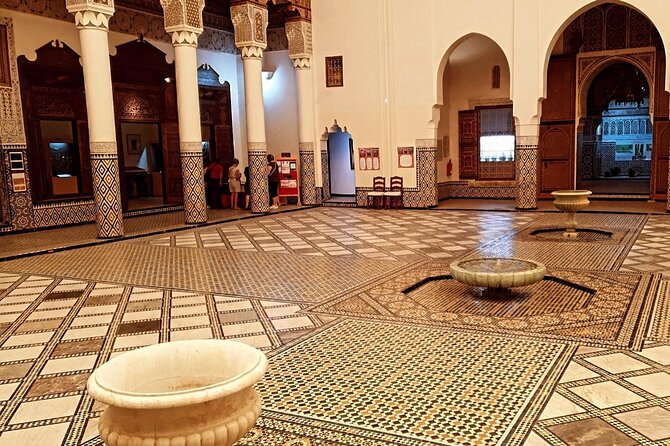
After Bahia Palace, the route goes through authentic neighborhoods and old-city lanes toward Ben Youssef Medersa. This connecting walk is one of the tour’s strongest features because it puts the polished palace beside ordinary medina life.
You may pass workshops, small lanes, homes, and local businesses as the guide explains the streets around you. The supplied description emphasizes artisans and traditional neighborhoods rather than a vehicle transfer, so comfortable shoes are essential.
This is also where a small group helps. A maximum of 12 people is more manageable in narrow passages than a large party. The guide can keep the group together without turning the walk into a parade.
The route is not designed for anyone who wants a relaxed, seated sightseeing experience. You should expect several hours on foot, changing surfaces, market activity, and the need to keep alert around corners and shop entrances. A bottle of water is provided, with either two small bottles or one large bottle per person.
Ben Youssef Medersa is the architectural centerpiece
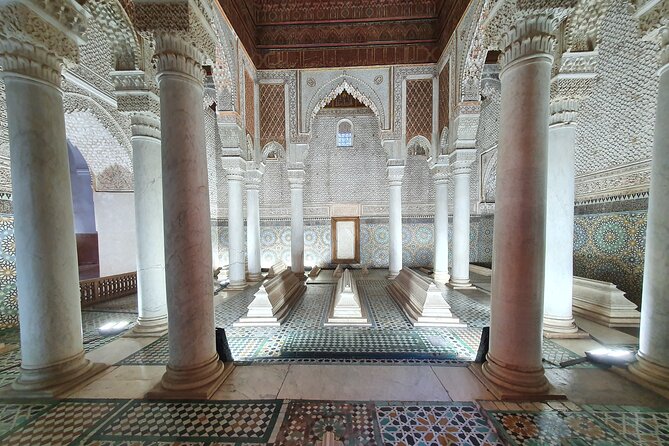
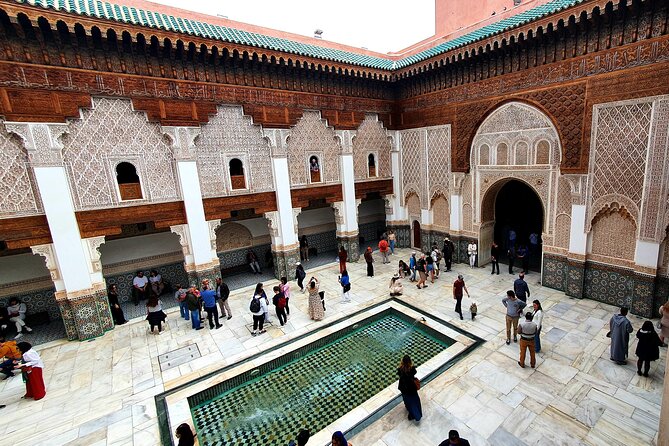
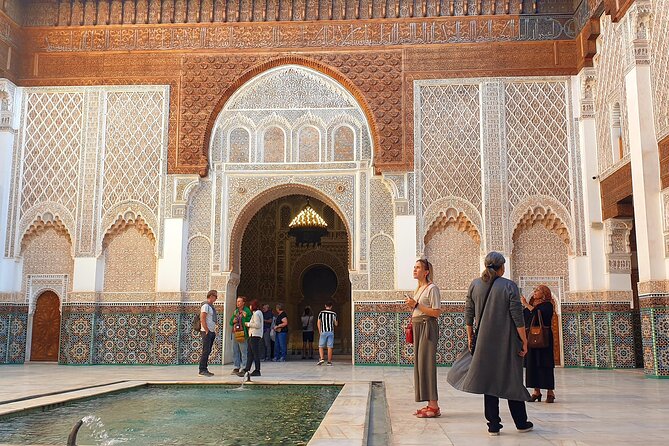
Ben Youssef Medersa receives about 45 minutes, and it is the tour’s strongest stop for Islamic design. This 16th-century religious school once housed as many as 900 students, making its scale easier to understand once you see the student rooms around the central courtyard.
The patio is the main visual reward. Arabo-Islamic decoration covers the space with patterned tilework, carved plaster, and carefully arranged architectural details. The prayer hall and ablutions room add a useful sense of how the school functioned, rather than leaving you with a pretty courtyard and no context.
The guide also discusses Muslim practice and traditional education. That makes the visit more meaningful than simply looking at decoration. You learn how a medersa served religious study and student life, and why the building was important within Marrakech.
Some people will want more time here. Forty-five minutes is enough for an explained visit, but not necessarily enough for a slow architectural study or extensive photography. If you are especially interested in tilework and Islamic design, listen closely during the guide’s explanation, then return independently if your schedule allows.
The ticket is included, which matters because this is one of the tour’s main reasons for existing. You are not paying only for a walk through the souks. You are getting a guided visit to a major historic school with a clear explanation of its purpose.
Souk Semmarine turns craft into part of the story
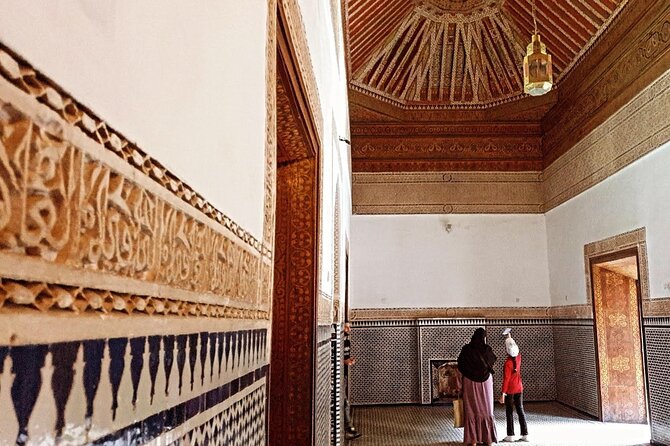
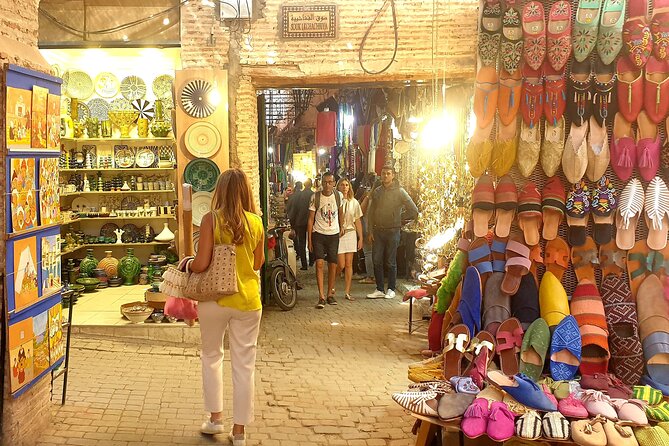
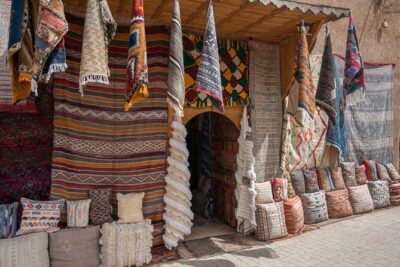
The route then reaches Souk Semmarine, described as the medina’s most prestigious souk and a major center for local artisans. The tour focuses on seeing craftsmen at work, learning about materials and techniques, and understanding the role of handmade production in Moroccan culture.
That focus is more useful than a generic shopping stop. You can look at how objects are made before deciding if you want to buy anything. The souk is also presented as a place that has inspired international artists and designers, which gives its workshops a wider cultural context.
The tour does not include purchases, and tips are not included. If you buy something, treat the shopping as your own separate decision. The guide can explain what you are seeing, but you should still judge quality and price for yourself.
Expect some sales attention in the souk. That is part of the setting, but it can make the walk tiring if you are not prepared. A polite, firm no is usually more useful than a long explanation.
Place des Epices adds color and a rooftop view
Place des Epices, or the spice square, gets about 20 minutes. It is described as one of the souks’ most colorful and fashionable squares, with a private terrace stop offering a view over the old-city maze.
That terrace is a welcome change after the narrow lanes. From above, the medina’s layout becomes easier to read, and you get a chance to pause without stepping out of the historic center.
The stop also connects spices with Moroccan food and local beauty products. You can look, photograph, and ask questions without needing to make the square a shopping mission.
Because the terrace is private, the stop offers something you may not find simply by wandering. The time is brief, so treat it as a viewpoint and orientation pause rather than a long café break.
Jemaa el-Fna is the right place to finish
The tour ends at Jemaa el-Fna, Marrakech’s UNESCO World Heritage site. Its importance comes from oral and living performance traditions, including storytellers, folk groups, musicians, and other street artists.
The formal tour time here is about 15 minutes, but the location gives you options after the guide leaves. You can continue exploring the square, return to the souks, or use it as a central point for the next part of your day.
The square changes character as the day progresses, but the tour information only promises an introduction to its cultural expressions. Do not expect a full evening food tour or a scheduled performance program as part of this booking.
Ending here is practical. You are not dropped at an isolated attraction, and you can keep your afternoon flexible. If the square feels too intense, you can leave after the guided explanation. If you enjoy street performance and public life, you can stay longer.
Pace, group size, and guide quality
The tour lasts roughly 3 to 4 hours, with a maximum of 12 people. That is a useful middle ground: more social and affordable than a private guide, but smaller than a typical large walking group.
Guide quality matters greatly in Marrakech, where architecture, religion, trade, and local customs can be hard to interpret without context. Youssef is specifically praised for being clear, professional, and flexible, including adjusting around a participant with mobility issues.
That does not guarantee that every departure will have Youssef. The tour lists English and French-speaking licensed guides, so check the assigned guide if a particular person matters to you.
The tour receives a 4.4 rating from 9 reviews. That is a positive signal, but it is a small sample, so I would treat the strongest praise as encouraging rather than conclusive.
Wear comfortable walking shoes. Most travelers can participate, and service animals are allowed, but the route’s old streets and several hours on foot may still be tiring for anyone with mobility concerns. If that applies to you, contact the provider before booking and ask about the day’s pace.
Should you book this Marrakech tour?
I would book this tour if you want a first look at Marrakech that combines major architecture, local quarters, crafts, and public culture. The route is well chosen, the two main entrance tickets are included, and the small maximum group size gives the guide room to explain rather than simply lead.
I would skip it if you prefer to explore slowly on your own, dislike market approaches, or want long, unhurried visits inside each monument. You should also remember that Koutoubia is an exterior stop and that the price does not include gratuities.
For most first-time visitors with only a few days in Marrakech, this is a solid half-day introduction. Book it with comfortable shoes, keep the rest of your day open after Jemaa el-Fna, and confirm the precise meeting point before setting out.
FAQ
How long does the tour last?
The tour lasts approximately 3 to 4 hours.
How much does the tour cost?
The listed price is $58.86 per person.
Where does the tour start?
The meeting information lists Kubba Fatima Zohra, with the tour introduction taking place around Koutoubia Mosque. Confirm the exact meeting point when booking.
Where does the tour end?
The tour ends at Jemaa el-Fna, also called Jamaâ El-Fna Square.
Is entry to Bahia Palace included?
Yes. Admission to Bahia Palace and the guided visit are included.
Is entry to Ben Youssef Medersa included?
Yes. Admission to Ben Youssef Medersa and the guided visit are included.
Does the tour include skip-the-line tickets?
Yes. Skip-the-line tickets are included for Bahia Palace and Ben Youssef Medersa.
What languages are offered?
The licensed guide service is offered in English or French.
Is bottled water included?
Yes. Each person receives either two small bottles or one large bottle of water.
What is the maximum group size?
The tour has a maximum of 12 travelers.
Can I cancel for a full refund?
Yes, if you cancel at least 24 hours before the experience start time. Cancellations made less than 24 hours before the start time are not refunded.
Just added around Marrakech
- Marrakech: Jewish Quarter, Bahia Palace, Handicraft, Jemaa fna★ 5.0 · 7 reviews
- Marrakech : Saadian Tombs & Bahia Palace, Souk and Medina Tour★ 4.5 · 9 reviews
- Marrakech : Bahia Palace & Madrasa Ben Youssef And Medina Tour★ 5.0 · 39 reviews
- Half-Day Marrakech Highlights: Medina, Palaces, and More★ 4.5 · 6 reviews
- Explore Marrakech Medina: Private Tour Including Bahia Palace Visit★ 4.5 · 59 reviews
- Marrakech: Palace, Museum, Madrasa & Medina Highlights Tour★ 5.0 · 26 reviews
- Marrakech City Tour, Bahia Palace, Badii Palace, Majorelle Garden★ 4.5 · 144 reviews
- Marrakech Jewish Quarter & Bahia Palace: Private Half-day Guided Tour★ 4.5 · 20 reviews
Bahia Palace and Marrakech Tours, compared.
Bahia Palace, Saadian Tombs, Souk and Medina Tour
Read our review →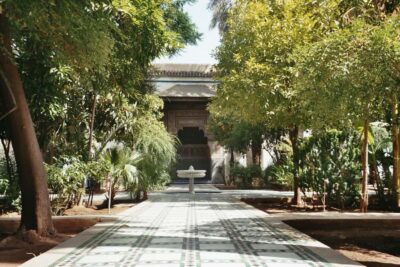
Bahia Palace, Saadian Tombs, & Koutoubia Mosque
Read our review →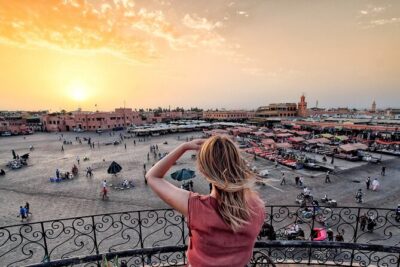
Bahia Palace, Madrasa Ben Youssef and Medina Tour
Read our review →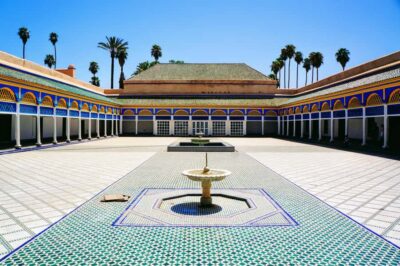
Bahia Palace Guided Tour with Skip-the-Line Entry
Read our review →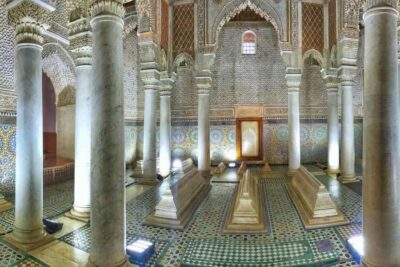
Saadian Tombs, Bahia Palace, Medina and Souk Tour
Read our review →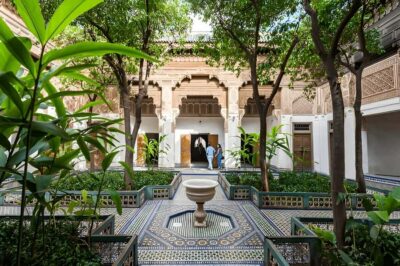
Bahia Palace, Ben Youssef Medersa, & Souks Tour
Read our review →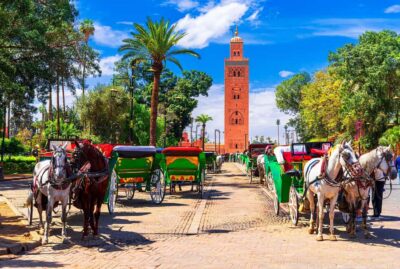
Bahia Palace, Madrasa Ben Youssef & Secret Garden
Read our review →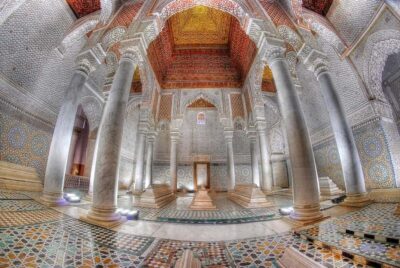
Bahia Palace, Saadian Tombs & Medina Guided Tour
Read our review →Browse the lists this tour appears in