
REVIEW · CALIFORNIA, UNITED STATES
Historic Hollywood Boulevard and Movie Palaces Walking Tour
Hollywood still knows how to put on a show. This 2.5-hour walking tour connects the Walk of Fame, classic movie palaces, famous hotels, and the stories that turned one Los Angeles boulevard into a symbol of the film world. You get more than photo stops, with a local guide explaining how Hollywood changed over time and how its theaters shaped movie culture.
I especially like the focus on Grauman’s Chinese Theatre and the Egyptian Theatre, two buildings that give the boulevard real character. I also like the small-group format, which should make it easier to ask questions and hear side stories. The main drawback is simple: you will walk a lot, and some stops are exterior visits rather than full interior tours.
The tour costs $35 per person, which is fair if you want context instead of simply passing the sights on your own. The strongest guide feedback centers on Mark, who works in the film industry, and Éloi, praised for humor and clear explanations in both French and English. Arrive 15 minutes early, wear good shoes, and expect Hollywood to be crowded, noisy, and gloriously theatrical.
Key points to know before booking
- The tour begins at Hollywood/Highland Metro Station, in front of the elevator at 6815 Hollywood Boulevard.
- The Walk of Fame is part of a guided stroll, with stories about its origins in 1960 and its unusual mix of honorees.
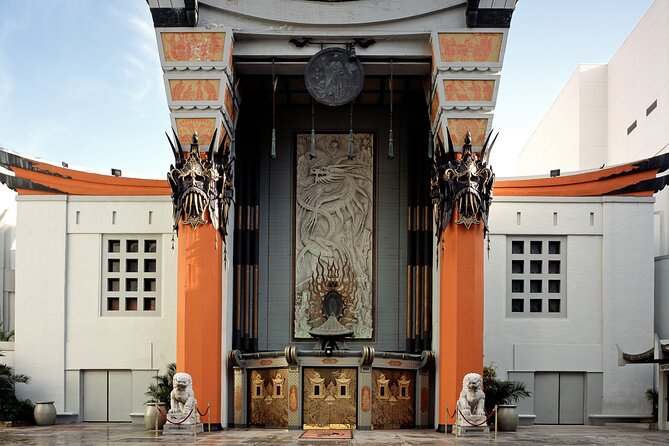
- The Egyptian Theatre and TCL Chinese Theatre provide the best architectural focus, with connections to early premieres and celebrity footprints.
- You visit the Dolby Theatre and Roosevelt Hotel, tying today’s awards culture to Hollywood’s earliest ceremonies.
- Guides speak English and French, and private groups are available.
- Free cancellation up to 24 hours before departure and reserve-now, pay-later booking make planning less rigid.
What this Hollywood walk is really about
This is a history walk disguised as a celebrity tour. You will see famous names underfoot and grand theaters along the boulevard, but the guide’s job is to explain how those pieces fit together.
Hollywood Boulevard began as a quieter street before becoming a major theater district. The tour follows that change through movie palaces, restaurants, hotels, and public ceremonies. That makes the experience useful for first-time visitors who want a clear introduction to Hollywood without spending a full day at a museum or studio.
At 150 minutes, the length is substantial but manageable. You cover several blocks and make repeated stops, so this is not a relaxed café-to-café stroll. Still, the schedule gives the guide enough time to explain the places rather than point at them and hurry on.
The group is described as intimate, with a private option available. That matters here. Hollywood sights are busy, and a smaller group should help you stay close to the guide when the boulevard is loud or crowded. It also gives you a better chance to ask about a favorite actor, theater, or movie.
More Palace Walking Tours in the world:
- Venice: Doge’s Palace and St Mark’s Basilica Walking Tour
★ 4.4 · 6,291 reviews - Split: Old Town and Diocletian Palace Walking Tour
★ 4.9 · 4,727 reviews - Walking Tour of Split and Diocletian’s Palace
★ 5.0 · 2,588 reviews
Meeting at Hollywood and Highland
The starting point is in front of the elevator at the entrance to the Metro Station Hollywood/Highland on Hollywood Boulevard, at 6815 Hollywood Boulevard. This is a useful meeting place because the tour begins in the middle of the main Hollywood sightseeing area rather than in a remote neighborhood.
You should arrive 15 minutes early. The boulevard can be distracting, with crowds, signs, performers, and plenty of places competing for your attention. Give yourself time to find the elevator entrance and locate the guide without turning the first few minutes into a small search party.
From the meeting area, the walk includes a 20-minute stretch to Ovation, Hollywood. The route gives you an early look at the district’s modern side before the tour settles into its film history. Comfortable shoes are not optional advice here. You will be on foot for most of the experience.
Hollywood Sign stories beyond the postcard
The Hollywood Sign is one of the tour’s opening subjects. You will hear that it was built in 1923 as Hollywoodland, a reminder that the sign began as part of a development promotion rather than as a pure film symbol.
Its later story is more dramatic. The sign faced near-demolition before restoration efforts helped preserve it. The account includes unusual supporters such as Alice Cooper and Hugh Hefner, giving you a better sense of how a commercial hillside sign became a public icon.
The tour does not take you to the sign itself. Instead, you learn about it while taking in panoramic views. That distinction matters if your main goal is a close photograph from the hillside. This experience is about the sign’s place in Hollywood culture, not a hike to its base.
I like this opening because it sets the tone. Hollywood’s most famous objects often have less glamorous beginnings than you might expect, and the guide uses that tension well.
Walking the Walk of Fame
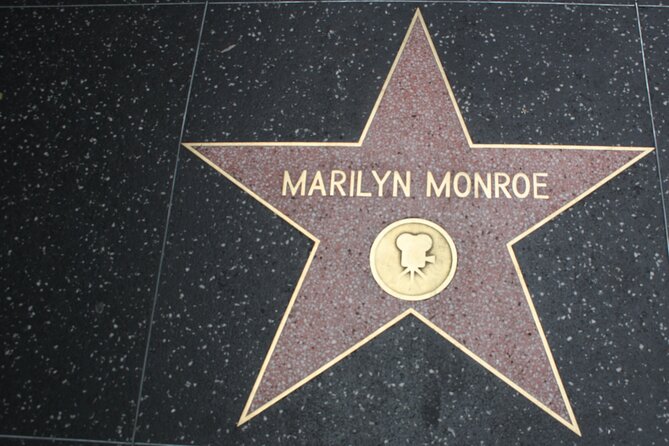
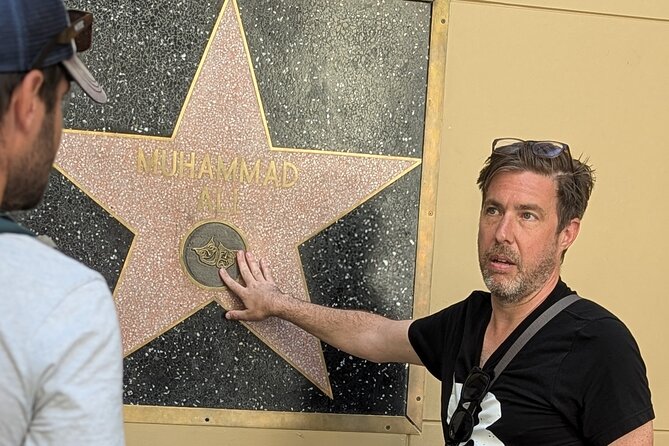
The Hollywood Walk of Fame is more than a long pavement of names, though it is easy to treat it that way. The guided portion explains how the Walk began in 1960 and why its stars honor more than film actors.
You will encounter names connected with music, radio, television, and other parts of entertainment. Fictional characters also appear, including Mickey Mouse and Godzilla. That mix is one of the fun details of the stop. It shows how Hollywood defines fame broadly, often with one foot in show business and the other in pop culture.
There are now about 2,700 stars, so you cannot take in the whole project during a short visit. The value comes from having the guide point out the oddities and explain the idea behind the sidewalk. If you arrive expecting a quiet memorial, adjust your expectations. This is an active public boulevard, and the Walk of Fame is woven into everyday traffic.
The stop works best for first-time visitors and movie fans who want a little order among the names. You can always return later to search for a favorite star at your own pace.
More Heritage Trips in the world:
- Madrid Essential: Historic Center, Plaza Mayor & Royal Palace
★ 5.0 · 6,416 reviews - Venice’s Best: Basilica, Doge’s Palace, Gondola & History Gallery
★ 4.5 · 2,478 reviews - Tokyo: Imperial Palace and Shogun Historical Walking Tour
★ 5.0 · 2,251 reviews - Dubai: Abu Dhabi Grand Mosque, Palace, and Heritage Village
★ 4.8 · 1,265 reviews
The Egyptian Theatre and Hollywood’s first red carpet
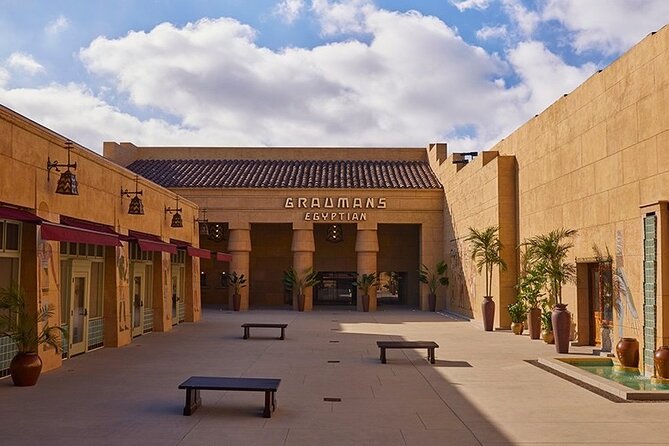
The Grauman’s Egyptian Theatre is one of the most interesting buildings on the route. Its design gives the boulevard a strong visual break from ordinary commercial streets, and its story connects directly to Hollywood’s premiere culture.
The theater hosted Hollywood’s first red carpet, making it an important place to discuss how movie openings became public events. Today’s premieres, press lines, and celebrity arrivals did not appear from nowhere. This theater helped establish the idea that the screening could be a spectacle in its own right.
You spend about 20 minutes on this sightseeing stop. That is enough time for the guide to explain the building’s place in Hollywood without turning the tour into a long architectural lecture. Look closely at the exterior details, since the supplied schedule does not promise a full interior tour or a film screening.
For me, this is one of the tour’s best stops because it connects a beautiful old building with a familiar modern habit. The red carpet remains one of Hollywood’s most durable inventions.
Dolby Theatre and the modern awards connection
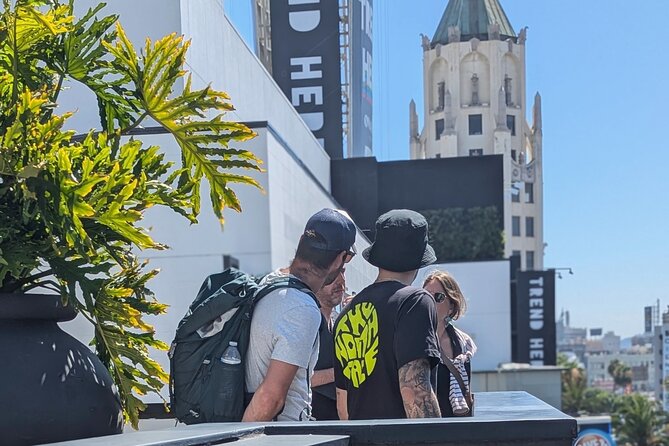
The Dolby Theatre brings the story forward. You visit for about 15 minutes, linking the old movie palaces with the current awards industry.
The theater is important because it hosts the Academy Awards, and its presence shows that Hollywood is not only a preserved memory. The district still supports major entertainment events and public ceremonies. The guide can help you see how the modern venue relates to the older theaters nearby.
Do not expect this to function as a backstage visit. The schedule identifies it as a visit, not an extended theater tour. Its value is mainly in the explanation and the connection between Hollywood’s early premiere culture and its present-day awards machinery.
This stop is especially useful if you want a basic map of Hollywood’s film institutions. You see the older Egyptian Theatre, the Walk of Fame, the Chinese Theatre, and the newer awards venue within one walk.
TCL Chinese Theatre and the cement handprints
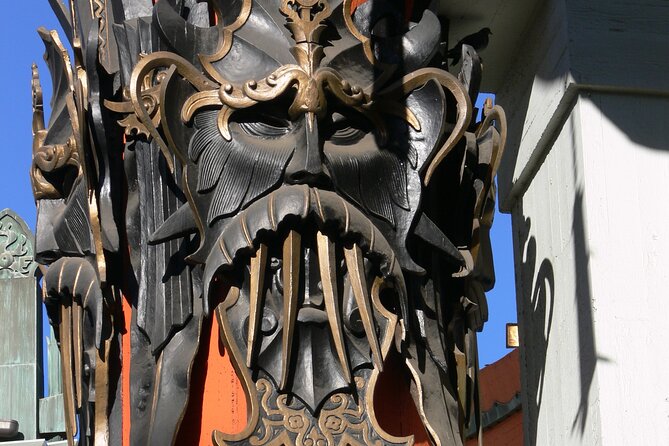
The TCL Chinese Theatre is the tour’s centerpiece. It opened in 1927 and became famous for the tradition of celebrity handprints and footprints in cement.
You will see marks connected with stars such as Marilyn Monroe and Harrison Ford. Even R2-D2 has a place, which neatly captures the theater’s mix of classic movie glamour and popular science fiction.
The guided stop lasts about 15 minutes. That is enough to understand why the theater matters, though you will need to pay attention because the forecourt can be crowded and visually busy. The cement blocks are easy to treat as a photo backdrop, but the stories give them more weight.
The theater also helps explain why Hollywood became a place where movies were experienced as events. The building was designed to attract attention, welcome celebrities, and give audiences something to remember beyond the film itself.
If you have limited time in Hollywood, this is the stop I would prioritize. It combines architecture, celebrity culture, movie history, and a large dose of oddball charm in one place.
Musso and Frank Grill, food and film history
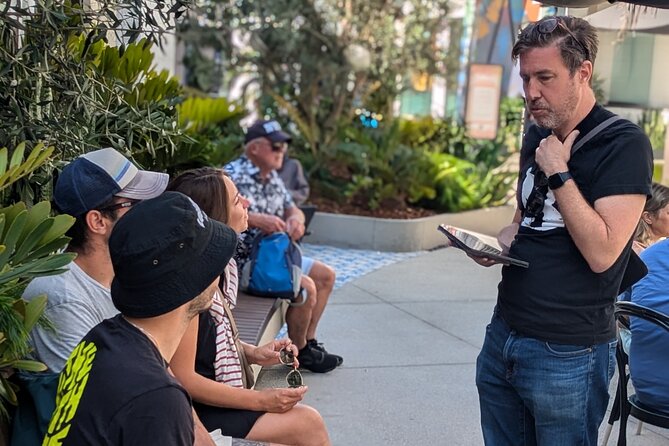
Musso and Frank Grill adds a different kind of Hollywood story. Instead of focusing on a theater, the tour discusses Hollywood’s oldest restaurant and the stars who spent time there, including Charlie Chaplin, Humphrey Bogart, and Marilyn Monroe.
The restaurant also has a food connection. Mary Pickford and Douglas Fairbanks helped bring fettuccine Alfredo to the United States after encountering it abroad. That small detail makes the stop memorable because it ties Hollywood’s social life to a dish many people already know.
You should understand that the tour discusses the restaurant rather than promising a meal there. If you want to eat at Musso and Frank, plan that separately and allow extra time. On the walking tour, the point is to picture the boulevard as a working social world, not just a row of tourist sights.
This is the kind of stop that gives the tour texture. Movie history did not happen only on sets and at premieres. Restaurants, hotels, and informal meeting places also helped shape the industry.
The Roosevelt Hotel and the end of old Hollywood
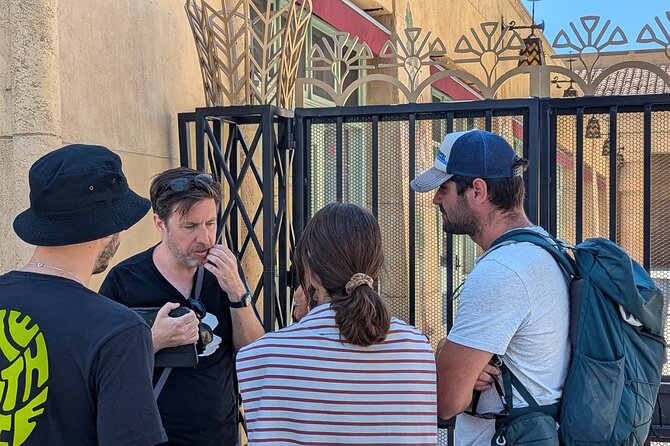
The tour ends at the Hollywood Roosevelt, a Spanish Colonial Revival hotel with a direct link to the Academy Awards. Hollywood’s first Academy Awards ceremony took place there, giving the hotel a place in the industry’s earliest awards story.
The hotel was also associated with stars such as Marilyn Monroe. Its interiors are known for an old Hollywood feel, and the guide uses the building to bring the tour back to the people who lived and worked around the boulevard.
The visit lasts about 10 minutes. That is a short stop, but it works as an ending because it gathers several themes together: celebrity, awards, architecture, and the social world behind the screen.
The tour returns to 6815 Hollywood Boulevard, so you do not finish in an unknown part of town. That makes it easier to continue sightseeing, catch the Metro, or arrange a meal afterward.
What the guides add to the experience
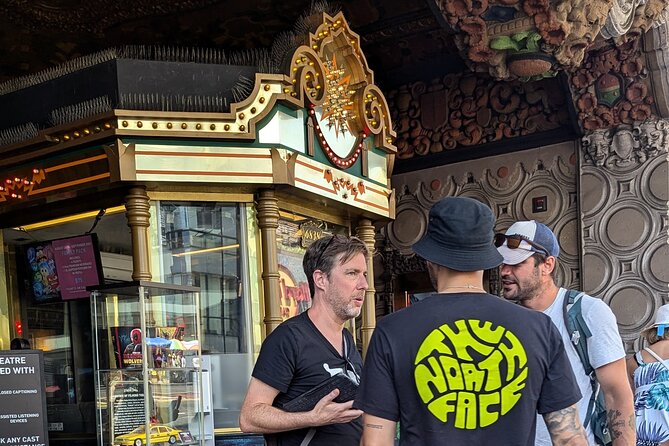
The guide is the main reason to book this instead of simply walking Hollywood Boulevard with a phone in hand. The strongest guide feedback points to people who add industry context rather than reciting dates.
Mark works in the film industry and has been able to explain practical details about how cinemas operate, along with stories about the theaters and the development of Hollywood’s film business. That kind of background is useful because it explains not only what a building looks like, but why it mattered.
Éloi has received praise for humor and strong historical explanations. One tour had an English-speaking couple booked at the same time as a French-speaking couple because of a platform problem. Éloi adjusted to the mixed group and kept both adults and teenagers involved. That suggests a flexible teaching style, though any mixed-language tour can take a little more patience from everyone.
English and French are available. If you want the most personal exchange, a private group is also possible. I would consider that option for families with teenagers, people with very specific film interests, or anyone who prefers a slower pace.
Is $35 a fair price?
At $35 per person, the tour is reasonably priced for 150 minutes with a local guide and several major stops. You are paying for interpretation, not admission to a string of paid attractions. The included feature is the guide, so you should not expect meals, theater tickets, or a special backstage entry.
The value is strongest if you are new to Hollywood. Without context, the Walk of Fame can feel like a long sidewalk, and the movie palaces can blur together after a few blocks. A good guide gives each stop a role in the larger story.
The price is less compelling if you already know Hollywood well or only want quick photographs. You could walk the boulevard independently, though you would lose the explanations about the Hollywoodland sign, the first red carpet, the cement handprints, and the Academy Awards ceremony.
The average rating is 4.8 from four published ratings, with scores of four and five. That is encouraging, but it is still a small sample. I would treat the guide quality as the key variable, especially since much of the tour’s value comes from stories and conversation.
Who should book this walk?
I would recommend it to first-time visitors, movie fans, history-minded adults, and families with older children or teenagers. The stories about Mickey Mouse, Godzilla, R2-D2, and the famous restaurants give younger participants several ways into the subject.
It also suits you if you want to understand Hollywood before visiting other Los Angeles attractions. The tour gives you a useful street-level map of the district and explains why the theaters, hotels, and public symbols are grouped together.
You might skip it if you dislike walking, need frequent seated breaks, or want full interior access to every theater. The route is active, and several stops are visits or sightseeing from the outside. Check the weather before setting out and dress for the conditions.
Bring a camera, but keep your eyes up too. Hollywood rewards photographs, yet the best parts of this tour are often the small facts behind the famous surfaces.
Should you book the Historic Hollywood Boulevard and Movie Palaces Walking Tour?
Book it if you want Hollywood to make sense, not just look familiar. The best parts are the Chinese Theatre, Egyptian Theatre, Walk of Fame, and the guide’s extra film-industry stories, especially with someone such as Mark or Éloi leading the walk.
Skip it if your main goal is a Hollywood Sign hike, a full theater interior tour, or a leisurely afternoon with little walking. For $35, though, this is a sensible introduction to the boulevard, with enough history to turn a famous street into a place with character and connections.
FAQ
How long does the tour last?
The tour lasts 150 minutes, or 2.5 hours.
How much does the tour cost?
The price is $35 per person.
Where does the tour meet?
Meet in front of the elevator at the entrance to the Metro Station Hollywood/Highland on Hollywood Boulevard, at 6815 Hollywood Boulevard.
How early should I arrive?
You should arrive 15 minutes before the tour starts.
What languages are available?
The live tour is available in English and French.
Is a private group available?
Yes, a private group option is available.
What is included in the price?
An expert local guide is included.
Does the tour visit the Hollywood Walk of Fame?
Yes. The Walk of Fame is included as a guided walking stop.
Which movie theaters are included?
The tour includes the Grauman’s Egyptian Theatre, Dolby Theatre, and TCL Chinese Theatre.
Can I cancel for a full refund?
Yes. You can cancel up to 24 hours in advance for a full refund.
Just added around the world
- Pena Palace, Moorish Castle,Quinta ad Regaleira:Walking tour★ 5.0 · 3 reviews
- Porto Bishop’s Palace Guided Tour★ 4.5 · 8 reviews
- Paris: Versailles Palace and Queen Hamlet E-Bike Tour★ 5.0 · 126 reviews
- Phnom Penh: Full-Day City Tour with Royal Palace & Killing …★ 4.7 · 2 reviews
- Petchaburi Temples & Royal Palace – small Join Group Tour★ 4.6 · 46 reviews
- Paris: Versailles Golf Cart & Bike Tour with Palace Entry★ 4.8 · 58 reviews
- Petit Palais Paris Museum of Fine Arts Tour with Tickets★ 4.2 · 3 reviews
- Paris: Palace of Versailles Private Tour with Transportation★ 5.0 · 2 reviews
Palace Walking Tours, compared.
Doge’s Palace and St Mark’s Basilica Walking Tour
Read our review →
Walking Tour of Split and Diocletian’s Palace
Read our review →
Grand Palace and Wat Phra Kaew Guided Walking Tour
Read our review →
Imperial Palace and Shogun Historical Walking Tour
Read our review →
Madrid Old Town & Royal Palace Walking Tour Skip the Line Ticket
Read our review →
Knossos: Knossos Palace Skip-the-Line Guided Walking Tour
Read our review →
Browse the lists this tour appears in