REVIEW · NAPLES
Campania: Royal Palace of Caserta Guided Private Tour
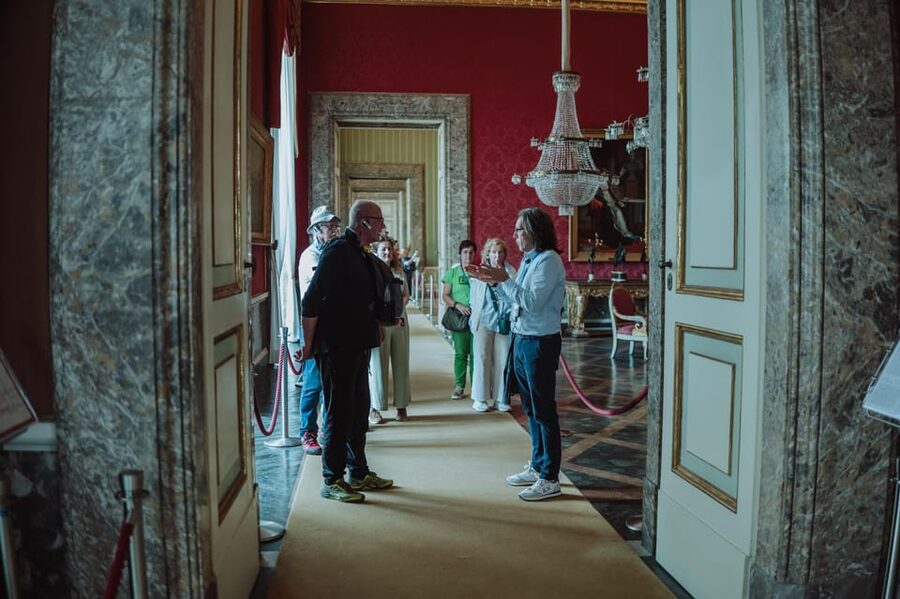
Royal grandeur comes in enormous doses here. The Royal Palace of Caserta gives you two focused hours inside the Bourbon Kings of Naples’ vast residence, where 1,200 rooms and 34 staircases reveal the ambition of 18th-century royal life. I like the private format, which gives your guide room to explain the details rather than rush a large crowd, and I like the skip-the-line admission, especially at a palace this big. The main drawback is simple: two hours cannot cover every corner of a building with 1,970 windows.
I also like the clear route through the grand staircase, Palatine Chapel, royal apartments, Murat’s apartment, and court theater. Guides such as Anna and Serena have earned especially warm praise for making the palace understandable and for keeping children involved. You should know that transportation, food, and drinks are not included, and the tour is not suitable for wheelchair users.
Key details at a glance
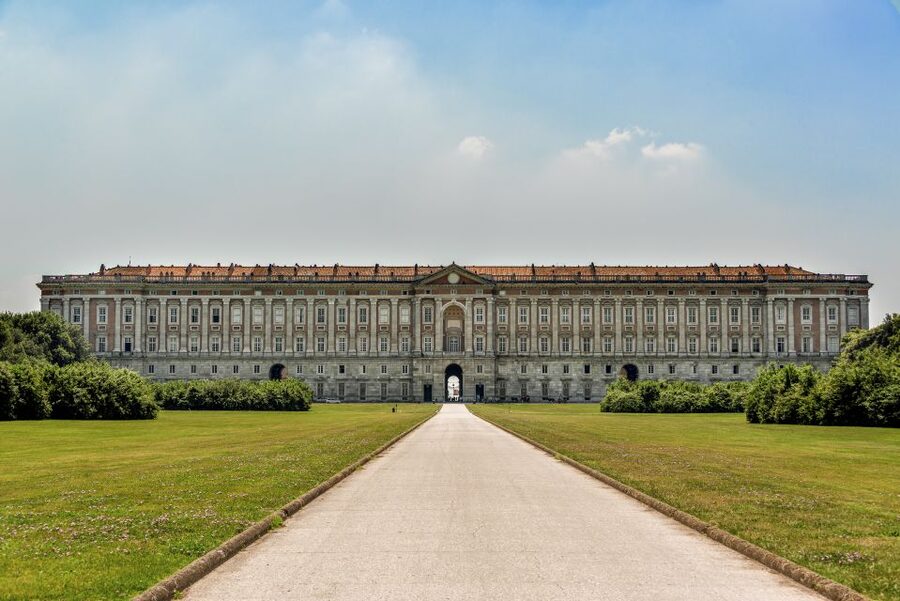
- A palace built to rival Europe’s great royal residences: King Charles of Bourbon commissioned the project in 1751, and architect Luigi Vanvitelli designed a huge complex meant to match the power of other European monarchs.
- A 116-step ceremonial entrance: The marble staircase in the main atrium leads to the upper vestibule and Palatine Chapel, making the arrival itself one of the tour’s main sights.
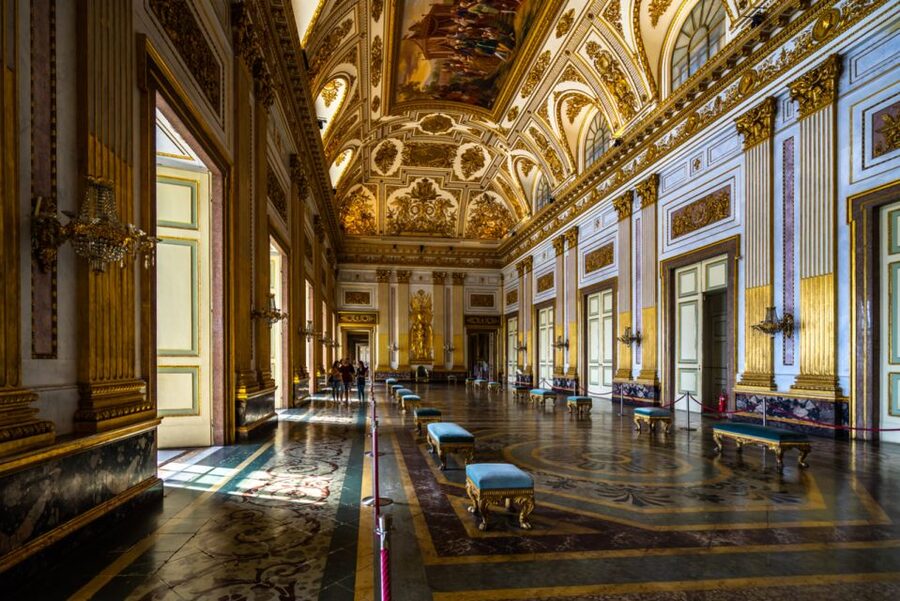
- Rococo beside Neoclassical design: The royal apartments combine graceful decoration with more restrained forms, giving you a useful way to read the palace’s changing artistic taste.
- Private guidance for $47 per person: The price is strongest for couples, families, or small groups who want direct attention and explanations tailored to them.
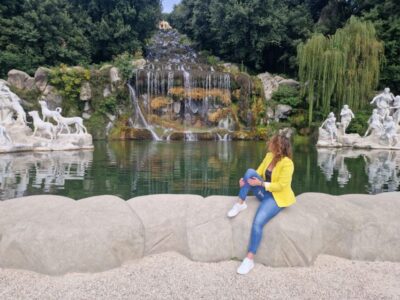
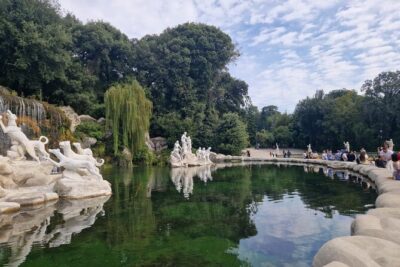
- Time remains for the gardens afterward: The guided portion focuses on the palace interiors, so you can continue on your own after the two-hour visit.
- Six guide languages are offered: You can request English, Spanish, Italian, French, German, or Portuguese, subject to availability.
Why the Royal Palace of Caserta matters
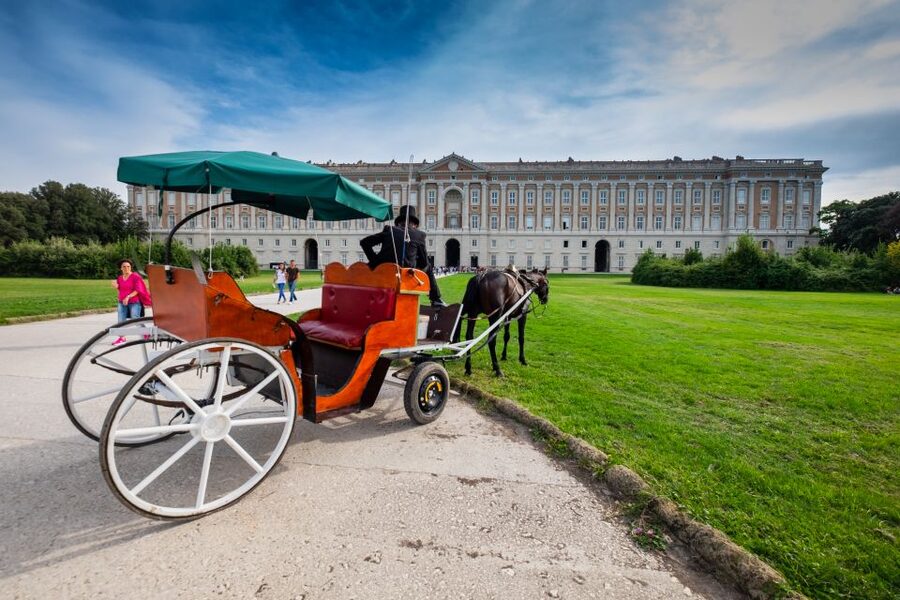
Caserta is not a small royal residence with a few decorated rooms. It was conceived as a statement of Bourbon power, built at the foot of the Campanian Subapennine mountain range. The scale tells you something before the guide even begins explaining the paintings or furniture: this was a palace designed to support a court, impress visitors, and compete with the grand residences of Europe.
King Charles of Bourbon commissioned the palace in 1751. Luigi Vanvitelli took on the design, creating a building that could serve both royal ceremony and everyday court life. The result combines monumental architecture with rooms meant for private use, official business, worship, entertainment, and display.
I find a guided visit particularly useful here because the size can blur together if you simply walk from room to room. A guide can point out why the main stairway matters, how the Rococo and Neoclassical styles differ, and which rooms were linked to the Bourbon court or the later Murat period.
The rating of 4.8 from 93 submitted ratings suggests a strong level of satisfaction, but the more useful point is what the praise focuses on: clear explanations, good pacing, and guides who make the palace approachable. That matters more here than a flashy promise of access to every room.
More Private Palace Tours in Italy
- Private 4hrs Venice Tour: Doge’s Palace, Grand Canal & St Mark’s
★ 4.5 · 715 reviews - Venice: Private Entry Doge Palace & St. Mark Terraces Tour
★ 4.8 · 337 reviews - Private or Semi Doge’s Palace & Saint Mark’s Basilica Guided Tour
★ 5.0 · 316 reviews
Meeting beneath the flags at Piazza Carlo di Borbone
The tour begins at the main entrance portal of the palace in Piazza Carlo di Borbone. Look for the guide under the flags, holding an ASKOS TOURS sign. This is a straightforward meeting arrangement, but the palace is large enough that you should allow time to reach the entrance without cutting it close.
The starting point also gives you an immediate sense of scale. You are not meeting at a side door or a small museum entrance. You are approaching the formal front of a royal complex built to make an impression.
Transportation is not included, so you need to arrange your own way to Caserta and the palace. Food and drinks are also not part of the tour. Those exclusions are not surprising for a two-hour indoor visit, but they matter if you are planning this as part of a full day.
Starting times vary, so check availability when you book. The two-hour length is long enough for a meaningful introduction without taking the entire day. One useful advantage is that you can continue exploring the gardens after the guided palace visit, as one visitor specifically noted.
The 116-step staircase and upper vestibule
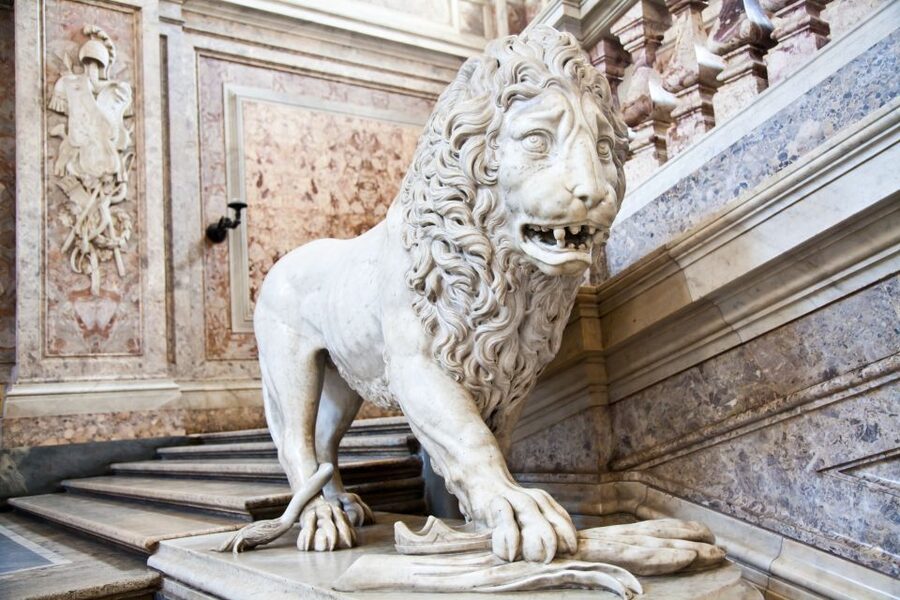
The grand staircase is the first major architectural showpiece on the route. It has 116 marble steps and statues that lead from the atrium toward the upper vestibule and Palatine Chapel. This is not just a passage from one floor to another. It was designed as a ceremonial approach, and the scale makes that purpose clear.
I like this part of the tour because it gives you a practical way to understand royal architecture. The Bourbon court did not want guests to enter quietly and disappear into a corridor. Movement through the building was part of the performance. The staircase framed the arrival, guided the eye upward, and prepared visitors for the rooms beyond.
The marble statues add to that staged effect. Your guide can help connect the physical design to court life, so you are not left admiring a staircase without knowing why it was made so imposing.
This is also one area where the accessibility limitation matters. The tour is not suitable for wheelchair users, and the grand staircase is a substantial part of the palace route. If stairs are difficult for you, ask the provider for current access details before booking.
The Palatine Chapel and the palace’s formal heart
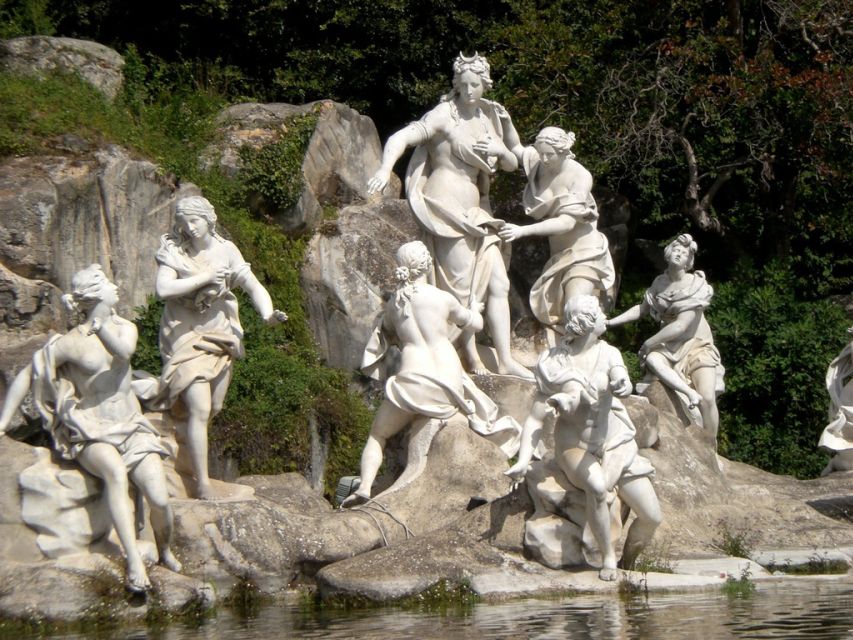
The staircase leads to the Palatine Chapel, where vaulted ceilings and gilded rosettes bring a religious setting into the royal ceremonial route. Its decoration shows how the palace joined political authority, court ritual, and worship under one roof.
The chapel is worth seeing for its ceiling treatment alone, but I would pay attention to how it fits into the larger plan. In a residence of this scale, the chapel was not an isolated neighborhood church. It was part of the royal interior and a visible expression of Bourbon identity.
A guide is helpful here because decorative details can be easy to overlook. The gilded rosettes and vaulted form reward a slower look, even though the overall tour has plenty of ground to cover. If you enjoy architecture, this may be one of the most satisfying stops because it links the palace’s grand scale with smaller decorative choices.
More Royal Palace Tours in Italy
- Naples: Royal Palace and Monumental Area Small Group Tour
★ 4.8 · 1,191 reviews - Turin: Savoy Royal Palace Small Group Guided Tour
★ 4.9 · 750 reviews - Caserta Royal Palace & Gardens Small Group Tour with Shuttle
★ 4.9 · 632 reviews - Turin: Royal Palace Entry Ticket and Guided Tour
★ 4.8 · 562 reviews
Royal apartments in Rococo and Neoclassical style
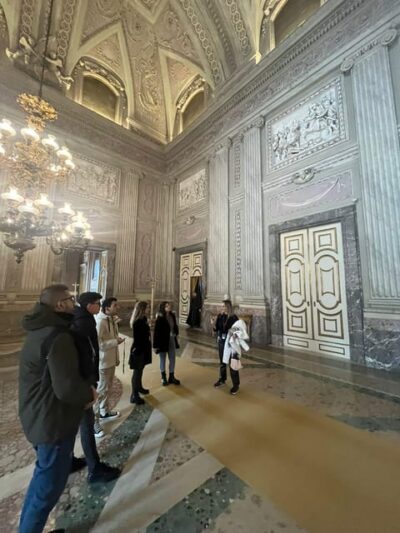
The royal apartments are where the tour shifts from broad architectural drama to the details of court life. Rooms are decorated in a mix of Rococo and Neoclassical styles, giving you a chance to compare two different approaches to royal taste.
Rococo decoration tends toward lightness, ornament, and graceful movement. Neoclassical design brings a more ordered and formal mood. You do not need a background in art to notice the difference, but a guide can show you where those changes appear and explain why the styles matter.
The palace’s interiors were made by leading painters and cabinet makers of 18th-century Italy. That phrase has real weight here. The rooms were not filled with generic decoration after the architecture was finished. Furniture, painted surfaces, ceiling work, and other details were part of a larger plan to present the court at its highest level.
I would not expect to see all 1,200 rooms in two hours. That is not a weakness in the tour. It is a reason to choose a focused route. The guide selects important spaces, explains their purpose, and gives you enough context to continue looking on your own if you have more time.
The King’s apartment and royal display
The King’s apartment offers one of the clearest looks at how the Bourbon court presented itself. Here, decoration was not simply a matter of comfort. The rooms projected rank, taste, and control.
Pay attention to the relationship between the room’s structure and its furnishings. The palace’s scale can make individual pieces seem secondary, but the painters and cabinet makers were working together to create a unified royal setting. A good guide will help you connect those details to the larger role of the apartment.
The private format is useful in these rooms. You can ask why a particular style appears, how a room was used, or what changed between different royal occupants. The published languages are English, Spanish, Italian, French, German, and Portuguese, so the tour can work well for a mixed-language group if the requested guide is available.
Murat’s apartment and a change in royal history

Murat’s apartment adds another layer to the palace story. The tour is not limited to one Bourbon moment. It also acknowledges the period linked to Murat, allowing you to see how the residence continued to carry political meaning as power shifted.
This stop is useful because it prevents the palace from becoming a simple story about one king and one building campaign. Royal residences often outlive their original patrons, and rooms can take on new meaning as rulers change. Your guide can make those transitions easier to follow.
The contrast between the Bourbon rooms and Murat’s apartment also gives you another chance to look at decoration as evidence. Furnishings and style are not just pretty surfaces. They help explain the people who used the rooms and the image they wanted to present.
Court theater and the palace as a working court
The court theater shows that Caserta was built for more than official ceremonies and private apartments. Entertainment had a place in palace life, and a theater within the complex helped keep court activity close to the royal household.
I like this stop because it broadens your picture of the palace. Without it, you might imagine a chain of formal rooms used only for meetings and receptions. The theater reminds you that royal life also included performance, spectacle, and social events.
The itinerary includes the court theater along with the King’s apartment and Murat’s apartment, but the exact time spent in each space can depend on the guide’s route and the pace of your group. A private visit gives you a better chance to ask for emphasis on the rooms that interest you most.
What the private format is really worth
At $47 per person, this is not the cheapest way to enter the Royal Palace of Caserta. The value depends on how much you want from the visit. If you only need admission and prefer to wander quietly, a guided private tour may feel like more than you need.
For most first visits, I think the price is easier to justify because admission fees and private guidance are included, and the ticket line is skipped. The palace’s size creates a real risk of seeing grand rooms without understanding their purpose. Two hours of explanation can turn a collection of impressive interiors into a coherent visit.
The value improves for families and small groups. Serena has been praised for giving close attention to children aged five and six while keeping the story interesting. That is a useful sign for parents, since a palace tour can lose young children quickly if it becomes a string of names and dates.
The group is private, but the supplied information does not specify the maximum number of people. If group size is important to you, confirm it before booking. The provider also offers free cancellation up to 24 hours before the tour and a reserve now, pay later option, which gives you some flexibility while planning.
Who will enjoy this two-hour visit
I would choose this tour if you want the palace’s major interiors explained in a short, organized visit. It fits well into a day in Caserta because the guided section lasts two hours and leaves time for the gardens afterward.
It is especially suitable for:
- Couples who want private guidance without joining a large group
- Families who need a guide able to adjust explanations for children
- Architecture fans interested in Vanvitelli, the staircase, chapel, and palace plan
- Art lovers comparing Rococo and Neoclassical decoration
- First-time visitors who want help choosing the most important rooms
- Visitors who prefer a live guide in English, Spanish, Italian, French, German, or Portuguese
I would think twice if you dislike guided visits, want to explore every room at your own pace, or need wheelchair access. The tour covers selected rooms rather than the entire 1,200-room complex, and the stair-heavy route may not suit everyone.
How the guides shape the experience
The guide can make or break a palace visit, and the praise here is specific. Anna is described as helpful and capable, while Serena is praised for her expertise, warmth, and ability to keep the tour from feeling heavy. Another particularly useful comment points to the value of explanations that reveal the story behind details a visitor might otherwise miss.
That is exactly what I want from a place like Caserta. The palace has enough decoration to impress you without assistance, but the meaning behind the rooms is harder to read. A guide should help you notice the difference between styles, understand the role of the apartments, and see how the building served the Bourbon court.
The private setting also gives you a chance to ask direct questions. You can spend more time on the chapel, focus on royal interiors, or ask about the theater instead of accepting a fixed lecture. The exact result depends on your guide, but the format gives you more room than a large shared group.
Practical limits to keep in mind
Two hours is a useful length, but it is also a firm limit in a palace of this size. You will see selected highlights, not all 1,200 rooms, 34 staircases, and 1,970 windows. Think of this as an introduction with expert direction, not a complete survey.
The tour begins at the main entrance portal under the flags, where the guide holds an ASKOS TOURS sign. Transportation is your responsibility, and food and drinks are not included. Check the starting time when selecting your date, since availability changes.
The palace is not suitable for wheelchair users according to the supplied activity details. If you have other mobility concerns, ask for current route information before paying. The listing does not provide a separate accessibility plan.
Should you book the Caserta palace tour?
Book it if you want the Royal Palace of Caserta to make sense, not just look grand. The combination of skip-the-line admission, private guidance, and a focused route through the staircase, chapel, apartments, and theater gives you a strong first look at one of Europe’s largest royal residences.
The $47 price is reasonable for couples, families, and small groups who value direct explanations. It is less compelling if you prefer independent wandering or plan to spend many hours exploring every available room and garden without a guide.
For families, Serena’s attention to young children is an encouraging detail. For architecture and art lovers, Vanvitelli’s staircase, the Rococo and Neoclassical interiors, and the palace’s formal planning give the visit plenty to study. Just arrive at the correct portal, plan your own transportation, and remember that two hours reveals the palace’s highlights rather than its full scale.
FAQ
Where does the Royal Palace of Caserta tour begin?
It begins at the main entrance portal of the Royal Palace in Piazza Carlo di Borbone. The guide will be under the flags holding an ASKOS TOURS sign.
How long does the guided tour last?
The guided tour lasts two hours.
What is the price of the tour?
The listed price is $47 per person.
Is admission included?
Yes. Skip-the-line admission fees and private guidance are included.
Is transportation included?
No. Transportation to and from the Royal Palace is not included.
Are food and drinks included?
No. Food and drinks are not included.
Which languages are available?
Live guiding is offered in English, Spanish, Italian, French, German, and Portuguese.
Is the tour private?
A private group is available, and the tour includes private guidance.
Is the tour suitable for wheelchair users?
No. The activity is listed as not suitable for wheelchair users.
More Palace of Caserta Tours in Italy
- Caserta: Small-Group Royal Palace Tour
★ 4.8 · 461 reviews - Caserta: Royal Palace of Caserta Guided Tour
★ 4.7 · 400 reviews - From Naples: Royal Palace of Caserta Ticket & Digital Guide
★ 4.4 · 387 reviews - Caserta Royal Palace & Gardens Small Group Tour with Shuttle
★ 5.0 · 320 reviews
Just added around Italy
- Palermo: City & Palazzo dei Normanni Guided Walking Tour★ 4.7 · 28 reviews
- Palermo: Norman Palace Ticket & Audio App Downloadable★ 3.5 · 4 reviews
- Palermo: Palatine Chapel, Audio App & optional Norman Palace★ 3.8 · 70 reviews
- Palazzo Vecchio Secret Passages Tour & Lunch or “Gelato”★ 4.3 · 16 reviews
- Palazzo Vecchio Small Group Tour★ 4.9 · 10 reviews
- Palazzo Normanni and Palatine Chapel Tour – Ticket Included (Italian)★ 3.8 · 14 reviews
- Palazzo Vecchio 90-Minute Morning Guided Tour★ 4.7 · 104 reviews
- Palazzo Vecchio: Private Guided Museum Tour & Tower Tickets★ 4.7 · 18 reviews
Palace of Caserta Tours, compared.
Caserta Royal Palace & Gardens Small Group Tour with Shuttle
Read our review →
Caserta Royal Palace & Gardens Small Group Tour with Shuttle
Read our review →
Guided Tour to the Royal Palace of Caserta: discover the Royal Palace and gardens
Read our review →